MOZOM-analyse
MOZOM analysis: call from Edi Rama shows how Europe likes to repeat its great historical language, but it is much more difficult to decide who can follow it politically today
- Source
- Euronews
- MOZOM headline
- MOZOM analysis: call from Edi Rama shows how Europe likes to repeat its great historical language, but it is much more difficult to decide who can follow it politically today
- Original headline
- Albania's PM Edi Rama: Is Europe ready for its next Helmut Kohl moment?
- Author
- Redactie Euronews
- Date
- 19 juni 2026 om 20:58
- Subject
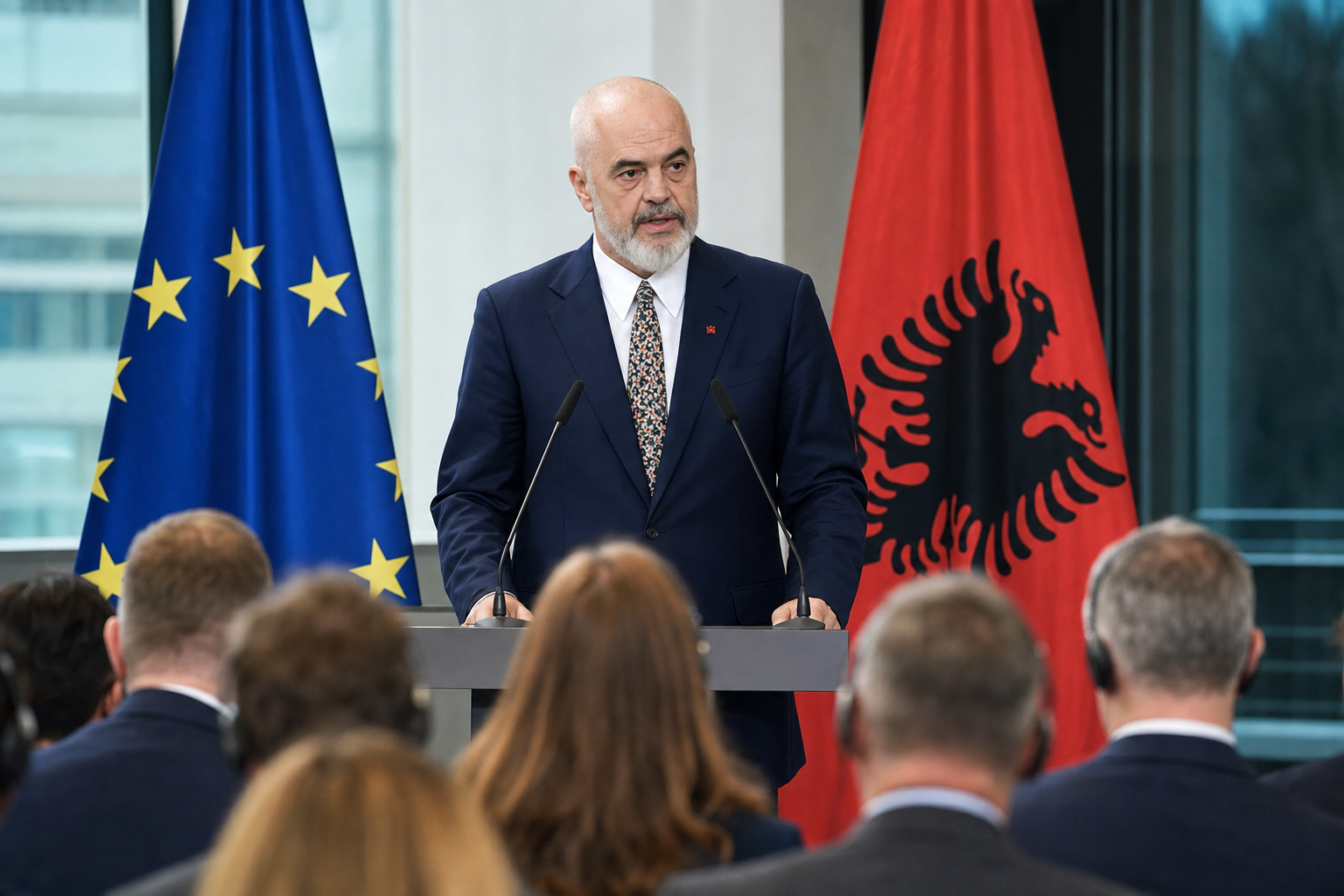
- Euronews reports that Albanian Prime Minister Edi Rama is calling on Europe for a new 'Helmut Kohl moment', once again casting the discussion about enlargement, leadership and historic ambition in grand political language.
Summary of the original report
Euronews describes how Albanian Prime Minister Edi Rama in Berlin called on Europe to once again show historic leadership and made the comparison with Helmut Kohl, the German chancellor who remains strongly linked to German reunification and a larger European project. In a direct sense, this is a politically symbolic speech about the future of Europe. But beneath that layer lies a well-known tension: enlargement and European ambition are often celebrated in grand historical terms, while decision-making on accession, institutional courage and political inclusion of candidate member states proceeds much more slowly. Rama uses the past here not only to inspire, but also to implicitly confront Europe with its own reluctance. This makes his statement more than rhetoric. It also functions as a test: does the European Union still want to see itself as a growing geopolitical project, or primarily as an existing club that uses historical language without fully embracing its consequences?
Striking in this message
It is striking that the headline immediately focuses on the Helmut Kohl moment. As a result, it is not Albania first, nor the technical expansion policy, but the great historical metaphor itself that comes first. This gives the message weight and ambition, but it also directs the reader towards a Europe story about leadership, courage and missed historical opportunities. The metaphor lifts the message from diplomatic wish to civilizational demand.
The broader framework
For international readers, it is useful to briefly clarify that Helmut Kohl in Europe often symbolizes political courage, historical scale and integration power, especially through his role in the German reunification and its further European integration. What is less visible is that candidate member states such as Albania have long experienced that European openness in principles often does not coincide with real speed in decision-making. Underlying this message is therefore also frustration about a Union that likes to present itself as a major historical project, but in practice often operates hesitantly and internally divided as soon as expansion becomes concrete.
Possible message behind the news
A possible message behind this news is that Europe likes to recognize itself in great historical names as long as it requires little direct political price. In plain language: it is easier to admire a new 'Kohl moment' as an idea than to actually take the risk of expanding and redesigning the European order. Between the lines, the image emerges that Rama is not only asking for vision, but above all for proof that the Union still believes in its own historical self-image.
Neutral conclusion
The article thus shows that Rama's call is more than a nice European reference. It is also a subtle pressure test as to whether the European Union today is still prepared to translate its language of history, unity and enlargement into tangible political courage.