
MOZOM-analyse
MOZOM is angry: EU builds parcel wall and citizens pay
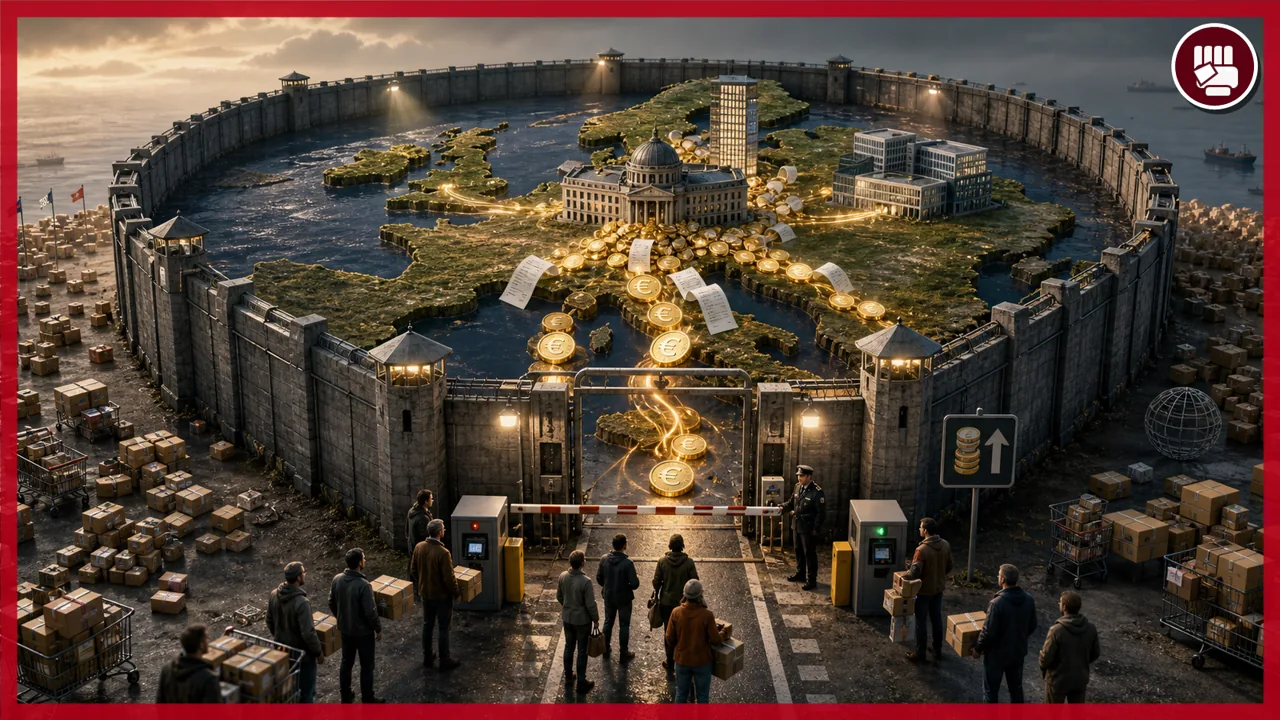
- Source
- Europese Commissie, Raad van de Europese Unie en ARD/Tagesschau
- MOZOM headline
- MOZOM is angry: EU builds parcel wall and citizens pay
- Original headline
- The European Union will introduce a temporary customs duty of 3 euros on small parcels from outside the EU from 1 July 2026
- Author
- MOZOM-redactie
- Date
- 28 juni 2026 om 14:28
- Subject
- Angry MOZOM analysis of the new EU tax on small parcels from countries outside the European Union, with attention to consumer prices, discouragement of cheap Chinese parcel competition, indirect protection of European stores, customs duties, legal justification and political coercion through the wallet.
Summary of the original report
The European Commission, the executive body of the European Union in Brussels, reports that from July 1, 2026, a temporary customs duty of 3 euros will apply to low-value shipments up to and including 150 euros imported from outside the European Union. The European Union is a partnership of 27 European countries, including the Netherlands, Germany, Belgium, France, Spain and Poland. According to the Commission, the measure will run until July 1, 2028, after which normal customs rates should apply. The Council of the European Union, where EU countries' governments make decisions, says the temporary levy will be levied on each item category in a small package. A package with multiple types of products can therefore be hit more severely than a package with one type of product. Formally, China is not directly affected and Chinese companies continue to have access to the EU market. This is legally important. But in practice, the importer pays: often the European consumer himself, or a platform that processes the costs at the checkout. This makes little difference to the buyer: the bill ends up with him. The measure is not secret, because it is in official EU communications. But official communication is different from broad warning to millions of consumers in all EU countries.
MOZOM is angry
The language is striking. The word customs law sounds neutral, technical and almost innocent. But for cheap items, 3 euros per item category can be disproportionate. Anyone who orders a few small products for 5 euros from a foreign platform may incur costs that are greater than the value of the items themselves. That does not feel like fair competition, but as punishment for buying cheaply. It is reminiscent of a well-known policy form: formally something remains a free choice, but the consequences become so unattractive that the choice is controlled in practice. That comparison is not about health or vaccines, but about the mechanism of indirect pressure: you don't have to, but if you do, rules make it more expensive or difficult. Communication also fits in with that pattern: do not make a grand announcement as a purchasing power measure for all citizens, but package it as a technical customs reform.
Less visible context
What is less visible is that this concerns billions of packages and therefore a lot of money. According to the European Commission, customs duties are traditional own resources of the EU budget: national authorities collect them and member states keep a portion for collection costs. So it is too simple to say that this is of no use to Brussels. If a fixed levy is applied on a large scale, a structural income stream will be created and at the same time a price brake on imports from outside the European Union. The legal question is not just whether the EU is allowed to do this; the European Union has customs powers. The political question is more serious: is it proportionate to push consumers in all EU countries towards more expensive purchases, because Brussels and national governments believe that the market would otherwise be flooded too cheaply? And who is hit the hardest here? Not the wealthy consumer who hardly feels an expensive purchase, but the price-conscious citizen who is looking for small, cheap items because his budget is limited. If a measure first goes through the machine as a technical regulation and only later becomes widely felt in daily life, the resistance is often smaller: people discover it individually, not as a joint political shock.
Possible message behind the news
A possible message behind this policy is that European citizens may choose freely, as long as their choice fits within the desired European market model. Calling China harsh or hitting it directly can be diplomatically sensitive. Buying cheaply outside Europe is therefore not prohibited, but discouraged through price pressure. That is softer coercion: no ban, but a price wall. For policymakers, this is almost a win-win: Chinese price pressure is curbed, European suppliers can breathe, and the measure can be presented as a customs technique instead of protection. For the citizen it is not a win-win, but a loss of freedom of choice through higher costs. The possible administrative lesson seems to be: first enter it in technical language, then only explain it when the measure is already part of the system. This results in less prior resistance and more grumbling consumers afterwards.
Neutral conclusion
The neutral conclusion: the new EU tax can probably be defended legally as a customs policy, but politically and socially much less innocent than the technical language suggests. For Brussels it is a temporary instrument against parcel flows, unsafe products and unfair competition. For citizens it can feel like a disguised tax on cheap choices. The EU does not have to provoke China head-on, but European consumers will immediately notice the correction in their shopping cart. That is precisely the painful core: cheap package competition is not openly eliminated, but heavily discouraged in a roundabout way; European companies are indirectly protected and the bill goes through the buyer. And because this type of policy often appears as a technical EU rule before it is understood as an everyday consumer bill, the public debate comes too late. MOZOM is angry because ordinary citizens are once again paying for the policy wall that they themselves are encountering.
Source:
- Europese Commissie over het tijdelijke douanerecht van 3 euro op lagewaardezendingen
- Raad van de Europese Unie over 3 euro per itemcategorie in kleine pakketten
- Europese Commissie over het afschaffen van de vrijstelling onder 150 euro en het gelijke speelveld
- Raad van de Europese Unie over de stroom kleine pakketten naar Europa
- Europese Commissie over douanerechten als eigen middelen van de EU-begroting
- Tagesschau/ARD over de voorzichtige EU-koers tegenover China