MOZOM-analyse
MOZOM analysis: fire in German hospital shows how quickly a local incident turns into a broader demand for healthcare safety
- Source
- Zeit Online
- MOZOM headline
- MOZOM analysis: fire in German hospital shows how quickly a local incident turns into a broader demand for healthcare safety
- Original headline
- Fire: Two injured in fire in Harzklinikum
- Author
- Redactie Zeit Online
- Date
- 19 juni 2026 om 15:15
- Subject
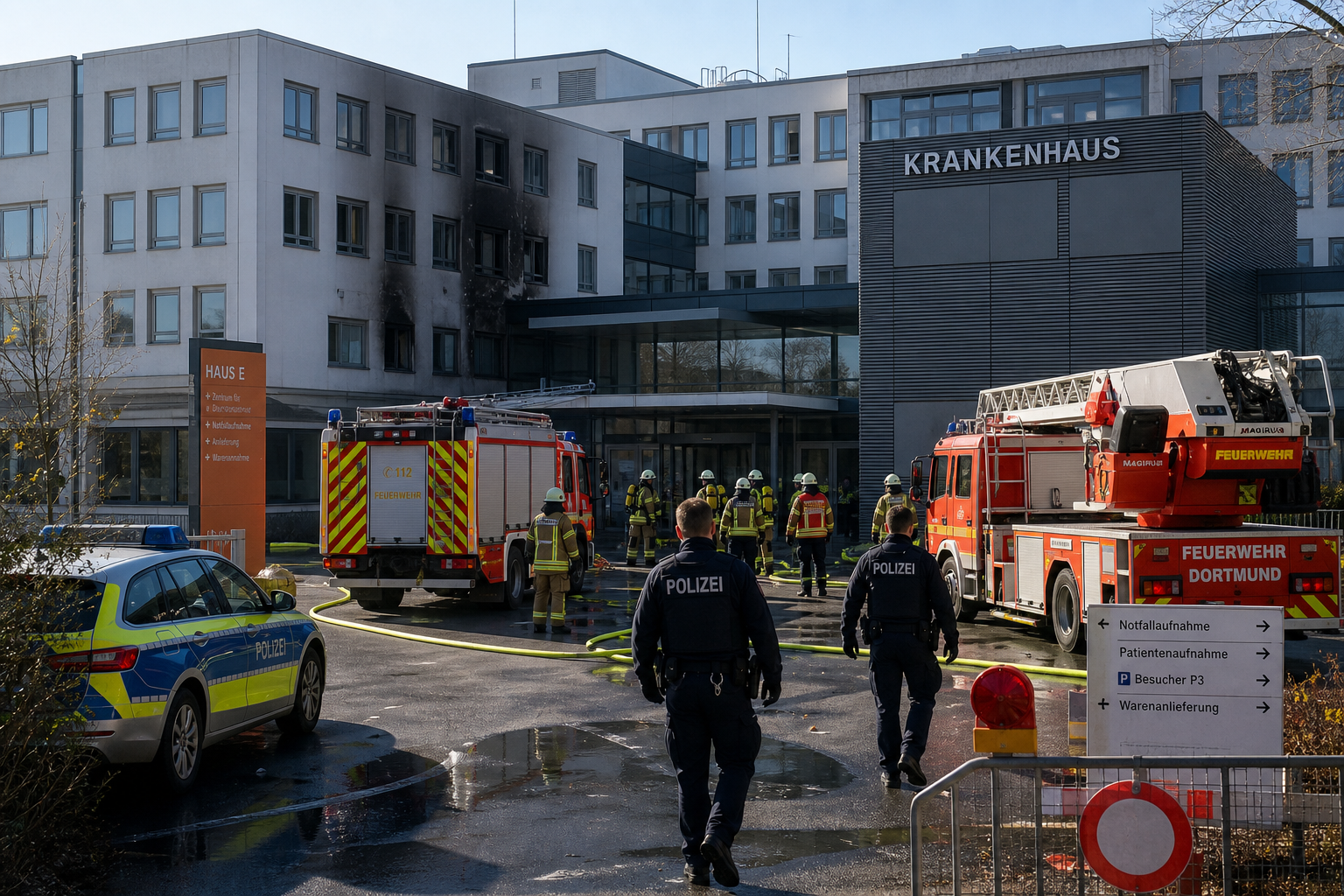
- Zeit Online reports that two people were injured in a fire at the Harzklinikum in Germany. Behind that local news also lies the broader vulnerability of healthcare institutions where safety, infrastructure and continuity constantly come together.
Summary of the original report
Zeit Online reports that two people were injured in a fire at the Harzklinikum. In itself this appears to be a local incident report: fire, injuries and emergency services. But at hospitals, every safety incident immediately takes on extra weight. A healthcare institution is not an ordinary workplace or residential location; it is a place where people are found who are less mobile, resilient or independent. Therefore, a fire in such an environment automatically becomes more than a technical or regional incident. The news is therefore about whether emergency procedures worked, how quickly departments could be protected and to what extent care continued under pressure. It is precisely that administrative layer that makes the incident bigger than the short headline suggests. Two injured people are a concrete fact, but the underlying meaning is also about system trust: citizens expect that a hospital not only provides care, but also continues to function as safely as possible under disruption.
Striking in this message
The headline is factual and short, but that is precisely why it is strong. Fire plus number of injured immediately forms a clear emergency framework. At the same time, a lot of context disappears behind this compactness: where in the hospital did the fire start, which departments were vulnerable, how was it evacuated and what does this say about infrastructure or prevention? The reader is mainly shocked by the incident, not automatically the institutional questions underlying it. Yet the word clinic implicitly evokes a different layer of feeling than a fire in any building. A hospital fire immediately sounds like an event in which failure, preparedness and protection of dependent people are also taken into account.
Background that often remains out of view
For international readers, it is useful to clarify that the Harzklinikum is a regional hospital in Germany and that these types of incidents in European reporting often quickly become symbolic of broader concerns about healthcare infrastructure. What remains less visible is that hospitals all over Europe are under pressure due to outdated buildings, technical vulnerability, personnel burden and high requirements for emergency continuity. As a result, a local fire incident is often also read as a signal about the system around it. Underlying this message is the question of how resilient healthcare institutions really are when something unexpected affects medical, logistics and safety chains at the same time.
Possible message behind the news
A possible message behind this news is that healthcare safety only becomes truly visible when something goes wrong. In plain language: citizens see a fire and two injured people, but immediately read the question whether a hospital remains safe enough in crisis situations for people who have nowhere to go. Between the lines, this creates the impression that incidents in healthcare are never just about the moment itself, but also about the strength of the entire system that should stand behind it.
Neutral conclusion
This article shows that the fire in the Harzklinikum is more than a regional incident. It is also a reminder that healthcare institutions must continually be resilient not only medically, but also physically and organizationally to disruption when the people inside have the least space to escape.