
MOZOM-analyse
MOZOM analysis: German-Polish defense pact shows that European security is increasingly shifting to countries on the eastern flank
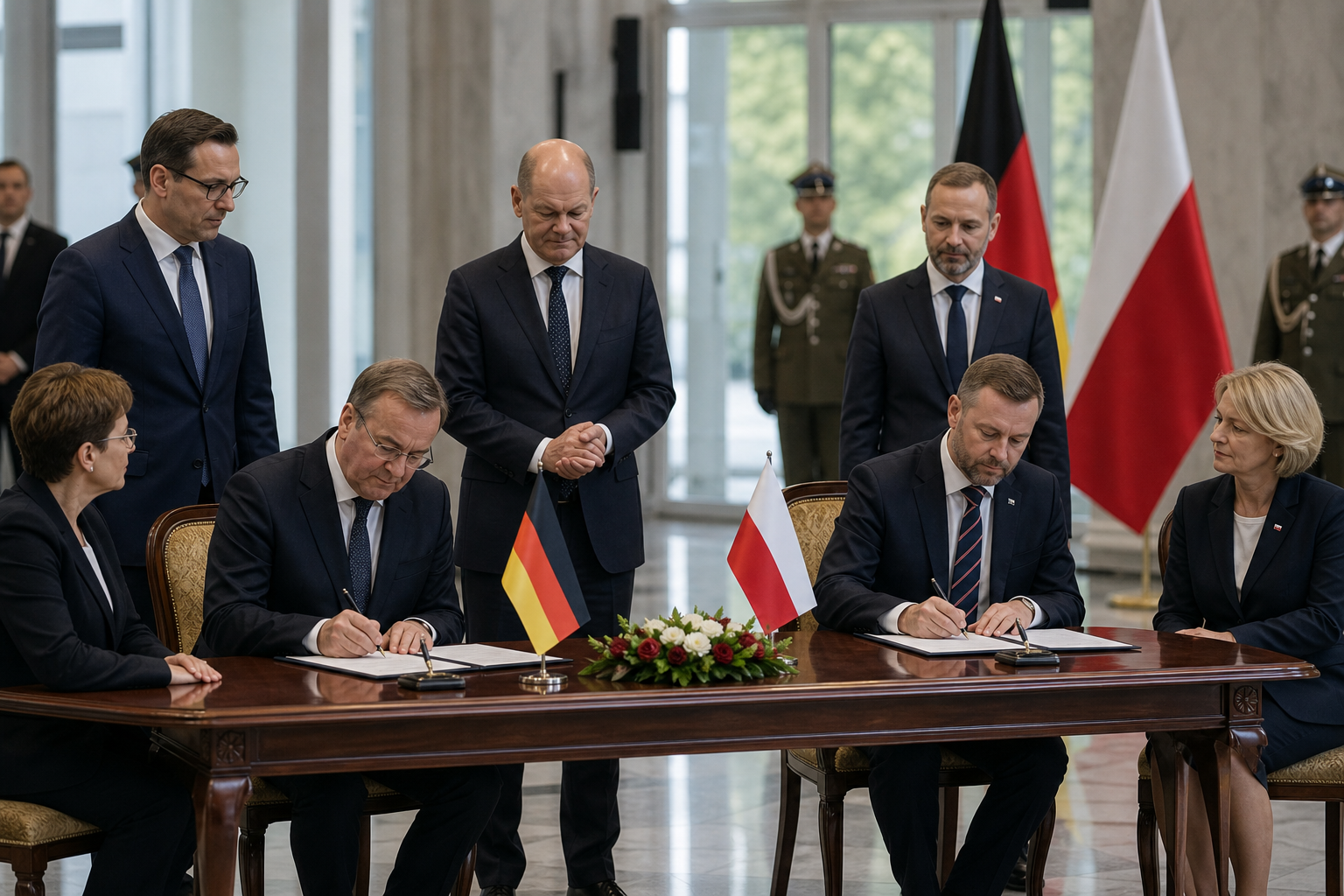
- Source
- Euronews
- MOZOM headline
- MOZOM analysis: German-Polish defense pact shows that European security is increasingly shifting to countries on the eastern flank
- Original headline
- Germany and Poland sign new defence deal as balance of power in Europe shifts
- Author
- Redactie Euronews
- Date
- 19 juni 2026 om 12:28
- Subject
- Euronews reports that Germany and Poland are signing a new defense agreement. Behind that news lies a broader shift in power in Europe, with countries on the eastern border not only warning of threats, but also increasingly setting the strategic pace.
Summary of the original report
Euronews describes that Germany and Poland have concluded a new defense agreement at a time when the balance of power in Europe is shifting. According to the source, Poland is playing an increasingly important role as a logistics hub for Ukraine, as a fast-growing military investor and as a strategic partner for major Western European countries. This makes the agreement more than an ordinary bilateral agreement. It shows that the countries that are geographically closer to the Russian threat also gain more weight in how Europe organizes security. In that context, Germany is not only looking for cooperation, but also credibility: anyone who talks seriously about European defense must visibly align with states that have long experienced the urgency as a daily reality. The significance of this pact therefore lies not only in what is signed on paper, but also in the recognition that the political and military gravity within Europe is moving further east.
Striking in this message
The headline links the agreement directly to a shifting balance of power. As a result, the message does not read as technical defense news, but as a signal about reorganization within Europe. That is a strong framing, because it immediately invites the reader to look beyond protocols and signatures. At the same time, this formulation automatically shifts the emphasis to strategic change, while it remains less visible how concrete the agreements are, how binding they become and what tensions still exist between national defense interests. The source makes the signing moment primarily a geopolitical indicator: not only policy changes here, but also the hierarchy of who can drive the security debate in Europe.
Background that often remains out of view
For international readers, it is useful to clarify that Warsaw here is not just a symbolic location, but the capital of a NATO country that has grown significantly in strategic importance since the war in Ukraine. What is less visible is that the German-Polish relationship is historically sensitive and does not automatically run smoothly today in the areas of defense, migration and EU policy. That is precisely why such an agreement is meaningful: it shows that a shared threat can sometimes force more administrative cohesion than years of classical European diplomacy. Underlying this message is therefore the question whether the future of European security is mainly shaped by old core countries, or by states that are closer to the front and therefore have less patience with slow consensus.
Possible message behind the news
A possible message behind this news is that Europe is slowly shifting its security center to countries that experience the Russian threat not abstractly but directly. In plain language: whoever is closest to the risk also has increasing influence on how the rest of Europe arms and organizes itself. Between the lines, the picture emerges that Germany is not only looking for a partner, but must also adapt to a new reality in which the east of Europe is becoming less of an implementer and more of a guideline.
Neutral conclusion
This article shows that the German-Polish defense pact is more than a new cooperation agreement. It is also a sign that the European security order is in flux and that countries on the eastern flank are increasingly helping to determine how the rest of the continent should organize its defense policy.