
MOZOM vergelijkt
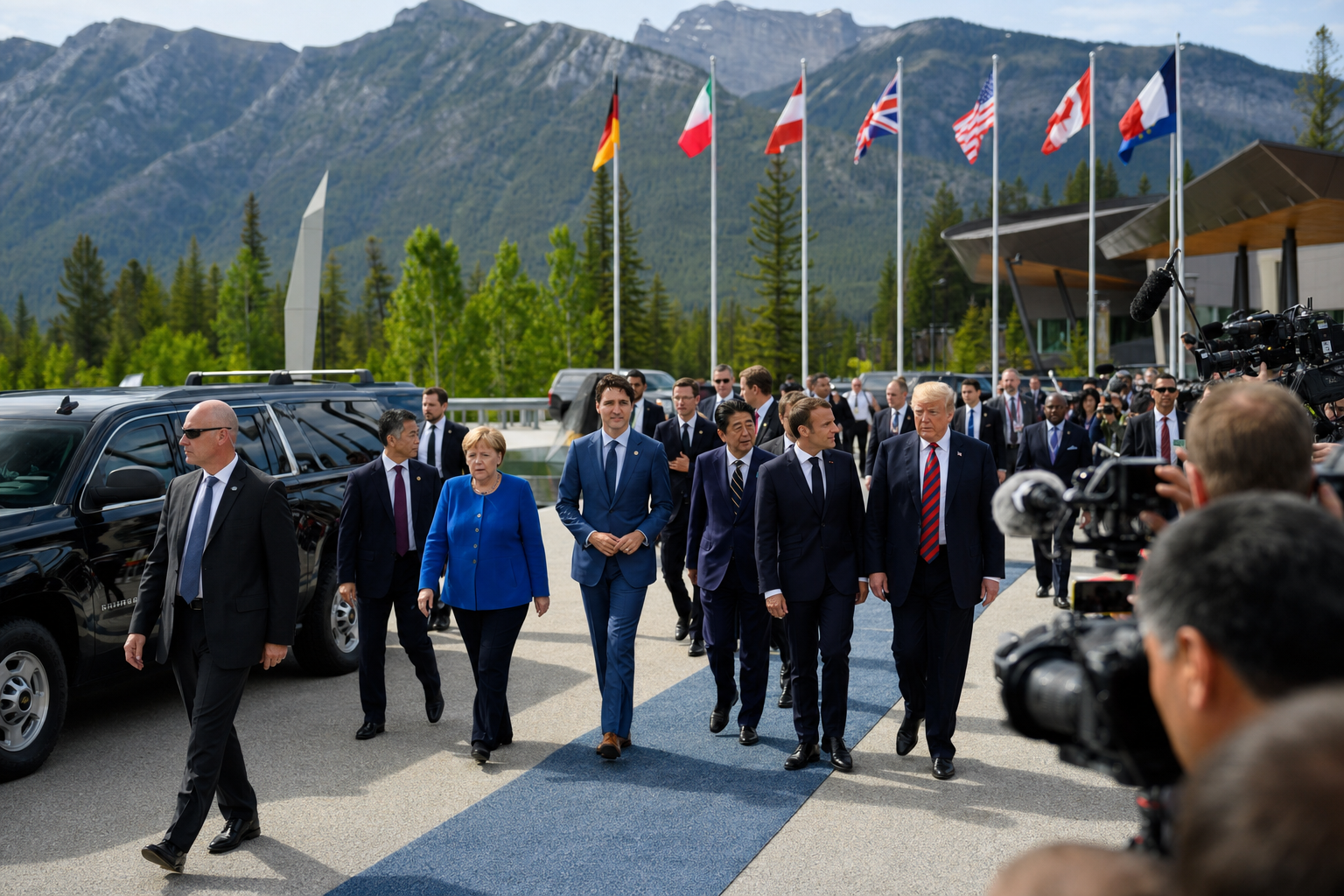
MOZOM compares: did the G7 remain largely fragile, or did the real strategic gain lie outside the club itself?
- Source
- MOZOM vergelijkt
- MOZOM headline
- MOZOM compares: did the G7 remain largely fragile, or did the real strategic gain lie outside the club itself?
- Original headline
- Tagesschau and Die Welt read the same G7 outcome differently: fragile stability or a winner that does not even belong to the G7
- Author
- MOZOM-redactie
- Date
- 19 juni 2026 om 11:24
- Subject
- Comparison of reporting on the outcome of the G7 summit, with Tagesschau emphasizing a vulnerable but productive summit moment and Die Welt suggesting that the biggest geopolitical winner should be sought outside the G7 itself.
Summary of the original report
Tagesschau writes that despite all the tensions, the G7 summit could still be seen as a relative success, but immediately adds that the international situation remains fragile. This means that not only the top is central, but especially the vulnerability of the balance afterwards. Die Welt takes a different approach. There, the attention shifts from the formal outcomes to the broader geopolitical profit distribution: if the summit ends productively, who really benefits from it, and is that a member state of the G7? Both lectures start from the same fact that there was more unanimity and explanations than was previously expected. Yet they make a different interpretive move. Tagesschau reads the summit as a moment of temporary administrative order in an unstable world. Die Welt rather reads the same outcome as proof that international summits also produce indirect winners, including players who are not at the table themselves but do benefit from the shifting relationships between the major industrialized countries.
Striking in this message
It is striking how words such as fragil, produktiv, Gewinner and gar nicht Teil der G7 each open up a different reading direction. Tagesschau focuses on administrative vulnerability and diplomatic caution. Die Welt draws the reader away from the formal top outcome and towards strategic by-catch. As a result, the choice of source determines whether the summit mainly reads as a fragile attempt at order, or as a geopolitical chess moment with winners outside the view of the official guest list.
Less visible context
What remains less visible is that summits like these often only gain meaning for ordinary citizens through second-order consequences: trade rates, energy prices, defense pressure, support for Ukraine and the question of whether the United States and Europe still remain on the same strategic line. For international readers, it is useful to clarify that Tagesschau is the major public German newsroom, while Die Welt usually focuses more sharply on geopolitical interpretation and power politics. Also underlying this comparison is a broader question: are modern summits still places where policy is actually made, or mainly stages where states try to safeguard the perception of coherence while the actual shift in power takes place elsewhere?
Possible message behind the news
A possible message behind this reporting is that major summits are not only about what leaders agree on, but also about who can subsequently claim that the world order is moving in their direction. In layman's terms: even if the G7 survives on paper, the real gains could be elsewhere. Between the lines, the picture emerges that international politics is less about the official closing sentence and more about the question of who can make the most intelligent use of the shifting balance of power.
Neutral conclusion
This comparison shows that the same G7 summit can be read simultaneously as a fragile attempt to maintain Western cohesion and as a moment when real geopolitical gains become visible precisely outside the formal circle of the G7.