
MOZOM vergelijkt
MOZOM compares: does Hegseth want to wake up NATO, or is Europe already showing that it is moving faster than Washington acknowledges?
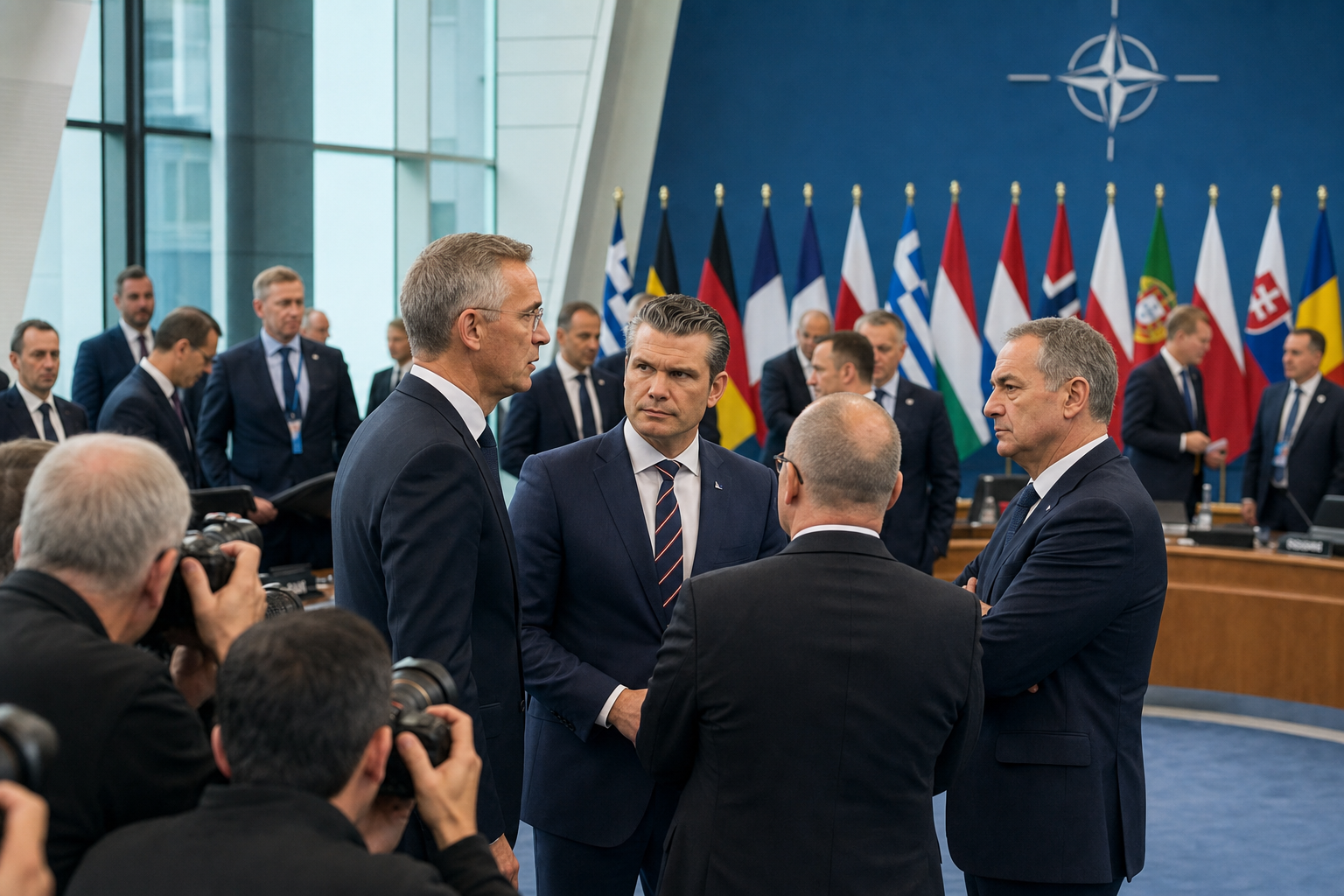
- Source
- MOZOM vergelijkt
- MOZOM headline
- MOZOM compares: does Hegseth want to wake up NATO, or is Europe already showing that it is moving faster than Washington acknowledges?
- Original headline
- AP and Euronews read Hegseth's NATO actions differently: allies lagging behind, or an alliance that is already visibly moving forward
- Author
- MOZOM-redactie
- Date
- 19 juni 2026 om 16:27
- Subject
- Comparison of reporting on Pete Hegseth's fierce NATO action in Brussels and his announced assessment of American troops in Europe, with AP emphasizing European progress that is already underway and Euronews on the confrontational American pressure tone.
Summary of the original report
AP describes Hegseth's actions as a moment in which the United States is once again taking strict measures against its allies, but immediately adds a correction: many European NATO countries have increased their spending, scaled up production and taken on more responsibility for deterrence since the Russian invasion of Ukraine. As a result, AP reads the news not only as American pressure, but also as a clash between political rhetoric and an alliance that is actually already shifting. Euronews takes a slightly different approach. There, Hegseth's actions themselves are more central: the fierce tone, the six-month assessment of American troops in Europe and the signal that allies must once again deal with an erratic partner in Washington. In that lecture, the emphasis is less on the question of whether Europe has already done enough and more on the message that the United States is increasingly formulating its security role in conditional terms.
Striking in this message
It is striking how words such as review, slammed, lambast and out of step already strongly determine the reading direction. Euronews keeps the reader close to the attack and the diplomatic tension. AP takes a broader view and asks the implicit question whether Washington is still responding to today's reality, or is still speaking in the register of past European dependence. The choice of source therefore determines whether Hegseth mainly sounds like someone who applies necessary pressure, or as someone who does not sufficiently recognize a changing alliance.
Less visible context
For international readers it is useful to clarify that NATO in Brussels not only talks about percentages and budgets, but also about command structure, military production, infrastructure and the question of who can actually act quickly in a crisis. What is less visible is that European countries have not only promised more money since 2022, but have also started investing much more specifically in ammunition, air defense and logistics. Underlying this comparison is therefore a broader question: does Washington primarily want a fairer burden sharing, or does it also use that demand to maintain continued political dependence on Europe?
Possible message behind the news
A possible message behind this reporting is that NATO is not just about tanks, budgets and troops, but also about who gets to decide when effort is enough. In plain language: Europe is moving, but Washington itself wants to continue to indicate the standard by which it will be judged. Between the lines, this creates the impression that safety here also remains a form of political discipline.
Neutral conclusion
This comparison shows that Hegseth's NATO actions can be read at the same time as a hard call for more European responsibility and as a signal that the United States wants to keep the hierarchy within the alliance firmly in its own hands, even in the face of visible European catch-up movements.