MOZOM vergelijkt
MOZOM compares: Irish EU presidency 2026, honest mediator or test of power?
- Source
- Irish Presidency, The Guardian en Financial Times
- MOZOM headline
- MOZOM compares: Irish EU presidency 2026, honest mediator or test of power?
- Original headline
- Ireland begins six months as President of the Council of the EU, with Ukraine, the budget and Big Tech on the table
- Author
- MOZOM-redactie
- Date
- 1 juli 2026 om 23:34
- Subject
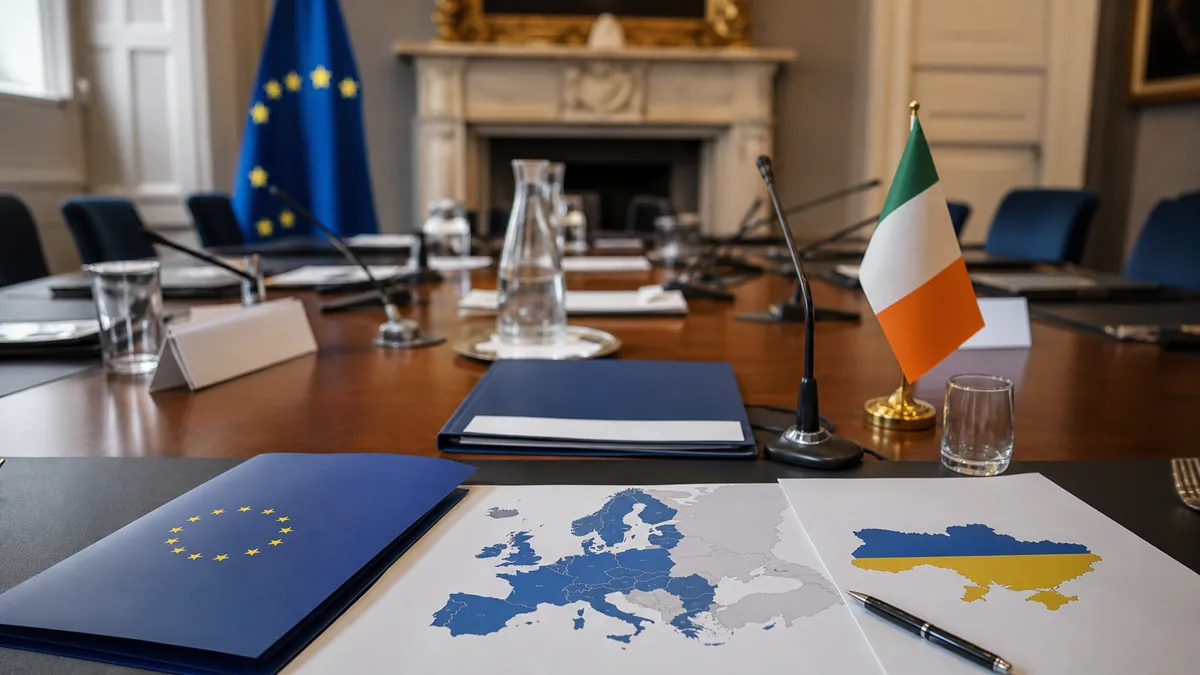
- The Irish EU presidency 2026 started on July 1 in Dublin. Ireland must send EU dossiers over the next six months on competitiveness, values, security, Ukraine, the 2028-2034 EU budget and digital power.
Summary of the original report
Ireland will hold the Presidency of the Council of the European Union from 1 July to 31 December 2026. The official presidency site mentions three central pillars: competitiveness, values and safety. This includes issues such as the internal market, economic resilience, rule of law, support for Ukraine, expansion of the EU and the new multi-year budget for 2028-2034. The opening took place in Dublin Castle, with Taoiseach Micheal Martin, European Council President Antonio Costa and Ukrainian President Volodymyr Zelenskyy. The Guardian mainly placed the news hook on Zelenskyy's call that the EU must keep its promises on accession talks. Financial Times shifted attention to a more sensitive Irish dossier: the Russian link surrounding Aughinish Alumina and the question of whether sanctions also affect Ireland itself. A Guardian opinion article added a third tension: Ireland as host country to many American tech companies and at the same time chairman of the EU consultation on digital power.
How do different sources present it?
The primary Irish presidency sources speak in administrative language: delivery, strength with unity, competitiveness, values, security and an agenda that must guide files through the Council. The Guardian opts more strongly for the geopolitical opening day: Zelenskyy in Dublin, EU promises to Ukraine, sanctions and the signal that expansion is not just paperwork. Financial Times makes it more concrete and uncomfortable by juxtaposing an Irish industrial dossier with the Ukrainian war. The Guardian opinion piece again uses a more critical language of power: Ireland can appear to be both a referee and a stakeholder in digital files. The same presidency thus becomes successively a work programme, a war dossier, a sanctions test and a credibility test.
Where does the emphasis differ?
Anyone who looks from the EU institutions sees a normal rotating chairman who has to build compromises. Anyone looking from Ukraine will see six months in which accession clusters, sanctions and defense-industrial agreements should not linger. Anyone who looks at digital rights from the perspective of digital rights sees a possible conflict of interest: Ireland has a lot to gain economically from Big Tech, while the EU wants stricter digital rules and supervision. As a result, the Irish EU Presidency 2026 is not only about what Ireland puts on the agenda, but also about which files it can credibly chair without a national shadow.
Own source research
MOZOM has placed the official presidency program page, the priorities page and the opening ceremony page next to the news frames of The Guardian and Financial Times. The primary source focuses on three main words: competitiveness, values and safety. In the news layer, the emphasis immediately shifts to three tensions: Ukraine wants tangible accession steps, sanctions also affect Irish economic interests, and digital sovereignty clashes with Ireland's role as a European location for large American tech companies. MOZOM's own layer therefore lies in the comparison between the neat agenda layout and the interests that make each agenda item politically charged.
Striking in this message
It is striking how positive the word mediator sounds. An EU president is often presented as a neutral process monitor, but during this period there are dossiers on the table where neutrality is difficult to prove: expansion, war sanctions, digital regulation, defense and the long EU budget. The presidency does not give Ireland all power, but it does give timing power: planning meetings, allowing texts to mature, accelerating or delaying compromises.
Less visible context
What is less visible is that small member states in the EU often gain trust by acting as an honest broker. That is exactly why the Irish role is relevant. The country has credibility through its pro-European tradition and diplomatic reputation, but also vulnerabilities: fiscal dependence on multinationals, a large tech sector, neutrality debates and economic consequences of sanctions policy. The social tension lies in the question of whether European unity can still be sold as a procedure when war, industry, platform power and budget money are mixed up.
Possible message behind the news
A possible message is that European power often does not start with the big speech, but with the agenda, the draft text and the moment when a compromise is declared ripe.
Neutral conclusion
The neutral conclusion: the Irish EU Presidency 2026 is topical because it started on July 1, but important because it falls exactly in a six-month period in which the EU wants to become stronger, bigger, safer and more digitally autonomous at the same time. Ireland can present itself as an honest mediator. The test is whether that image holds up when Ukraine, sanctions, Big Tech and the EU budget simultaneously demand priority.
Source:
- Irish Presidency: programme of the Irish Presidency
- Irish Presidency: priorities
- Irish Presidency: opening ceremony in Dublin Castle
- The Guardian: Ireland takes EU presidency, Zelenskyy urges progress
- Financial Times: Zelenskyy urges sanctions on Russian-owned alumina plant in Ireland
- The Guardian opinion: Ireland, Big Tech and EU digital sovereignty