
MOZOM vergelijkt
MOZOM compares: Martian organic carbon, life trail or geological signal?
- Source
- MOZOM vergelijkt
- MOZOM headline
- MOZOM compares: Martian organic carbon, life trail or geological signal?
- Original headline
- NASA rover detects potential signatures of ancient microbial life on Mars
- Author
- MOZOM-redactie
- Date
- 30 juni 2026 om 16:54
- Subject
- NASA's Perseverance rover found complex organic carbon molecules in Martian rocks, but that's not proof of ancient life.
Summary of the original report
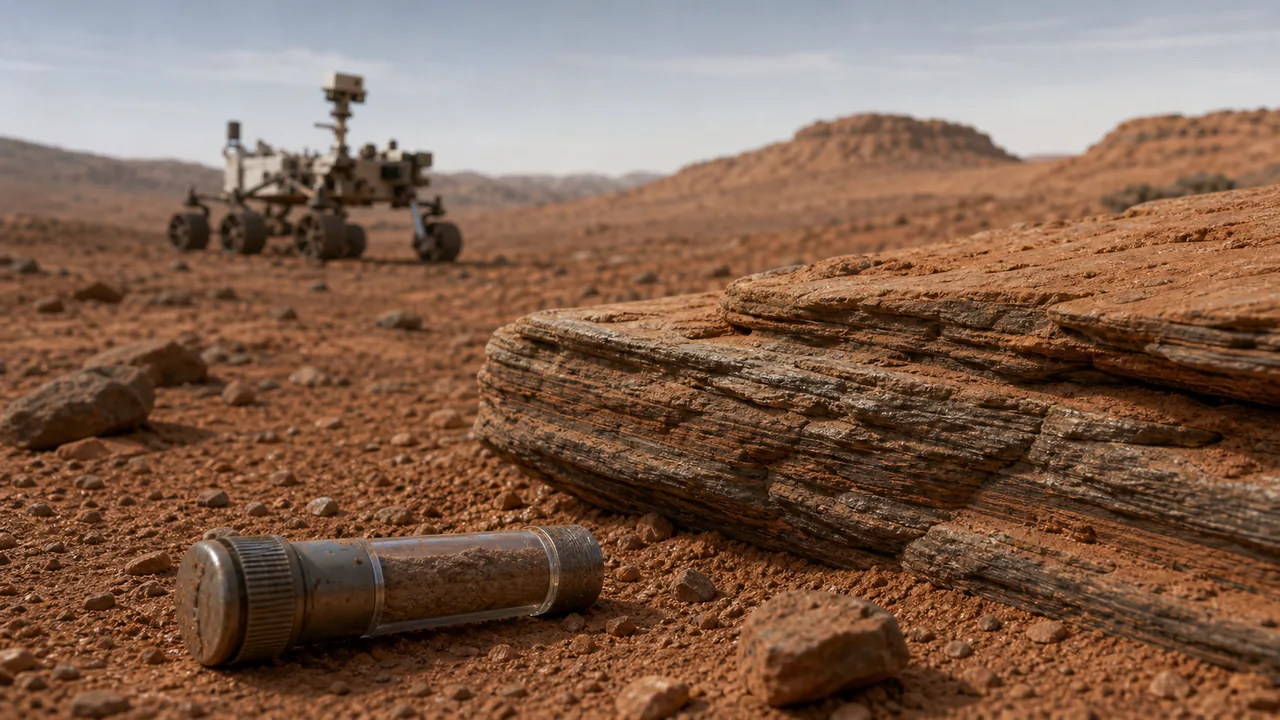
The Guardian reports that NASA's Perseverance rover, a Mars explorer of the US space agency NASA, has detected complex organic carbon molecules in rocks on Mars. The measurements come from the SHERLOC instrument in mudstones at the Bright Angel outcrop along Neretva Vallis, an ancient dry riverbed that brought water to the Jezero crater. According to scientists, the macromolecular carbon found may occur in a biological context, but it may also be created by geological processes or brought in via meteorites. Therefore, the finding is not evidence that there was ever microbial life on Mars. NASA describes Perseverance more broadly as a mission that searches for traces of ancient life, collects rocks and investigates the past habitability of Mars. The real scientific value therefore does not lie in a quick conclusion, but in the combination of location, rock layer, chemistry and possible future sample research on Earth.
Striking in this message
The word potential is striking. That keeps the door open without opening it. It makes news exciting, but at the same time forces us to be cautious: there may be no proof.
Less visible context
What remains less visible is that Martian science is dependent on instruments at great distances. A rover can measure a lot, but not everything. Returning samples to Earth laboratories would allow analyzes that are much more difficult on Mars itself. As a result, this news is also about priorities and budgets in space travel.
Possible message behind the news
One possible message is that great discoveries often start as small chemical clues that only become meaningful years later.
Neutral conclusion
The neutral conclusion: the find is scientifically interesting and possibly important, but not yet breakthrough proof. Mars remains no less fascinating when caution slows down the headline.