
MOZOM vergelijkt
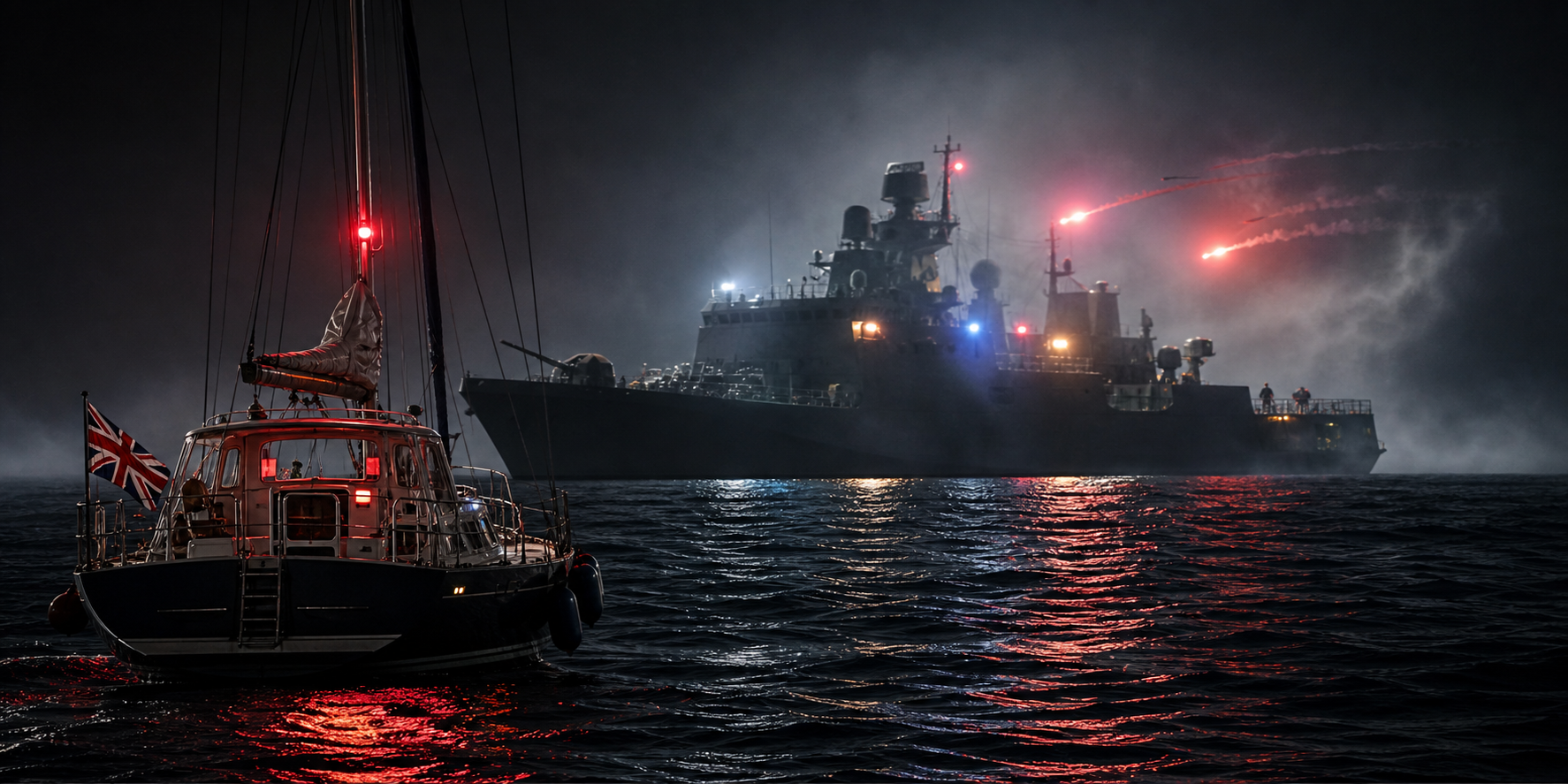
MOZOM compares: are the warning shots in the Channel a collision warning or a political signal?
- Source
- MOZOM vergelijkt
- MOZOM headline
- MOZOM compares: are the warning shots in the Channel a collision warning or a political signal?
- Original headline
- AP, Euronews and the German public newsroom Tagesschau place the same incident in the Channel slightly differently: safety at sea, British-Russian tension or shadow fleet context
- Author
- MOZOM-redactie
- Date
- 16 juni 2026 om 23:02
- Subject
- Comparing reporting on a Russian warship firing warning shots at a British yacht in the Channel, about twenty nautical miles south of the Isle of Wight, an island off the south coast of England.
Summary of the original report
AP News reports that a Russian warship fired warning shots at a British-registered pleasure yacht in the Channel, without damage or injuries. AP explains that the incident took place outside British territorial waters, approximately twenty nautical miles south of the Isle of Wight, and that the British Defense Department has launched an investigation. Euronews emphasizes more strongly that Moscow is talking about a dangerous approach and places the incident directly next to the recent British interception of a sanctioned tanker from the Russian shadow fleet. Tagesschau, the German public newsroom, describes the same incident as something that happened just off the British coast, linking it more sharply to broader tensions between Russia and Western states. All sources state that there have been no reports of injuries or damage and that the Russian frigate crew claims to have acted in accordance with international shipping rules. The difference therefore lies less in the bare facts than in the question of whether the reader should primarily see this as a maritime security incident or as a politically charged signal.
Striking in this message
It is striking how words such as dangerous approach, warning shots, investigation and shadow fleet focus attention differently each time. AP mainly uses these words to organize fact, response and escalation risk. Euronews gives heavy weight to the concept of shadow fleet, making the shots less isolated and more part of a strategic pattern. Tagesschau uses the incident as a compact entrance to greater Russia-West tension. For example, the framing determines whether the reader mainly thinks about nautical rules or political pressure at sea.
Less visible context
What remains less visible is how vulnerable busy international shipping lanes are when military ships, civilian yachts, sanctions enforcement and geopolitical rivalries move simultaneously through the same space. This may seem far away to ordinary citizens, but it directly affects trade, energy, insurance, maritime safety and the chance that a small incident will increase due to miscalculation. What is also neglected is how difficult it is to subsequently assess exactly what was a dangerous approach, a proportionate warning or an intimidating signal at sea, especially when both states quickly make their own reading public.
Possible message behind the news
A possible message behind this reporting is that almost no incident at sea is read from a purely technical point of view when Russia and a NATO country are in the vicinity. For a layman, that's the gist: the same shots can be formally interpreted as a warning, but between the lines they can also feel like a test of boundaries, reactions and political nerves. The reader therefore not only receives information about a yacht in the Channel, but also about how quickly maritime safety is turning into international symbolism.
Neutral conclusion
This comparison shows that the same warning shots can shift per source from collision prevention to geopolitical signal, and that it is precisely that shift that determines how large and charged the incident feels.