
MOZOM-analyse
MOZOM analyses: German building materials are becoming scarce, recycling or bureaucratic waste?
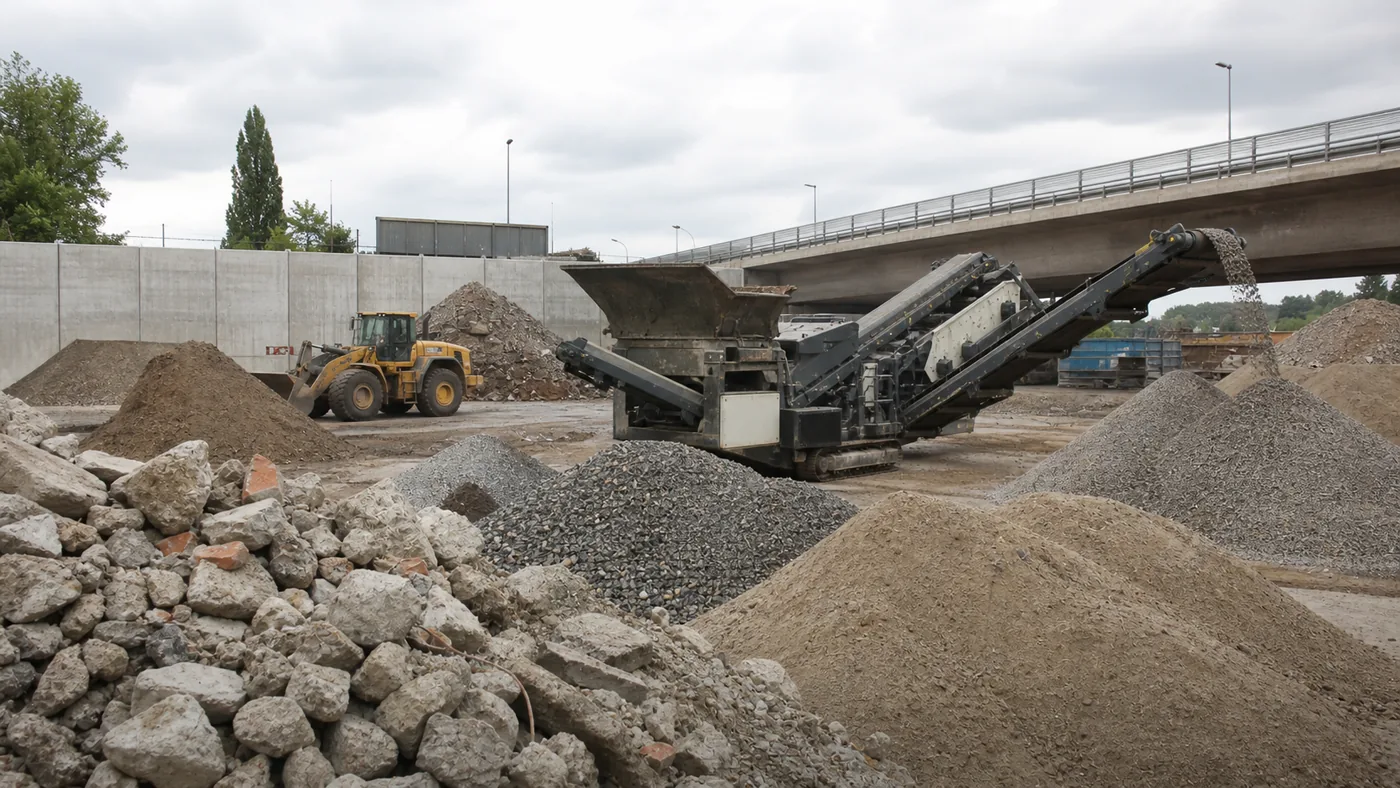
- Source
- Tagesschau, Umweltbundesamt, Bundesumweltministerium, Kreislaufwirtschaftsgesetz en Ersatzbaustoffverordnung
- MOZOM headline
- MOZOM analyses: German building materials are becoming scarce, recycling or bureaucratic waste?
- Original headline
- German construction sector sees scarcity of sand, gravel and crushed stone while recycling building materials are barely making the cut
- Author
- the MOZOM.nl editorial team
- Date
- 4 juli 2026 om 16:54
- Subject
- MOZOM investigates how Germany simultaneously struggles with more expensive primary building materials, available recycling technology and a government that does not make circular building materials a given in public contracts.
Summary of the original report
Tagesschau reports on July 4, 2026 that sand, gravel and crushed stone are becoming scarcer and more expensive in Germany, while recycled building materials are still rarely used despite available technology. According to the report, the share of recycled building materials in construction projects is around 15 percent. Industry representatives say that 30 to 35 percent would be technically feasible in the short term. At the same time, construction raw materials have become significantly more expensive: Tagesschau mentions plus 44.1 percent for construction sand, plus 45.4 percent for construction gravel and plus 53.6 percent for limestone for cement production over the past five years. The example mainly affects public construction projects. The government could take an example role there, but according to the companies involved, recycling materials are often stuck in extra consultation, fear of inspection, old specifications and uncertainty among clients, especially in public contracts.
Own source research
MOZOM has placed three layers next to each other. Tier one: the price tier. Tagesschau mentions significant increases for construction sand, construction gravel and limestone and describes permit processes that can take years. Layer two: the material layer. Construction and demolition waste is not a small by-product, but one of the largest mineral flows in the economy. If that stream can be technically upgraded, it is strange to continue to extract new raw materials at the same time as if secondary material were marginal. Layer three: the tender layer. Paragraph 45 of the Kreislaufwirtschaftsgesetz and the German circular strategy emphasize public example, but Tagesschau shows that it is precisely this public practice that often lags behind. MOZOM's own layer is therefore: recycling fails here not only due to technology, but due to institutional inertia. The government demands circularity from the market, but still too often buys as if the old world of raw materials is unlimited.
Striking in this message
It is striking that scarcity often sounds like a fact of nature. Sand and gravel are running out, permits take a long time, prices are rising. But as soon as certified replacement building materials exist and are still difficult to accept, scarcity is also a choice in the chain. Anyone who treats recycling as an exception makes primary extraction the standard. Then bureaucracy quietly becomes a raw material policy.
Less visible context
What is less visible is that public clients have enormous market power. A municipality, state or federal client can use specifications to determine whether recycled granulate will become normal or remain exceptional. At the same time, caution is not always pointless. Roads, bridges and public buildings must be safe and last a long time. But that is precisely why the difference between inspection obligation and risk avoidance is important. Certification should create trust, not become an extra mountain of paper with which everyone ultimately chooses primary material.
Possible message behind the news
A possible message is that Germany wants more recycling, but that construction practice is still lagging behind. The sharper counter-reading is that the government preaches circularity as long as citizens and companies have to adapt, but still too often protects the old routine in its own tenders.
Neutral conclusion
The neutral conclusion: Germany sees building materials becoming more expensive and scarce, while recycling building materials could technically contribute more than is currently happening. The more pointed MOZOM reading is that this is a textbook example of policy encountering itself. Circularity sounds modern as long as it is included in strategies. Only in the specifications, at the bridge, the road and the municipal building does it become clear whether the government really dares to buy what it says it wants.
Source:
- Tagesschau: Baustoffe werden knapp, Recycling kommt kaum zum Einsatz
- Umweltbundesamt: Bauabfaelle en verwerking van geselecteerde afvalstromen
- Bundesumweltministerium: Kreislaufwirtschaftsstrategie
- Kreislaufwirtschaftsgesetz paragraaf 45: plichten van de publieke hand
- Ersatzbaustoffverordnung: federale regels voor minerale vervangingsbouwstoffen