
MOZOM-analyse
Water resilience or power over water: does river water shift to Brussels?
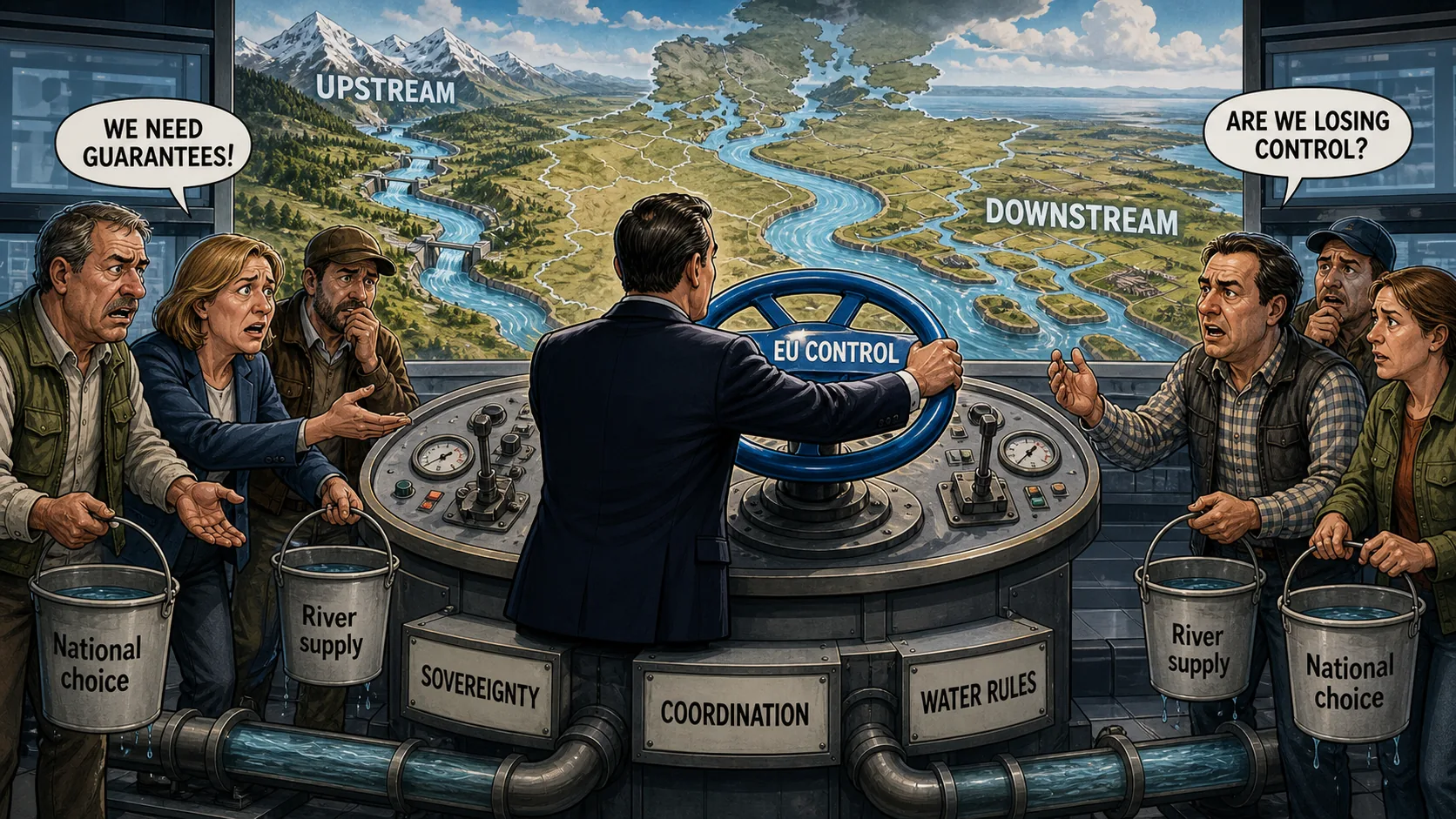
- Source
- Europese Commissie, EUR-Lex, NOS, Unie van Waterschappen, Europees Parlement en Raad van de EU
- MOZOM headline
- Water resilience or power over water: does river water shift to Brussels?
- Original headline
- European Water Resilience Strategy puts water higher on the European political agenda
- Author
- Ron Caroselli
- Date
- 18 juli 2026 om 18:45
- Subject
- MOZOM analyzes the European Water Resilience Strategy and the Dutch desire for binding agreements on river water as a sovereignty question: is this necessary cooperation, or is water policy moving toward more European allocation power?
Summary of the original report
The European water strategy is officially a policy framework with dozens of actions, not a direct law that currently forces member states to hand over river water according to Brussels distribution keys. The Commission wants, among other things, to improve water quality, restore ecosystems, use water more efficiently, mobilize investments, share data better and strengthen the European water technology sector. At the same time, the Netherlands, through the water boards, says that downstream countries such as the Netherlands should not remain dependent on what upstream countries have left. The Union of Water Boards therefore wants European agreements that make it clear how much river water must be allowed to pass through during dry periods. That makes this topic newsworthy: the strategy is soft policy today, but can become the administrative basis for hard agreements tomorrow.
Own source research
MOZOM has compared the Commission strategy with existing EU water legislation and the EU treaty. The Water Framework Directive has long obliged member states to work through river basin districts, including international river basins. This means that European water coordination is not new. What is especially new is the political weight: in the strategy, water is more closely linked to safety, crisis resilience, investments, digitalization and European competitiveness. Legally important is Article 192 of the Treaty on the Functioning of the European Union. Ordinary environmental measures can often be taken through the normal legislative procedure, but measures that affect quantitative water management or the availability of water sources fall under a more difficult route. This requires, in principle, unanimity in the Council after consultation with the European Parliament, the Economic and Social Committee and the Committee of the Regions. That is a brake on simple centralization, but not a blockade if member states agree politically.
Striking in this message
The word water resilience sounds broad and reassuring. It's about drought, floods, pollution and clean water. But in policy language, resilience can also be the first layer of more management: measuring, reporting, setting goals, linking financing, building standards and ultimately distributing. Anyone who reads it only as nature restoration misses the question of power. Anyone who reads it only as a power grab misses that the Netherlands is truly vulnerable as a downstream country.
Less visible context
It is less visible that water in dry periods is no longer an abstract environmental theme, but a distribution issue. When there is too little water, someone has to set priorities: drinking water, agriculture, nature, industry, power plants, shipping or cross-border transit. At that point, water policy becomes power politics. European enforceability can be attractive for the Netherlands, because the Netherlands is dependent on upstream choices in Germany, Belgium, France and Switzerland, among others. For those upstream countries, the same enforceability can feel like a loss of national space. The EU does not therefore have to aim for 'control over waters' in order to gain more control over water decisions in practice.
Possible message behind the news
The visible message is: Europe must become water resilient. The critical MOZOM lecture is: water resilience can become the stepping stone to greater European distribution power over a vital resource.
Neutral conclusion
The conclusion: the European Water Resilience Strategy is newsworthy because it shows how a policy strategy today can develop into a binding distribution of power tomorrow. Officially it concerns drought, floods, pollution and water security. Legally it is not yet a water distribution law. But as soon as the Netherlands and other countries want European enforceability about how much river water must be allowed upstream, the debate shifts from cooperation to sovereignty. This can be useful for a vulnerable downstream country such as the Netherlands. At the same time, it could mean that national policy freedom on water shifts further to the EU level. The fair question is therefore not whether Brussels already controls all waters. The honest question is: which water decisions will be allowed to remain national when scarcity is declared European?
Source:
- Europese Commissie: European Water Resilience Strategy
- EUR-Lex: COM(2025) 280 final, European Water Resilience Strategy
- EUR-Lex: Water Framework Directive 2000/60/EC
- EUR-Lex: artikel 192 VWEU
- NOS: waterschappen willen Europese regels over rivierwater
- Unie van Waterschappen: reactie op Europese waterstrategie