MOZOM-analyse
MOZOM analyses: Hungary's public broadcaster M1/Kossuth, media reform or political intervention?
- Source
- NU.nl, The Guardian, Euronews, Daily News Hungary/Telex, OSCE, Europese Commissie, EU EMFA, CPJ, RSF en Reuters Institute
- MOZOM headline
- MOZOM analyses: Hungary's public broadcaster M1/Kossuth, media reform or political intervention?
- Original headline
- Hungarian public media outlets halt broadcasting in post-Orban shake-up
- Author
- Paul Giezen
- Date
- 7 juli 2026 om 23:47
- Subject
- MOZOM investigates whether the temporary suspension of Hungarian public news broadcasts is a necessary break with state propaganda, or a political risk for freedom of expression and EU media law.
Summary of the original report
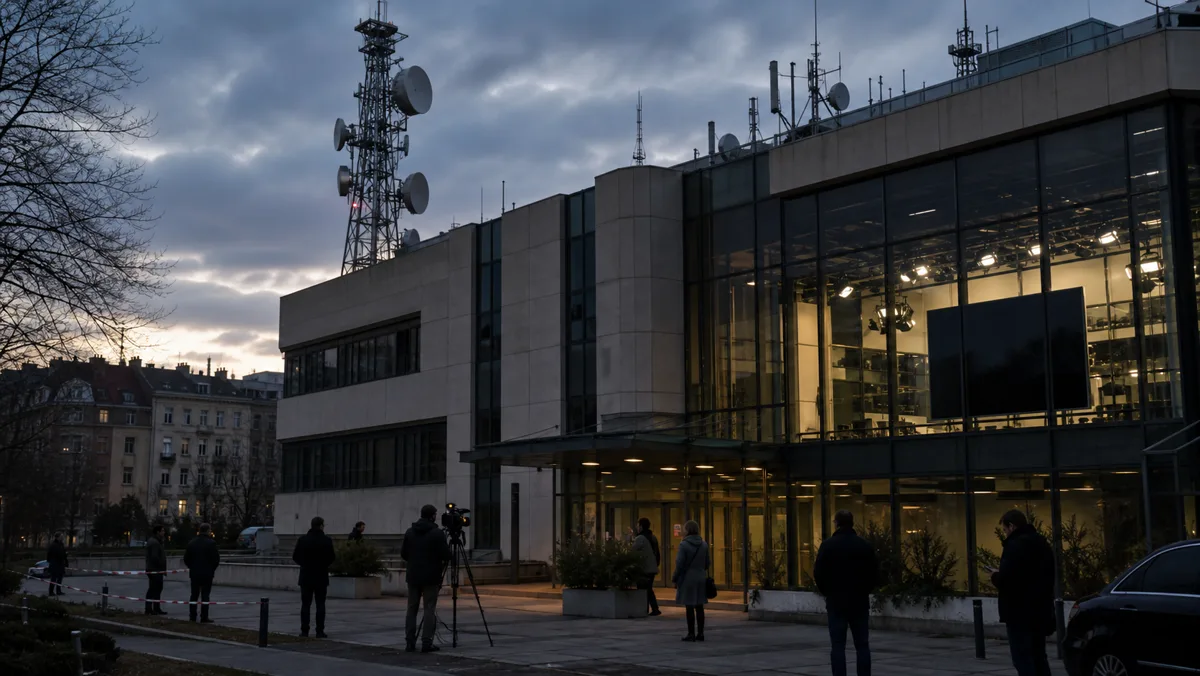
Hungarian public media abruptly entered a transition phase on July 7, 2026. According to The Guardian, Euronews and local Hungarian reporting, M1 and Kossuth Radio temporarily stopped news broadcasts after an interim management team was appointed at MTVA, the public media organization. M1 showed a black message with the core sentence that public media should not lie and that the news is temporarily reformed. Kossuth Radio reportedly switched to classical music via Bartók Radio, while M1 would later return without news programs with films or other non-news offerings. New Prime Minister Péter Magyar called this the end of propaganda on public media platforms. Viktor Orbán, who was voted out in April after sixteen years in power, spoke of Tisza tyranny and referred viewers to HírTV, affiliated with his political camp. The facts make it legally sensitive: according to OSCE, RSF, CPJ and Reuters Institute, the public broadcaster was part of a strongly pro-Fidesz media system for years, but the new power is now visibly intervening in channels, management and news offerings.
Own source research
MOZOM has submitted the file to ten messages and documents. 1. NU.nl: Dutch summary of the procedure. 2. The Guardian/Reuters/AFP: M1 and Kossuth temporarily stop, Orbán calls it tyranny. 3. Euronews: the channel went off-air after installing interim management; OSCE context on skewed campaign reporting. 4. Daily News Hungary/Telex: local details about MTVA, suspended employees and later resumption without news. 5. OSCE/ODIHR: election context with structural advantage for the ruling party and no level playing field. 6. RSF: Hungary will be in 74th place out of 180 in 2026 and, according to RSF, public broadcasting became propaganda under Orbán. 7. Reuters Institute: more than 80 percent of the media landscape was under Fidesz influence; opposition received very little airtime in prime-time public news bulletins. 8. CPJ: Reform is needed but must be based on EU law, consultation and supervision. 9. European Commission: there was already an infringement procedure against Hungary under the European Media Freedom Act and AVMSD. 10. EUR-Lex and EU Charter: Article 11 protects freedom of expression and media pluralism; EMFA Articles 4 and 5 protect editorial independence and independent public media. MOZOM's own layer: the central question is not only whether Orbán media was propaganda, but whether a new government organizes the recovery process in such a way that it does not become a mirror image of political control.
Striking in this message
It is striking that both camps claim the same word field. Magyar speaks about truth, credibility and independence. Orbán speaks of truth and tyranny. That is exactly why this file is bigger than Hungary. In media politics, 'stopping the lie' is a powerful frame, but also a dangerous button: whoever has the power to define a lie can also determine who temporarily disappears from the screen.
Less visible context
It is less visible that public media have a dual role. They are not a private newspaper that can choose its own political line, but neither are they a government microphone. They must give citizens access to pluralistic, reliable information. Under Orbán, this public task was seriously eroded, according to several international sources. However, a black channel does not solve that problem by itself. The real proof will only come with the next steps: open appointment procedures, restoration of editorial statutes, protection of dismissed journalists against arbitrariness, transparent supervision and room for Fidesz voters and opposition to be fairly represented.
Possible message behind the news
A possible message is that public media do not automatically become free after years of political capture by pressing a new political button. The sharper reading: freedom of expression is threatened not only by propaganda from the old power, but also by recovery operations that are themselves insufficiently independent.
Neutral conclusion
The neutral conclusion: the suspension of M1/Kossuth news is newsworthy and fits in with a broader break with Orbán media, but it is not legally a blank check. The MOZOM lecture: yes, this is a political intervention with a risk to freedom of opinion and the media; it can only be defended if Hungary quickly proves that this is not a new party control, but a temporary and testable path to real public broadcasting.
Source:
- NU.nl: Hongarije pakt propagandaomroep Orbán aan
- The Guardian: Hungarian public media outlets halt broadcasting
- Euronews: Hungary pulls plug on state broadcaster
- Daily News Hungary: M1 television goes off air
- OSCE/ODIHR: Hungary 2026 elections, no equal opportunities
- OSCE/ODIHR: Statement of Preliminary Findings and Conclusions
- Europese Commissie: Hungary and European Media Freedom Act infringement
- EUR-Lex: Regulation (EU) 2024/1083, European Media Freedom Act
- EU Charter Article 11: freedom of expression and media pluralism
- CPJ: EU should support press freedom reform in Hungary
- RSF: Hungary country profile and 2026 press freedom ranking
- Reuters Institute Digital News Report 2026: Hungary