
MOZOM-analyse
Ter Apel as a means of pressure: administrative failure or crisis that makes a second location acceptable?
- Source
- NU.nl, Rode Kruis, Rijksoverheid, COA, VluchtelingenWerk, Gemeente Groningen en Gemeente Het Hogeland
- MOZOM headline
- Ter Apel as a means of pressure: administrative failure or crisis that makes a second location acceptable?
- Original headline
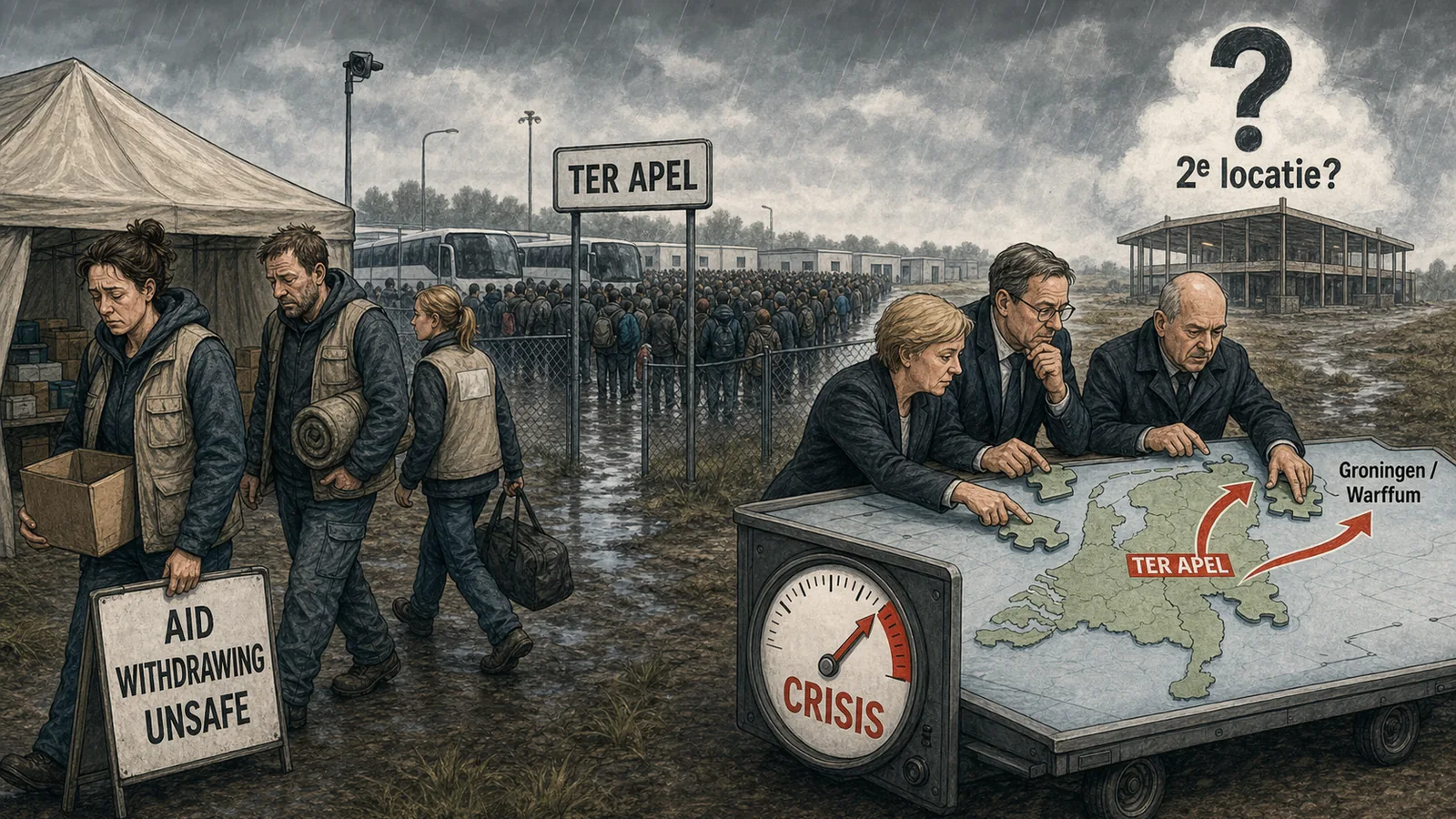
- Aid organizations withdrew from Ter Apel because aid was no longer safe. This was followed by additional measures, night shelter and again the question of whether the Netherlands needs a second registration structure.
- Author
- Ron Caroselli
- Date
- 16 juli 2026 om 06:28
- Subject
- MOZOM is investigating whether the crisis around Ter Apel, the departure of aid organizations and the use of Groningen and Warffum as an emergency valve point to conscious policy or mainly to administrative failure that still pushes politics towards additional reception locations.
Summary of the original report
NU.nl reported that the Red Cross and other aid organizations stopped their work at Ter Apel because the situation was no longer safe. The Red Cross stated that the government must solve the reception problem and that emergency assistance from volunteers cannot be a structural replacement for reception policy. Shortly afterwards, the government announced additional measures: including the opening of the DISA building, more supervision, a safety risk area, preventive frisking, bus transport to night shelters and a new call for municipalities to provide shelter places. At the same time, Groningen, Warffum and other places were again used as a temporary valve for people who could not go to Ter Apel. There is no public evidence of a pre-arranged plan to deliberately escalate the situation. However, the pattern is administratively relevant: in each case, first a visible crisis arises, then emergency shelter, then pressure on municipalities and then again the message that more structural shelter capacity is needed.
Own source research
MOZOM has compared the sequence of events to the administrative route. Step one: Ter Apel remains structurally too full or too restless, with recurring safety and reception problems. Step two: aid organizations draw the line because they can no longer do their work safely. Step three: the government announces safety measures and additional emergency shelter measures. Step four: Groningen, Warffum, Biddinghuizen and other locations are used as a temporary valve. Step five: the political argument for additional structural capacity becomes stronger. Biddinghuizen is important in this regard, because with approximately 1,250 temporary places it demonstrably provided space for Ter Apel, but at the same time it did not become a second Ter Apel: no permanent registration chain, no structural IND/AVIM function and dismantling as soon as the site is needed again for the season. The aid freeze, the government response and the use of temporary night shelter and emergency shelter have been proven. It is likely that the crisis pressure will shift the discussion of support. It is unproven that the government deliberately pushed for escalation to force a second location.
Striking in this message
The word 'emergency shelter' sounds temporary and humane. For many citizens, the word 'second Ter Apel' actually sounds like loss of control. This makes language important. A government can talk about relief, distribution, safety and human dignity. Opponents may hear: first let the crisis grow, then say that new locations are inevitable. Both lectures deal with the same administrative reality, but send the reader to a different conclusion.
Less visible context
It is less visible that Ter Apel is not just a place, but an administrative hub. This is where registration, reception capacity, safety, municipal capacity, European migration policy, transition to housing and national politics come together. If one part breaks down, Ter Apel gets the symbolic blame. This is politically useful and administratively dangerous at the same time: the location becomes proof that the system is failing, but also the argument with which more system capacity is requested.
Possible message behind the news
The official message is that safety, shelter and distribution now require additional measures. The critical MOZOM reading is that a problem that has been unresolved for years automatically becomes a political means of pressure: not because a plan has been proven, but because crisis shifts the boundaries of resistance.
Neutral conclusion
The conclusion: there is no public evidence that the Ter Apel government deliberately escalated the situation in order to force a second registration center. But the order is politically sensitive. Aid organizations withdraw, security becomes a crisis, Groningen and Warffum step in temporarily, and then the message is heard again that more structural reception capacity is needed. That could be administrative failure. It can also function, intentionally or unintentionally, as crisis pressure. Precisely for that reason, the question is on the table: does the Netherlands still use Ter Apel as a reception location, or now also as an argument for imposing new reception structures elsewhere?
Source:
- NU.nl: Rode Kruis over aftocht Ter Apel
- NU.nl: hulporganisaties stoppen werkzaamheden bij Ter Apel
- Rode Kruis: hulp Ter Apel kan niet langer veilig
- Rijksoverheid: extra maatregelen voor veiligheid en opvang in Ter Apel
- COA: situatie Ter Apel
- VluchtelingenWerk: hervatting dienstverlening Ter Apel
- Gemeente Groningen: tijdelijke nachtopvang in Hanzeplaza
- Gemeente Het Hogeland: tijdelijke nachtopvang in Warffum
- NOS: noodopvang Biddinghuizen verlaagt aantal mensen in Ter Apel
- Rijksoverheid: Spreidingswet