
MOZOM-analyse
AliExpress fine or purchasing control: will Europe send consumers back to the European checkout?
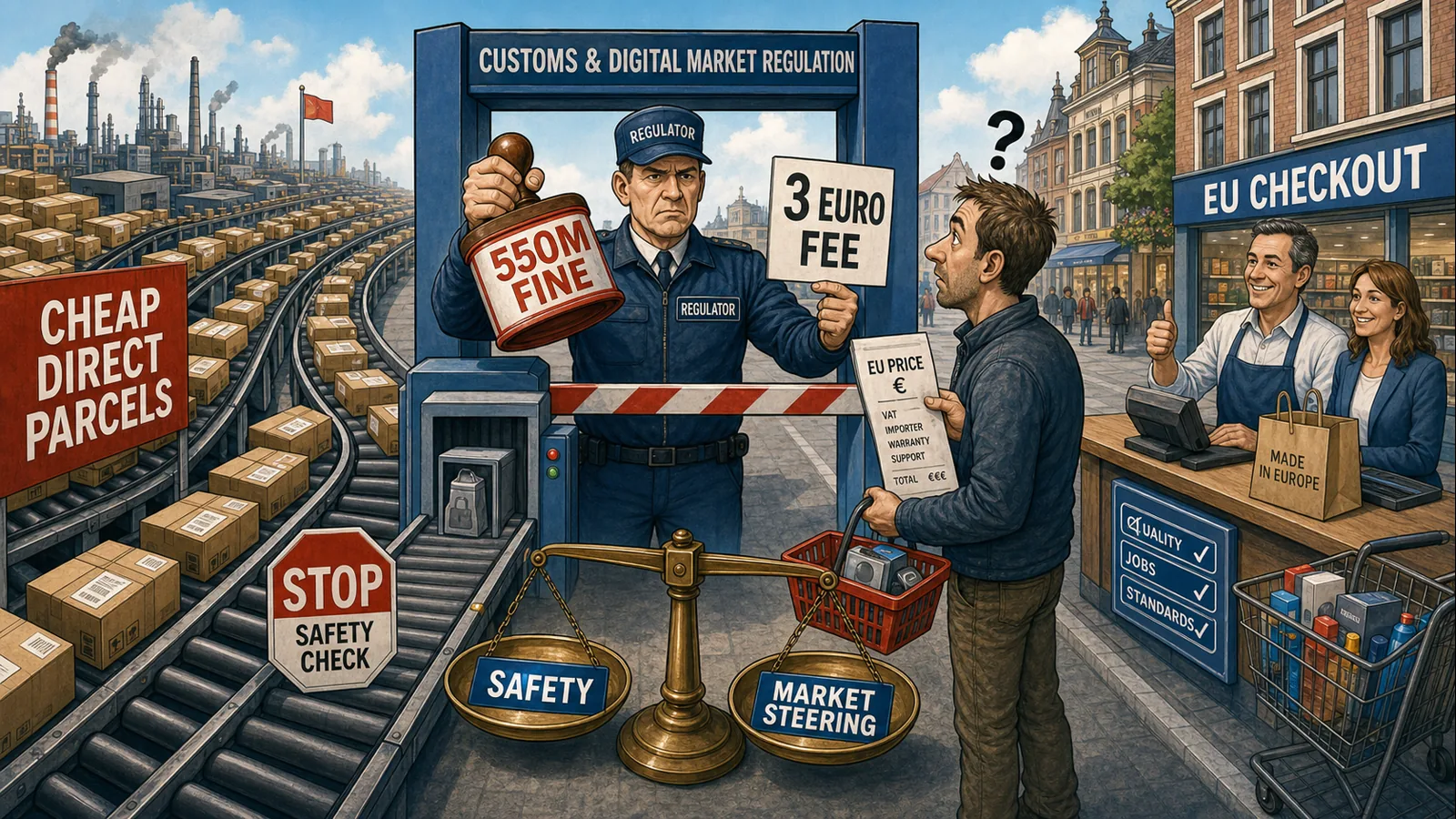
- Source
- Europese Commissie, AP, Reuters, NU.nl, Euronews, The Edge Singapore, Raad van de EU, China Daily en ECNS
- MOZOM headline
- AliExpress fine or purchasing control: will Europe send consumers back to the European checkout?
- Original headline
- European Commission fines AliExpress 550 million euros for failing to tackle illegal, unsafe and counterfeit products
- Author
- Paul Giezen
- Date
- 20 juli 2026 om 14:45
- Subject
- MOZOM is investigating whether the AliExpress fine is only consumer protection, or also fits into a broader European attempt to make direct Chinese online store imports more expensive and less attractive.
Summary of the original report
The European Commission has fined AliExpress, the international online shopping platform of Alibaba Group, 550 million euros under the Digital Services Act. According to Brussels, the platform has not sufficiently assessed and limited illegal, unsafe and counterfeit products from reaching European consumers via the platform. AliExpress disputes the fine and calls it disproportionate. At the same time, the decision coincides with a broader European course: stricter DSA enforcement, pressure on Shein and Temu, a temporary 3 euro levy on small packages from outside the EU and the phasing out of the old favorable treatment of shipments under 150 euros. This does not ban direct cheap imports from China, but it does make it more expensive, stricter and riskier.
Own source research
MOZOM places three layers next to each other. Layer one is the DSA fine itself: the Commission accuses AliExpress of inadequate risk assessment, insufficient restrictions on illegal products and weak controls on counterfeit and dangerous goods. Layer two is the parcel line: the EU says billions of small e-commerce shipments are putting pressure on customs and market controls, with a very large share coming from China. The temporary 3 euro levy makes cheap direct packages noticeably less cheap. Layer three is the market layer: European stores often also sell products made in China, but VAT, liability and supervision are easier to enforce through a European seller or importer. MOZOM's own addition is therefore that the battle is not simply about Chinese products, but about who manages the cash register, control and margin.
Protection or return to the European cash register
Consumer protection is a strong and often justified frame. No one wants unsafe chargers, dangerous toys or counterfeit cosmetics in their home. But the same frame can also legitimize market management. If a product goes through a European counter, more money remains in the European system: VAT, logistics, distribution margin, compliance costs and liability. This can be safer for consumers, but also more expensive. It can be fairer for European entrepreneurs. For Chinese platforms, it means that their price advantage is shrinking.
Less visible context
What is less visible is that Europe not only wants to prevent the sale of dangerous products, but also wants to make the scale of direct platform imports manageable. Top EU official Henna Virkkunen pointed out that many Europeans buy from Shein, Temu and AliExpress every month. That is not a detail: if one in five Europeans regularly buys outside the European retail chain, part of the turnover, margin and customer relationship will disappear from the European trade model. The 550 million euro fine is therefore formally legal. The economic side effect is that consumers are again increasingly pushed towards a controlled European intermediate layer.
Possible message behind the news
The visible message is: Europe protects consumers against unsafe and illegal products. The critical MOZOM reading is: Europe simultaneously protects its own market model by making direct Chinese platform trade less attractive.
Neutral conclusion
The conclusion: the AliExpress fine is not officially an import ban and not proof that Europe wants to ban Chinese products. But together with the 3 euro levy, DSA pressure on large platforms and investigations into Shein and Temu, a clear line is emerging. Anyone who wants access to European consumers must submit to European product, platform and customs rules. Anyone who structurally refuses to do so may risk fines, additional measures and ultimately severe access restrictions. For citizens, this may mean more safety and liability, but also higher prices and fewer direct cheap choices. The real question is therefore not just whether AliExpress was wrong. The question is also whether Europe protects consumers or simultaneously sends them back to a cash register over which Brussels has more control.
Source:
- Europese Commissie: boete AliExpress onder de Digital Services Act
- AP: AliExpress fined by EU over counterfeit and illegal goods
- Reuters: AliExpress hit with EU fine over illegal and counterfeit products
- NU.nl: webwinkel AliExpress krijgt 550 miljoen euro boete
- Euronews: EU slaps 550 million fine on AliExpress
- The Edge Singapore: Alibaba fined record 550 million euro in EU illegal sales case
- Raad van de EU: aanpak instroom van kleine pakketjes
- Europese Commissie: uitdagingen door e-commerce-importen
- China Daily: fast-fashionmaatregelen raken Chinese e-commerceplatforms
- ECNS: Chinese e-commerceplatforms en Franse fast-fashiondruk