
MOZOM-analyse
Digital euro after Parliament agreement: direct payment or new payment rails?
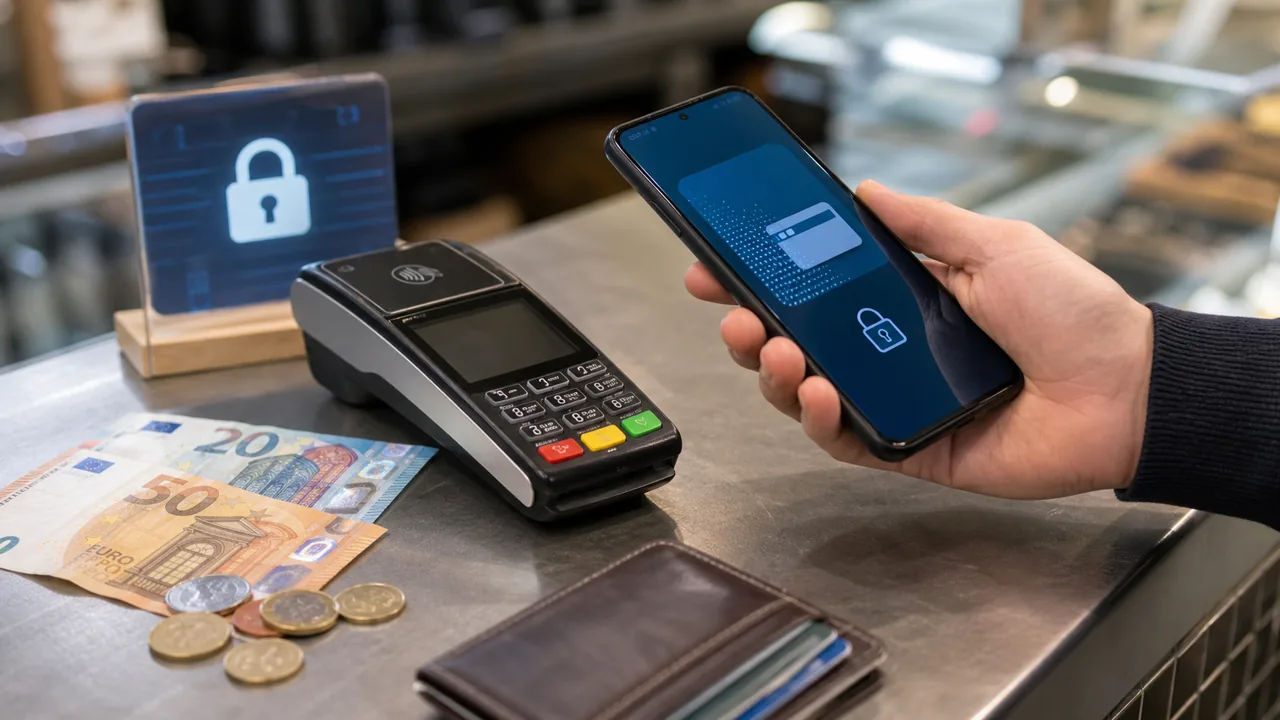
- Source
- NOS, Europees Parlement, ECB, Europese Commissie, EuroCommerce, DIHK, Finance Watch en academische kritiek
- MOZOM headline
- Digital euro after Parliament agreement: direct payment or new payment rails?
- Original headline
- Digital euro one step closer, European Parliament agrees
- Author
- Paul Giezen
- Date
- 9 juli 2026 om 17:33
- Subject
- MOZOM investigates why the European Parliament's agreement on the digital euro is not only about faster and European payments, but also about costs, interest, privacy, merchant fees, bankrolls and the question of how cash-like digital money can really become.
Summary of the original report
NOS reports that the digital euro is another step closer after approval from the European Parliament. The ECB presents the digital euro as public central bank money in digital form: free for basic use by citizens, usable in addition to cash and intended as a European alternative to dominant non-European payment networks. Parliament emphasizes privacy, financial stability, free basic services, limits on funds and caps on costs for retailers and payment service providers. At the same time, sources from retailers, entrepreneurs, consumer organizations and academic critics show that the key is not whether the digital euro exists digitally, but how the system is organized economically. No interest on balances sounds cash-like. Free basic use sounds attractive. But once wallets run through payment service providers and retailers have to deal with merchant fees or integration costs, the digital euro is less direct than a banknote that passes from hand to hand.
Own source research
MOZOM has placed the NOS news layer next to the ECB FAQ, the Parliament text, the legislative planning, EuroCommerce, DIHK, Finance Watch and academic criticism. Our own finding: the digital euro is publicly sold as cash-like, but legally and practically three different payment worlds emerge. Offline payments are the closest to cash: according to the ECB and Parliament, they should be more privacy-friendly and free of charge. Online payments are different: payment service providers remain involved, anti-money laundering rules continue to apply and costs are distributed in the system via caps, merchant fees or additional services. The third layer is holding limits: citizens are only allowed to hold a limited amount of digital euros and companies are not allowed to freely use deposits as a normal cash position. This prevents banking risks, but at the same time makes the digital euro less free than cash.
Striking in this message
It is striking how often the digital euro is described with words such as free, public, direct and cash-like. Those words are not incorrect, but they are not complete either. Free basic use for citizens does not mean that no one pays. No interest does not mean there is no economic incentive. And a direct payment in digital euros is only cash-like if the payment does not become dependent on an entire chain of wallets, identification, terminals, caps, compliance and merchant fees.
Less visible context
What is less visible is that cash has a unique property: when one person gives a note to another, there is no payment provider that charges a fee per transaction, no app that changes conditions and no online system that must remain available. The digital euro tries to recreate part of that property digitally, but it cannot do so completely without infrastructure. This makes the political question sharper: who pays for the payment rails if citizens have to pay for free, retailers want low costs, banks want to be compensated and the ECB says it does not want to earn transaction costs?
Possible message behind the news
A possible message is that Europe wants to become less dependent on foreign payment companies with the digital euro. The sharper MOZOM lecture: if digital public money only works through new intermediate layers, cost models and limits, politicians must honestly say where it is cash-like and where it is not.
Neutral conclusion
The neutral conclusion: the Parliament agreement brings the digital euro closer to the trialogues and possibly to introduction later this decade. The MOZOM conclusion: the decisive question is not only whether Europe will get a digital euro, but whether it really gives citizens a cheaper, freer and more privacy-friendly means of payment. A digital currency without interest can still be a payment rail with fees, conditions and dependencies.
Source:
- NOS: Digitale euro weer een stap dichterbij, Europees Parlement akkoord
- Europees Parlement: digitale euro, soevereiniteit, privacy en financiële stabiliteit
- ECB: FAQ over de digitale euro
- ECB: governance en wetgevingsproces digitale euro
- Europees Parlement: Legislative Train Schedule digitale euro
- EuroCommerce: merchant fee model voor de digitale euro
- DIHK: digitale euro positief onder voorwaarden
- Finance Watch: The Digital Euro, A Matter of Trust
- ArXiv: Digital Euro, Frequently Asked Questions Revisited
- Europese Commissie: voorstel verordening digitale euro