
MOZOM-analyse
MOZOM analyses: drones over Volkel, evidence or threat frame for shadow fleet actions?
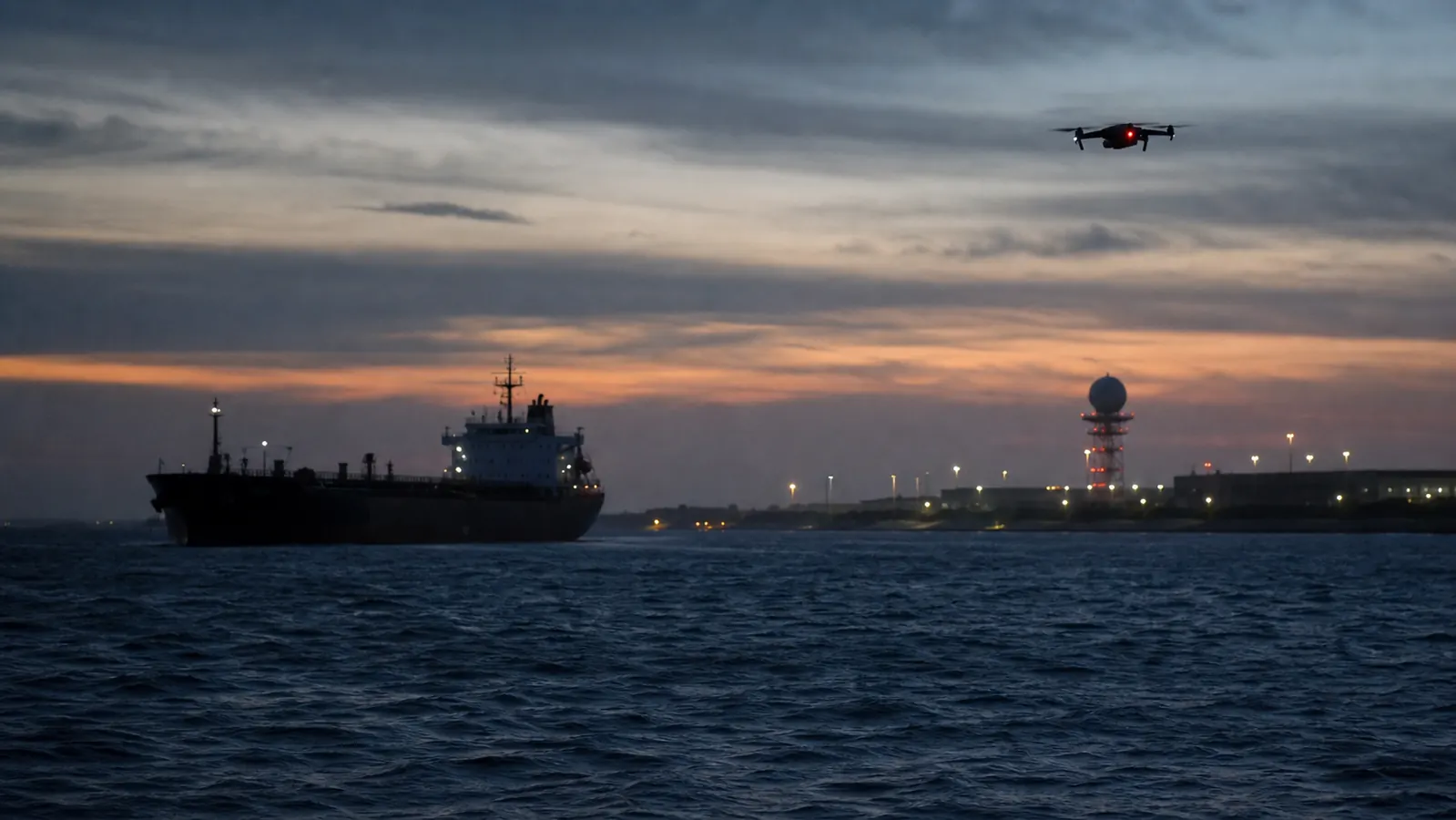
- Source
- IISS, NOS, AP en Dronewatch Europe
- MOZOM headline
- MOZOM analyses: drones over Volkel, evidence or threat frame for shadow fleet actions?
- Original headline
- British think tank: drones over Dutch bases probably from Russian ships
- Author
- the MOZOM.nl editorial team
- Date
- 4 juli 2026 om 07:20
- Subject
- The IISS states that drones over Volkel and Eindhoven, among others, were probably launched from Russian or Russian-linked ships, but public hard evidence remains limited while such claims could create political space for tougher European actions against the Russian shadow fleet.
Summary of the original report
The International Institute for Strategic Studies (IISS) states in the report Russia's UAV Campaign Over Europe that it is very likely that the Kremlin carried out a drone campaign over Europe between August 2024 and February 2026. The report counts 144 incidents in 13 European countries. According to IISS, Germany recorded 58 reports, Belgium 25, Denmark 16 and the Netherlands 9. In the Netherlands, these included Volkel and Eindhoven in November and December 2025. On November 21, up to ten drones were reportedly seen above Volkel; according to the report, base personnel tried to take them out from the ground, but no debris was found. IISS links the Dutch incidents to ships such as Arctica, Cgas Leopard and Tranquil Sea, which were traced around the incident windows on or near the North Sea. At the same time, the core remains vulnerable: the report mainly works with open sources, AIS and ship data, pattern recognition and plausibility. In the public layer, there is no drone shown, no wreckage, no intercepted command signal, and no forensic chain linking a specific drone to a specific ship. That is precisely why the political side effect is important: whoever uses the shadow fleet not only as a sanctions avoidance, but also as a possible military platform, makes it easier to sell European inspections, interceptions, detentions or economic pressure on Russian oil as a security necessity.
Own source research
MOZOM has compared the IISS report with the NOS view, AP context and Dronewatch criticism. Layer one: IISS uses a dataset of 144 incidents and says hobby activity and Ukraine spillover are filtered out. That makes the pattern stronger than individual reports. Layer two: in the Netherlands, the report mentions Volkel as a sensitive target, Eindhoven as a civil-military hub and three ships in the vicinity of the Dutch and French coasts. Layer three: the layer of evidence remains indirect. The report mentions ship positions, timing, technical feasibility and behavioral logic, but no publicly released wreckage, telemetry or intercepted controls. MOZOM's own layer is that this is exactly the point of tension: security cannot wait for court evidence, but news must not unnoticed turn probability into certainty. Particularly important is the economic layer: the same term 'Russian shadow fleet' is used in discussions about oil, sanctions, inspections and ship detentions. If a military threat frame is added, the public justification changes from economic pressure to protecting Europe.
Striking in this message
It is striking how quickly the word 'probably' becomes more weighty than it seems in the public reception. In plain language it probably sounds cautious. In security communications, the same word can be enough to reinforce an enemy image, guide budgets, expand powers and make actions against ships easier to explain. The word 'shadow fleet' adds something on top of that: it does not sound like regular merchant shipping or oil trading, but like secret infrastructure. This makes tougher action against Russian oil and tankers morally easier to sell. That does not make probability language prohibited, but it does make it dangerous if the reader cannot weigh the layer of evidence.
Less visible context
What is less visible is that, after years of war in Ukraine, Europe finds itself in an information environment in which every unexplained drone, cable break or suspicious tanker can immediately fall into a Russian context. Sometimes that is right. Sometimes it can also become a frame that accelerates policy before citizens see exactly what chain of evidence there is. The question is therefore not only whether Russia could have done this. The question is also who gets to publicly determine when 'may', 'seems' and 'probable' are enough for political consequences. If citizens first hear that the shadow fleet can be a danger to European bases, subsequent economic pressure on Russian oil is more easily perceived as protection rather than geopolitical escalation.
Possible message behind the news
One possible message is that Europe is being spied on by a Russian maritime drone campaign. The critical counter-reading is that the public mainly sees a probability construction of which the heaviest burden of proof is not publicly carried, while that construction can build support for tougher actions against Russian oil and ships.
Neutral conclusion
The neutral conclusion: IISS presents a serious reconstruction of drone observations over European bases and probably links the Dutch incidents to Russian-linked ships in the North Sea. The more pointed MOZOM reading is that it is precisely these types of messages that prove how powerful probability language is. Without public hard evidence, a claim can still have a political impact, strengthen an enemy image and help justify later actions against the shadow fleet, tankers and Russian oil. That is exactly why critical reading here is not a defense of Russia, but democratic hygiene.