MOZOM-analyse
Global Water Bankruptcy: who will decide how much water you can use?
- Source
- United Nations University, UN-Water, Europese Commissie, EUR-Lex, RIVM, ILT, Rijkswaterstaat en Europese Commissie datacenters
- MOZOM headline
- Global Water Bankruptcy: who will decide how much water you can use?
- Original headline
- UN think tank warns of global water depletion as Europe and the Netherlands make water use increasingly measurable, expensive and administrative
- Author
- the MOZOM.nl editorial team
- Date
- 20 juli 2026 om 11:10
- Subject
- MOZOM examines the term Global Water Bankruptcy as a policy warning and looks at the practical question behind water shortages: will water soon become mainly a right, a price incentive, a permit or a quota?
Summary of the original report
United Nations University warns with the report Global Water Bankruptcy that the world is living beyond its hydrological resources in many places. That is not a formal UN declaration of bankruptcy nor is it a global water law. It is a strong policy warning: groundwater, rivers and ecosystems are becoming so overloaded that a return to normal cannot be taken for granted. In Europe, this warning coincides with the Water Resilience Strategy, existing EU rules on cost recovery in water policy, Dutch concerns about drinking water availability and existing drought rules in which water is already distributed according to priorities. The newsworthy question is therefore not only whether there is enough water, but who will decide what is enough.
Own source research
MOZOM has placed the term Global Water Bankruptcy next to four concrete policy layers. Layer one is the global warning from United Nations University: water use, pollution and ecosystem damage are outpacing recovery in many places. Layer two is the European layer: the Water Resilience Strategy wants more economical use, better data, investments and cross-border cooperation. Layer three is the legal layer: the Water Framework Directive already includes cost recovery for water services, meaning users can be held accountable not only for supply but also for source and environmental costs. Layer four is the Dutch practice: in the event of drought, the displacement series exists and in the case of drinking water, RIVM and ILT warn of shortages towards 2030. MOZOM's own addition is the connection between those layers: a water crisis does not have to be a conspiracy to end in more price control, permits and priority power.
From tap law to quota thinking
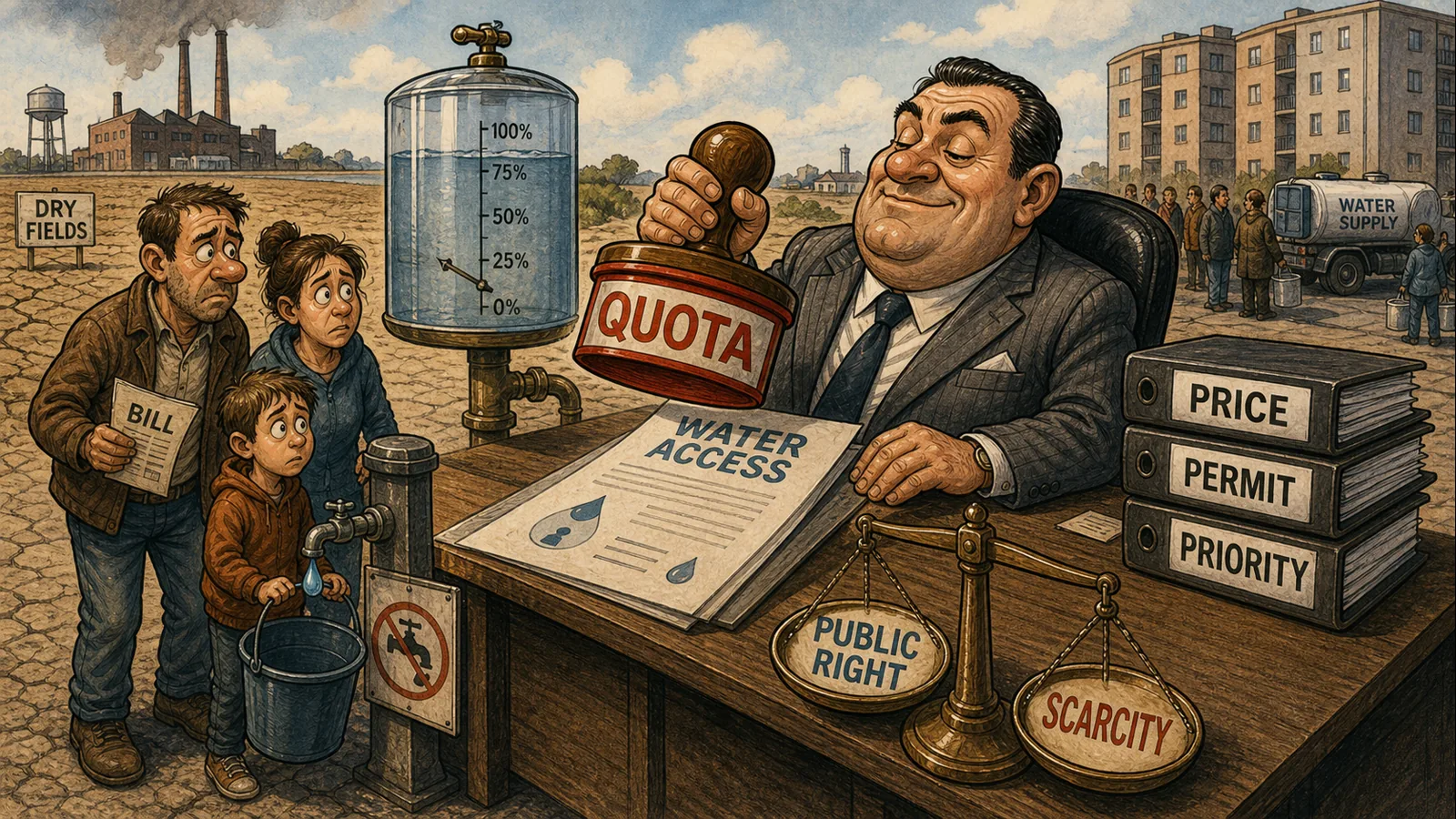
Citizens usually hear that water is becoming scarce and that frugality is necessary. That may be true. But the same message can also cause habituation to a new governance model: water as a measurable right under certain conditions. Words like resilience, efficiency and security sound technical and reasonable. Words like price, permit, priority and restriction feel much more direct. Yet they belong to the same policy family as soon as scarcity is made administrative.
Less visible context
What is less visible is that not all water use is treated equally. A household, farmer, power plant, factory, data center, nature reserve or ship all require water, but not with the same political power or economic value. In the Netherlands, there is already a division in the event of water shortage in which safety, irreversible damage, utilities and economic interests are weighed against each other. This can be reassuring for citizens as long as drinking water remains protected. But it also means that water use is ultimately not a purely individual right; it is a public distribution decision when supplies are under pressure.
Possible message behind the news
The visible message is: the world must use water more sparingly. The critical MOZOM lecture is: being more economical may be necessary, but the real battle is about who will operate the water button.
Neutral conclusion
The conclusion: Global Water Bankruptcy is newsworthy because it turns an old self-evident right into a new administrative question. There is no evidence that the UN, EU or the Netherlands are today introducing a personal water quota for every citizen. But the direction is visible: water is measured, compared, priced, reported and, in case of shortage, distributed according to priorities. This may be necessary to protect drinking water, nature and food production. It may also mean that access to water becomes increasingly dependent on rules, permits and administrative choices. The honest question is therefore: if water becomes scarce enough to distribute, who will decide how much you, your company or your region can use?
Source:
- United Nations University: World enters era of global water bankruptcy
- UNU-INWEH: Global Water Bankruptcy rapportcollectie
- UN-Water: bericht over UNU-INWEH rapport Global Water Bankruptcy
- Europese Commissie: Water Resilience Strategy
- EUR-Lex: Kaderrichtlijn Water 2000/60/EG
- RIVM: waterbeschikbaarheid voor bereiding van drinkwater tot 2030
- ILT: dringende oproep aan provincies over beschikbaarheid drinkwater
- Rijkswaterstaat: verdeling van water bij droogte
- Europese Commissie: energieprestaties en water-footprint van datacenters