
MOZOM-analyse
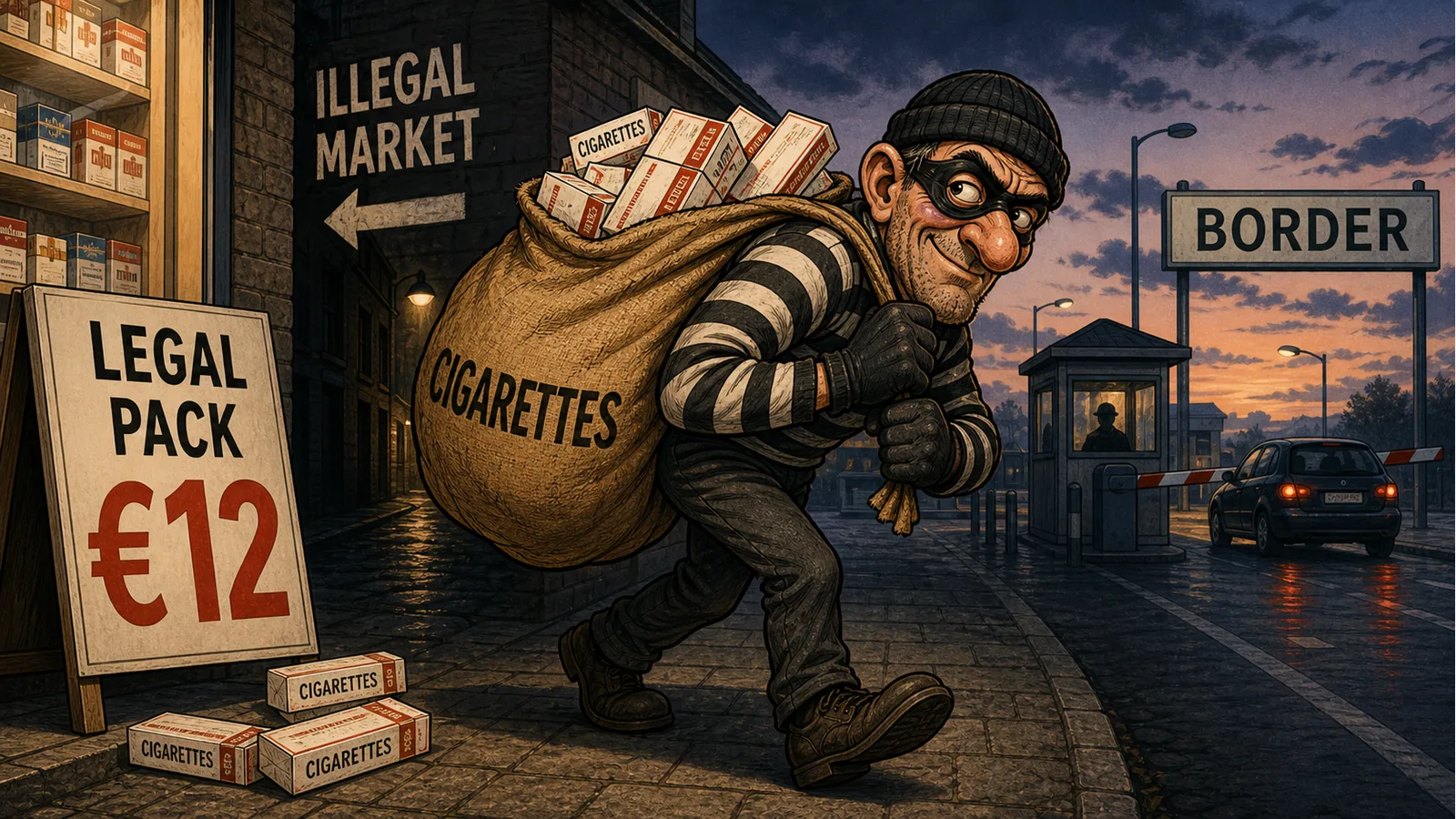
The more expensive the cigarette pack, the larger the smuggling market
- Source
- NOS, Douane Nederland, CBS, Rijksoverheid, Europese Commissie, RIVM, Trimbos, WHO, World Bank, Tax Foundation en FIOD
- MOZOM headline
- The more expensive the cigarette pack, the larger the smuggling market
- Original headline
- The Netherlands again intercepts a large shipment of illegal cigarettes at the border
- Author
- the MOZOM.nl editorial team
- Date
- 24 juli 2026 om 06:06
- Subject
- MOZOM investigates whether Dutch tobacco taxes, high package prices and price differences within Europe make the illegal cigarette market more attractive, and calculates what lower taxes could mean economically.
Summary of the original report
The Netherlands has increased tobacco taxes sharply in recent years. According to the central government, the excise duty on a pack of twenty cigarettes increased to 7.81 euros from April 1, 2024, with an average pack price of 11.10 euros. CBS reported in 2026 that the government received 15 percent less tobacco tax and that the minimum rate has approximately doubled since 2020. The public statement is twofold: fewer smokers and more cross-border purchases. At the same time, Customs reports large interceptions of illegal cigarettes and the European Commission calls illegal tobacco production and trade an EU-wide problem that costs billions in tax revenues every year. So the core issue is not just crime at the border. It is also a price system in which the legal store, the foreign store and the illegal market can become increasingly divergent.
Own source research and calculation
MOZOM calculated a simple scenario based on public Dutch figures. Starting point: an average pack of 20 cigarettes costs 11.10 euros, according to the central government, with 7.81 euros in excise duty. The VAT on 11.10 euros is approximately 1.93 euros. The government then statically receives approximately 9.74 euros per legally sold package: excise duty plus VAT. If the Netherlands were to reduce the excise duty to 5.87 euros, the level stated by the central government for the 2024 increase, and the rest of the price remained the same, the retail price would drop roughly to 8.75 euros. The government then receives approximately 7.39 euros per parcel: 5.87 euros in excise duty plus approximately 1.52 euros in VAT. To maintain the same tax revenue, legal sales would have to be approximately 32 percent higher. If only 10 or 20 percent of additional legal sales come from cross-border purchases and illegal trade, the treasury will lose money in this simple calculation. If more than about a third comes back, lower excise duties can start to have a fiscal effect. But that calculation ignores a major disadvantage: lower prices can also mean more smoking or less quitting. Therefore, this is not a simple solution, but it is a relevant policy question.
Fake, illegal or not taxed?
The word fake cigarettes sounds as if it mainly refers to fake brands. That may be the case, but without a public laboratory report or brand research it is not always visible exactly which layer is meant. Illegal cigarettes is broader: counterfeit, clandestine production, smuggling or real cigarettes on which no excise duty has been paid in the Netherlands. Excise duty evasion sounds fiscal, fake cigarettes sounds more dangerous for consumers and organized crime sounds like a safety problem. Each word puts the same discovery in a different light.
What is happening elsewhere in Europe?
The Dutch problem is not an isolated one. Ireland and France are among the most expensive cigarette markets in Europe and have been pursuing tough pricing policies for years. The Netherlands is now also in the high price range. Germany and Belgium are or were more attractive to Dutch smokers due to lower prices, while countries in Eastern and Southern Europe often have lower legal prices. That price difference is exactly what cross-border purchasing, transit and illegal trade can benefit from. At the same time, the EU line shows that Brussels does not opt for lower minimum excise duties, but rather for modernization and tightening of the Tobacco Taxation Directive. The European Commission wants to better monitor the internal market, monitor raw tobacco better and tackle illegal production. The tension remains: the higher the legal price in one country and the lower elsewhere, the greater the scope for trade outside the normal store.
Possible message behind the news
The visible message is that Customs and the police are intercepting illegal cigarettes. The deeper MOZOM reading is that the Netherlands must dare to ask whether its price policy is still in balance: when does expensive tobacco protect public health, and when does it unintentionally build a market for smuggling?
Neutral conclusion
The main question remains: the more expensive the cigarette pack, the larger the smuggling market? The honest answer is: not automatically, but the incentive does increase. High excise taxes can reduce smoking and are, according to health organizations, an effective instrument. At the same time, declining excise tax revenues, foreign purchases and large interceptions show that the market will move as soon as the price difference becomes large enough. A reduction in excise duty would only become fiscally logical if a large number of sales return to legal shops; In a simple calculation, approximately 32 percent additional legal sales are needed to compensate for a return to the old excise tax level per cigarette pack. The real question is not whether the Netherlands should make smoking cheaper, but whether current policy is helping the illegal market more than the government wants to admit.
Source:
- NOS: 1,2 miljoen nepsigaretten onderschept bij Bad Nieuweschans
- CBS: overheid ontvangt 15 procent minder inkomsten uit tabaksaccijns
- Rijksoverheid: accijns op een pakje sigaretten vanaf 1 april 2024
- Douane: 43 miljoen illegale sigaretten onderschept in een maand
- Douane: sigaretten of tabak meenemen uit het buitenland
- FIOD: ruim 13 miljoen illegale sigaretten in beslag
- Europese Commissie: herziening Tobacco Taxation Directive
- Europese Commissie: illegale tabak kost EU naar schatting 13 miljard euro per jaar
- RIVM: doorrekening scenario's accijnsverhoging op tabak
- Trimbos: tabaksaccijns in Nederland
- WHO: technical manual on tobacco tax policy and administration
- World Bank: Confronting Illicit Tobacco Trade
- Tax Foundation: Cigarette taxes in Europe 2026