
MOZOM-analyse
After the AfD landslide: reporting or international framing wave?

- Source
- Landeswahlleiter Sachsen-Anhalt, Verfassungsschutz Sachsen-Anhalt, ARD, ZDF, Deutschlandfunk, DW, AP, BBC, The Guardian, Euronews, Le Monde, El País, NOS, NU. nl, NPO Radio 1 and Axios
- MOZOM headline
- After the AfD landslide: reporting or international framing wave?
- Original headline
- After the AfD victory, international media place very similar accents on the extreme right, 1945, fear and the Brandmauer
- Author
- Ron Caroselli
- Date
- 8 september 2026 om 14:00
- Subject
- A systematic analysis of the dominant media frames after the AfD's election win in Saxony-Anhalt.
Summary of the original report
The factual basis is clear. According to the provisional final results, the AfD achieved 43.8 percent and 39 seats, more than doubling compared to 2021. The CDU fell to 17.2 percent. The turnout was 77.8 percent. The AfD won convincingly, but lacked an absolute majority of 42 seats and therefore needs support to form a government. Within 48 hours, German, Dutch, French, Spanish, British, American and pan-European media published very similar stories. The recurring order was: ideological classification, historical comparison with Nazi times or 1945, warning about democracy and Europe, and then the question whether the Brandmauer will hold up. The result and CDU defeat were usually stated correctly, but voters' concrete policy motives were generally given less space in the headline and first paragraphs.
Publication before publication: dominant framing and missing context
The table assesses the headline and dominant angle, not every sentence of the publication. A frame can be factually defensible and still guide perception. Inclusion does not mean that MOZOM attributes intent or coordination.
| Publication / country | Dominant framing | Factual basis | MOZOM analysis of what remains underexposed |
|---|---|---|---|
| ARD/Tagesschau - Germany | Record victory, far-right classification, government question and international shock. | Result, classification and coalition problems are verifiable. | Also offers seat calculations and voter motives; less one-sided than many foreign minds. |
| ZDFheute - Germany | Historic victory, maximum polarization and fear among opponents. | CDU debacle and AfD mandate are also mentioned. | Emotional reactions are prominent; BSW criticism of exclusion offers some counterbalance. |
| Deutschlandfunk - Germany | Press comments talk about earthquake, Nazi references and danger. | Also publishes voter research and the commentary that this is not the downfall of democracy. | Shows more clearly than many media that multiple frames are possible within one editorial team. |
| DW - international | Far-right landmark win and test for the firewall. | Classification, CDU loss and government calculations are factual. | Also recognizes that the clear political mandate is difficult to deny. |
| Die Zeit - Germany | Historical result and possibility of first extreme right-wing government participation. | Extensive results, turnout and coalition combinations. | Strong historical positioning, but a lot of verifiable election data. |
| Süddeutsche Zeitung - Germany | Historic AfD victory with national consequences. | Result and high turnout are stated. | The substantive rejection of the established course is given less emphasis than the historical cut-off. |
| RND - Germany | Dramatic international reactions, betrayal and Merz criticism. | Bundles actual published foreign responses. | A press review reinforces alarmist language because the sharpest quotes are selected. |
| Die Welt - Germany | Personal humiliation for Merz and international political shock. | CDU loss and pressure on the Chancellor are evident. | More attention to power struggles in Berlin than to regional policy motives. |
| AP - United States | Landslide test firewall; first far-right state government since World War II. | The Brandmauer and post-war exceptional position are a real context. | The agency frame is repeated worldwide and therefore gains disproportionate influence. |
| AP profile Ulrich Siegmund | Charismatic candidate puts a friendly face on the far right. | Personalization of the campaign is demonstrable. | The wording suggests that the friendly face is a wrapper for extremism. |
| BBC - United Kingdom | Stunning far-right victory that affects the European political order. | The scale and international consequences are newsworthy. | The regional result is quickly being scaled up to a European alarm signal. |
| The Guardian - United Kingdom | Shock victory, Merz under pressure and far-right triumph. | Merz himself called the defeat exceptionally heavy. | Much emphasis on shock and crisis; less on policy reasons behind the vote shift. |
| Euronews - Europe | Shocking surge rattles Europe's political foundations. | AfD growth has demonstrable consequences for European party relations. | One federal state is being made a threat to the European order before regional causes have been worked out. |
| Euronews Business - Europe | AfD victory as new risk for German economic recovery. | Political uncertainty can influence investments. | Causal economic risk is projected early while actual effects are still unknown. |
| Le Monde - France | Historic result of the far right with consequences for Merz and Europe. | Results and French political reactions are verifiable. | Le Monde also published a rare report in which AfD voters themselves spoke at length. |
| El País - Spain | Alarm signal for democracies and definitive establishment of the far right in Europe. | The growth of the party is historically relevant. | A normative editorial presents threat as the central meaning of the outcome. |
| El País voter analysis - Spain | Who voted for the far right, broken down by location, age and economy. | Uses election and socio-economic data. | More explanatory depth than the opinion headline, but the ideological qualification remains the starting point. |
| NOS Nieuwsuur - Netherlands | Main question: how extreme (right-wing) is the AfD? | The official classification and party positions make that question journalistically legitimate. | The question of why so many voters switched becomes secondary to the classification question. |
| NPO Radio 1/NOS - Netherlands | What does the win mean for democracy in Germany? | Institutional consequences are relevant. | The formulation immediately places election victory as a possible democratic problem instead of first as a democratic outcome. |
| NU.nl - Netherlands | Concerns about gains from the far-right AfD and ambition for national repetition. | Concerns and national ambitions have really been expressed. | The emotion of opponents determines the headline; joy or policy mandate from voters is given less weight. |
| Axios - United States | Far-right win tests Germany's political firewall. | De Brandmauer is demonstrably under pressure. | The exclusion of the winner becomes the organizing frame of the entire message. |
Legal boundary: classification is fact, total equivalence is interpretation
The Verfassungsschutz of Saxony-Anhalt has classified the AfD state branch as a 'gesichert right-wing extremist Bestrebung' since November 2023. This may be reported journalistically, preferably with clear source attribution. A judicial preliminary block from February 2026 concerns the federal classification of the AfD by the Bundesamt and, according to Tagesschau's legal explanation, did not change existing state classifications. However, it does not automatically follow that every voter is an extremist, that the election was undemocratic or that an AfD government is equivalent to the Nazi regime. Such conclusions are analysis or judgment and must remain recognizable as such. Nor can MOZOM state without evidence that editorial offices are centrally managed. Legal and journalistic purity is therefore: identifying demonstrable framing patterns, including source and rebuttal and not presenting intention or coordination as fact.
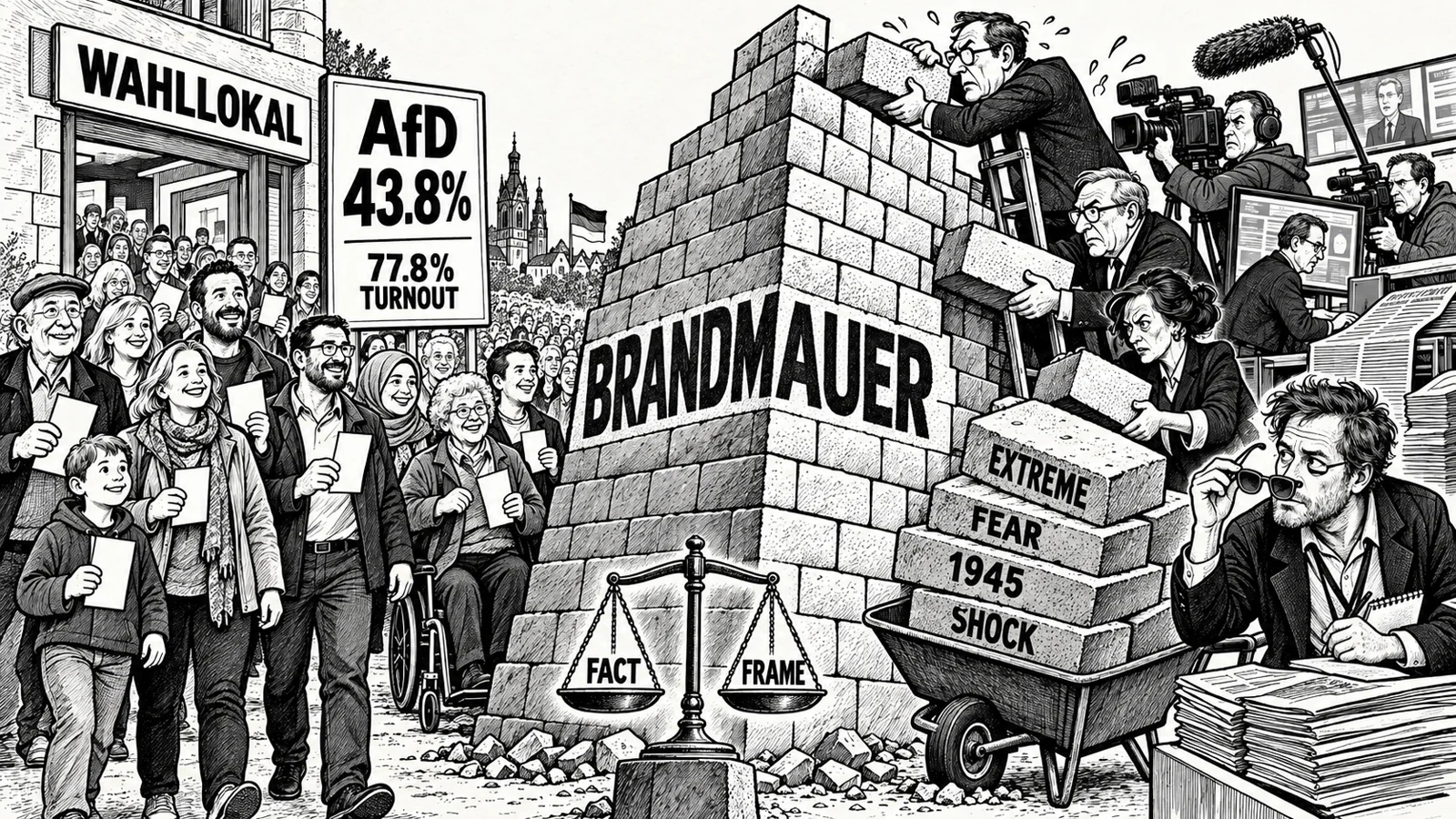
The six dominant frames after election night
1. Classification frame: 'far right', 'extreme right', 'radical right' or 'extreme right' is placed before party name and result. 2. Historical frame: 'first since 1945', 'since the Second World War' and references to the Nazi past increase the moral charge. 3. Alarm frame: 'shock', 'fear', 'nightmare', 'rattles Europe' and 'alarm signal' turn a regional election into a European emergency. 4. Brandmauer frame: the first follow-up question is often how other parties can keep the winner out of government. 5. Contagion frame: the result is linked to Russia, nationalism, racism, remigration and European instability. 6. Psychological voter frame: votes are explained by fear, anger, frustration or temptation; rational policy considerations receive less emphasis.
Why so many media end up on the same frame
Similarity does not prove conspiracy. International editors use AP, Reuters, AFP and dpa, quote the same party leaders and read each other's headlines. Moreover, German history is a legitimate context and the official extremism classification is newsworthy. At the same time, this information chain creates a reinforcing effect: a news agency chooses 'far right' and 'first since World War II', dozens of media adopt this and press reviews then present the repetition as international consensus. That's structure bias and editorial convergence. Demonstrable political coordination would require additional evidence, such as instructions, financial guidance, coordinated communications or documents that impose editorial choices from outside.
Possible message behind the news
The sum of the dominant frames can leave the message to readers that the most important reaction to the AfD victory is not policy change or self-examination by losing parties, but institutional shielding of the winner. That is a possible reading of the media effect, not a proven joint intention of the editors involved.
Neutral conclusion
There has been an extensive international framing wave since the AfD victory. The similarity in labels, historical comparisons and alarm language is too great to ignore as incidental. At the same time, a 'coordinated framing campaign' based on public reporting is a step too far: there is no evidence of central management. The best-substantiated conclusion is that news agency dependency, shared political sources and a similar editorial worldview form a self-reinforcing information chain. As a result, an elementary democratic question is underexposed: why did almost 44 percent of voters consciously choose the AfD? What this cannot yet prove: that all media have the same intention, that every critical qualification is incorrect or that one political power centrally controls the reporting.
Source:
- Tagesschau: provisional final results
- Verfassungsschutz Sachsen-Anhalt: official classification
- Tagesschau: legal status federal and state classifications
- Tagesschau: international press votes
- ZDFheute: historical result and government formation
- ZDFheute: international reactions
- Deutschlandfunk: press comments
- Deutschlandfunk: voters and election motives
- DW: landmark election win
- AP: Brandmauer after the landslide
- AP: rise of the right in Europe
- AP: profile Ulrich Siegmund
- The Guardian: response from Merz
- Euronews: political foundations of Europe
- Euronews: risk to economic recovery
- Le Monde: historic result
- Le Monde: AfD voters have their say
- El País: alarm signal for democracies
- El País: profile of AfD voters
- NOS Nieuwsuur: how extreme (right-wing) is the AfD?
- NPO Radio 1: significance for democracy
- NU.nl: concerns after AfD win
- Axios: election win tests the firewall