
MOZOM-analyse
Guilty until you can make the opposite plausible?
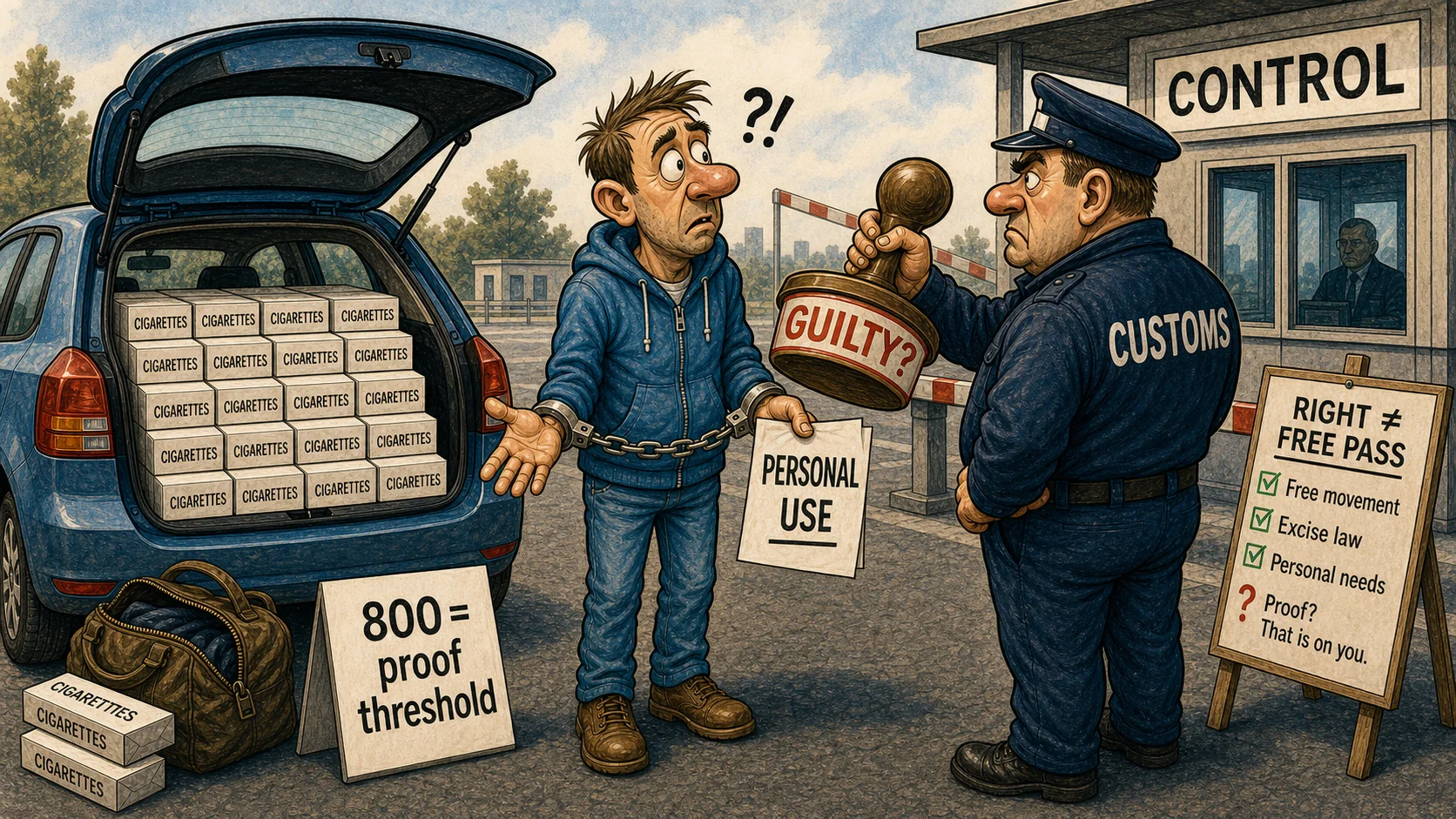
- Source
- EUR-Lex, Douane Nederland, Your Europe, Douane Handboek Accijns, Rechtspraak.nl en Hoge Raad
- MOZOM headline
- Guilty until you can make the opposite plausible?
- Original headline
- Cigarettes from an EU country: personal use is allowed, but above four cartons of cigarettes the evidence discussion begins
- Author
- Ron Caroselli
- Date
- 15 juli 2026 om 07:22
- Subject
- MOZOM investigates how the free movement of cigarettes within the EU conflicts with excise duty rules: a smoker who wants to take a year's supply for his own use will not be faced with a hard ban, but will be required to provide proof.
Summary of the original report
For travelers from an EU country or Northern Ireland, Customs stipulates that someone aged 17 or older may bring 800 cigarettes, 200 cigars, 400 cigarillos and 1 kilo of tobacco into the Netherlands tax-free for their own needs. The same Customs page also says that anyone taking more than the maximum amount must be able to prove that the tobacco is for their own use. If that works, the tobacco can usually be taken along; If this is not successful or insufficient, taxation or confiscation will follow. Your Europe, the EU information site for citizens, formulates the same mechanism in general terms: the guideline values are indicative and customs authorities can request supporting documents if they suspect that goods are not for personal use or are intended for sale. The legal core is therefore not that four cartons of cigarettes constitute an absolute EU ban. The gist is that the right to personal use above that limit changes into a burden of proof on the citizen.
Own source research
MOZOM has compared the calculation to the legal text. One pack per day means 20 cigarettes per day and approximately 7,300 cigarettes per year. That is approximately 36.5 cartons of cigarettes at 200 cigarettes per carton. Proven from Article 32 of Directive (EU) 2020/262: excise duty is only levied in the Member State of acquisition when a private individual acquires excise goods for his own needs and transports them to another Member State. Evidence from the same article: the assessment looks at multiple factors and the indicative levels should only serve as an element of evidence. Proven from Dutch Customs: above the stated quantity, the traveler must be able to prove that the tobacco is for his own use. Proven from Your Europe: if there is insufficient proof, customs in the country of destination can charge excise duties or confiscate goods. Proven from ECLI:NL:HR:2021:51: for smoking products from another Member State, the distinction between personal needs and needs other than personal needs is decisive. Uncertain: what quantity Customs would accept in advance as a credible annual supply in an individual case. It is precisely this uncertainty that is the social core.
Striking in this message
The language 'you are allowed to take four cartons of cigarettes' sounds like a maximum. The language of the law is more subtle: 800 cigarettes is an indicative level and an element of evidence. That difference is not small. A maximum says: it is not allowed above that. An element of evidence says: above that you must explain why it is allowed. For citizens, this difference only becomes apparent when it is checked.
Less visible context
What is less visible is that free movement within the EU does not disappear here, but is filtered by excise duties. Tobacco is no ordinary suitcase content. It is an excisable product with large price differences between Member States, health policy and fraud risks. That explains why Member States want rules of evidence. But it does not fully explain why a citizen can hardly obtain firm certainty in advance about a real private situation, such as buying a year's supply once a year. The tension is exactly there: the right formally exists, but practical certainty only arises when the executor believes the statement and evidence.
Possible message behind the news
A possible message from the Customs explanation is that large quantities of tobacco are suspicious and therefore require inspection. The sharper MOZOM reading is that in practice a guideline value quickly feels like a limit, because above that limit the citizen bears the risk of doubt, discussion, levy or seizure.
Neutral conclusion
The conclusion: this is newsworthy as a legal and social analysis, not as a manual for avoiding excise duties. Four cartons of cigarettes is not an absolute European ban. But above that limit, the right to personal use changes into a burden of proof. The headline 'Guilty until you prove otherwise?' is a legal question, not a criminal conclusion. As an analysis, it does touch the core of the sense of justice: a citizen is allowed to do something, but only notices at Customs whether he can sufficiently demonstrate it.