MOZOM vergelijkt
MOZOM compares: SDG 7 2026, 655 million without electricity or affordability crisis?
- Source
- WHO, IEA, IRENA, UN DESA, Wereldbank en Tracking SDG 7
- MOZOM headline
- MOZOM compares: SDG 7 2026, 655 million without electricity or affordability crisis?
- Original headline
- Tracking SDG 7 2026: 655 million people still lack electricity and two billion lack clean cooking
- Author
- Paul Giezen
- Date
- 8 juli 2026 om 13:26
- Subject
- MOZOM investigates why the new Tracking SDG 7 report is not just about electricity cables and solar panels, but especially about affordability, health, debt financing and who will be left behind until 2030.
Summary of the original report
The report Tracking SDG 7: The Energy Progress Report 2026 has been published by the SDG 7 custodian agencies: IEA, IRENA, UN DESA, the World Bank and WHO. The latest 2023 and 2024 data show that global electricity access remained at 92 percent in 2024, with 655 million people still living without power. Sub-Saharan Africa bears the brunt of that gap, with more than 560 million people without electricity and 970 million without access to clean cooking solutions. The reporting line is twofold: renewable electricity is growing and now supplies more than 30 percent of global electricity consumption, but the access gap is not closing quickly enough. According to the key figures, the pace of electrification must triple to achieve universal access by 2030. When it comes to cooking, the gap is even wider: about two billion people use polluting cooking fuels or technologies, causing serious health damage from household air pollution. At the same time, international public financial flows for clean energy in developing countries increased only slightly to $24.6 billion in 2024, while support to the least developed countries actually fell to $3.7 billion.
How do different sources present it?
The joint WHO/IEA/IRENA/UN DESA/World Bank press line emphasizes the urgency: electricity and clean cooking are basic conditions for development, health and security. WHO puts extra weight on household air pollution and the health burden of polluting cooking fuels. IEA emphasizes that hundreds of millions of people have gained access since 2010 and that the policy is therefore working. IRENA emphasizes domestic renewable energy to protect against energy and supply shocks. UN DESA places it in the SDG agenda and warns that the ambition for 2030 is disappearing. The World Bank places more emphasis on electricity demand, investment models and private financing. The Tracking SDG 7 dashboard turns all these lines into measurable indicators: access to electricity, clean cooking, renewable energy, energy efficiency and international financial flows.
Where does the emphasis differ?
Anyone who reads the report optimistically will see that progress is possible: since 2010, 800 million people have had access to electricity and 1.5 billion people have had access to clean cooking. Anyone who reads the report more closely will see that the most difficult final kilometers are now becoming more difficult. Those left behind more often live in rural areas, in low-income countries and in regions where connections, income, debt and infrastructure are simultaneously tight. As a result, SDG 7 is not just a technology story. It is also an affordability question, a health question and a financing question.
Own source research
MOZOM has placed the WHO press publication next to the IEA report page and the Tracking SDG 7 download page. Its own calculation is simple but telling: more than 560 million of the 655 million people without electricity live in Sub-Saharan Africa, so more than four-fifths of the global electricity gap is concentrated in one region. For renewable capacity, the inequality is even sharper: low-income countries are at 33.6 watts per person, according to the report line, compared to 1,224 watts per person in high-income countries. That's about 36 times the capacity per head. The financing mix is also important: according to the summary, international public financing for clean energy in 2024 consisted of approximately 80 percent of debt financing, while subsidies made up 13 percent. The MOZOM layer: poor countries therefore not only have to build access, but often also borrow to finance that access.
Striking in this message
It is striking how soft the term 'universal access to energy' sounds. She hides that in practice it concerns light in the house, cooling of medicines, charging telephones, school work after sunset, smoke-free cooking, collecting less wood and less illness due to indoor air pollution. The technical indicator is therefore at the same time a power indicator: those who do not have affordable energy lack time, health, information and economic space to maneuver.
Less visible context
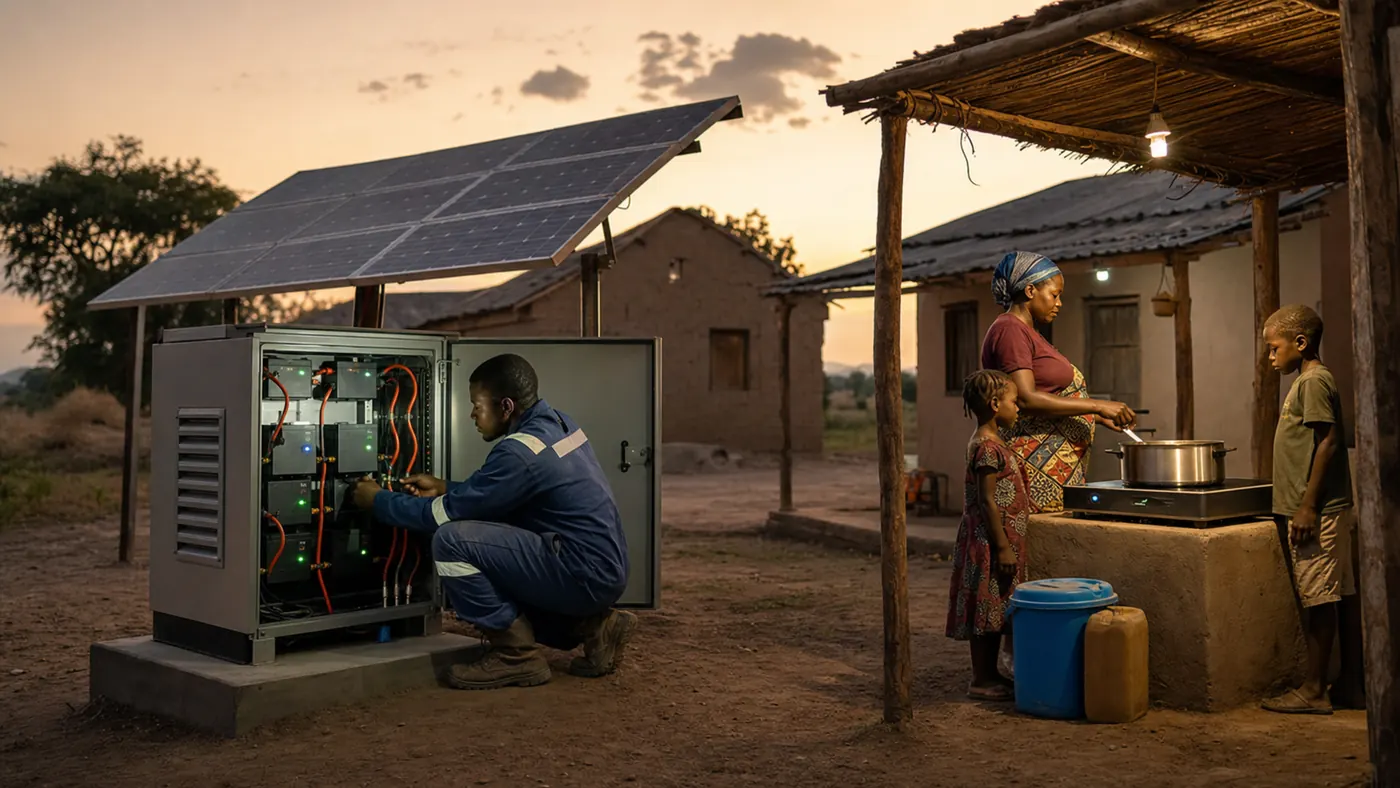
What is less visible is that the global energy transition has two speeds. In rich countries, the debate is often about grid congestion, heat pumps, industrial prices and climate goals. In poorer areas, the first question is whether a household can afford the connection, wiring, device and daily use. Off-grid solar, mini-grids, electric stoves, bio-ethanol and biogas can help, but only if the financing does not mainly end up as debt on countries and households that already have little margin.
Possible message behind the news
A possible message is that the energy transition is progressing worldwide. The sharper MOZOM lecture: the world can simultaneously produce more renewable electricity and still leave the poorest households behind if connections, cooking solutions and financing do not become affordable.
Neutral conclusion
The neutral conclusion: the Tracking SDG 7 report shows progress, but insufficient pace for universal access by 2030. The MOZOM conclusion: energy poverty will not disappear by counting capacity alone. The real test is whether electricity and clean cooking will become affordable, reliable and healthy for the people who still live in the dark or in smoke.