
MOZOM-analyse
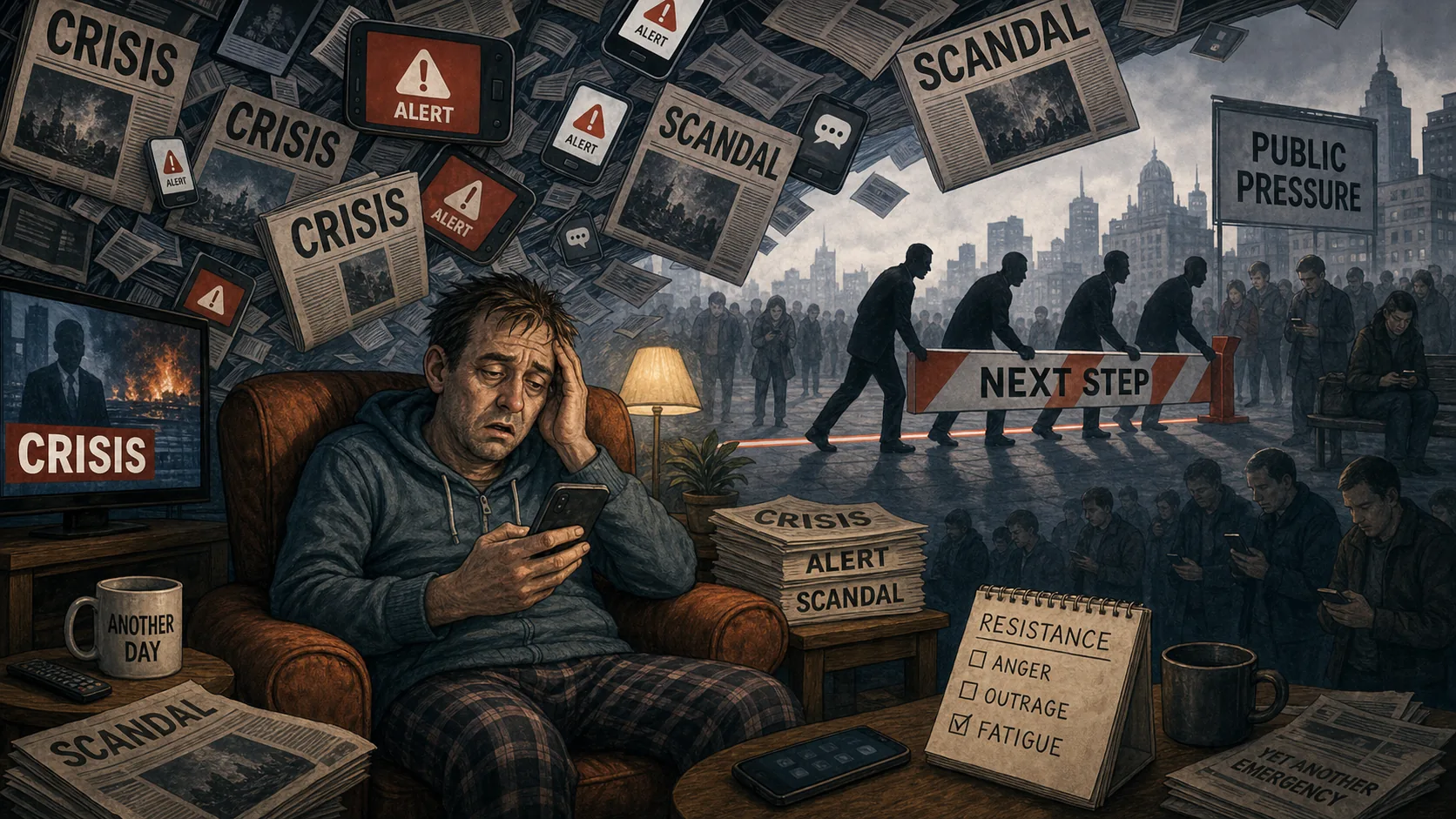
When news makes people numb: how permanent crisis weakens public resistance
- Source
- Reuters Institute, Pew Research Center, WHO Europe, RAND, National Affairs, PMC/NIH en APA
- MOZOM headline
- When news makes people numb: how permanent crisis weakens public resistance
- Original headline
- Research into news fatigue, crisis fatigue and the decline of public attention
- Author
- Paul Giezen
- Date
- 18 juli 2026 om 23:33
- Subject
- MOZOM analyzes how permanent crisis reporting, news fatigue, powerlessness and information overload can lead to less public resistance, without the need for proven intent every time.
Summary of the original report
Research into news avoidance, crisis fatigue, learned helplessness, propaganda and public attention points in the same direction. If people receive a lot of negative, urgent or contradictory information for a long time, they may first become indignant, then become powerless and ultimately drop out. Reuters Institute reports in its Digital News Report 2025 that 40 percent of news users surveyed sometimes or often avoid news, up from 29 percent in 2017. Pew Research Center reported in 2026 that 52 percent of Americans say they are exhausted by the amount of news and that 60 percent have reduced their overall news consumption at some point. That is no small side effect. It touches on democratic control: those who no longer watch, protest less, correct less and keep power less sharp.
Own source research
MOZOM has compared various research fields. In media studies it is called news avoidance or news fatigue. In psychology it touches on learned helplessness: when people repeatedly experience that they have no influence on a negative situation, they can become more passive. During corona, public health talked about pandemic fatigue: long-term threat and long-term behavioral pressure undermine motivation. In propaganda studies, RAND describes the firehose of falsehood model, in which a high flow of rapid and contradictory messages not only has to convince, but can also confuse and exhaust. In policy research, Downs' issue-attention cycle describes how public attention declines after a peak when solutions prove difficult, expensive or tiring. The striking thing is that these fields use different words, but have the same pattern: too much threat without grip leads to dropping out.
Striking in this mechanism
The classic idea is that citizens are mainly misled by too little information. But the opposite is also possible: too much loose information without organization can have the same effect. The citizen then no longer knows what is important, what is certain, what is exaggerated, what can be solved and who is responsible. This does not create resistance, but numbness.
Less visible context
That is dangerous for democracy. Democratic control requires not only the right to vote, but also attention, energy, trust and the feeling that action has meaning. If every problem is presented as a disaster and no problem appears visibly solvable, the citizen loses the perspective for action. A vicious circle can then arise: abuses receive attention, people get tired, attention fades, public pressure decreases, boundaries move further, and the next abuse feels like 'another crisis'.
Possible message behind the news
The visible message of much crisis news is: pay attention, this is serious. The MOZOM lecture is: if everything is constantly serious, ultimately nothing can really release political energy.
Neutral conclusion
The conclusion: this mechanism is newsworthy because it exposes a silent weakness in the public debate. Not only censorship, but also overload can damage democratic control. It is not journalistically pure to state that 'the evil ones' always consciously plan this. However, it is defensible to say that news fatigue, powerlessness and normalization can give space to parties that do not like much public opposition. The remedy is not less truth, but better ordered truth: separating fact from interpretation, identifying uncertainty, making patterns visible and giving citizens perspective for action.
Source:
- Reuters Institute: Digital News Report 2025
- Pew Research Center: Americans' Complicated Relationship With News
- WHO Europe: Pandemic fatigue
- RAND: The Russian Firehose of Falsehood Propaganda Model
- National Affairs: Anthony Downs, issue-attention cycle
- PMC/NIH: Learned Helplessness at Fifty
- APA: Media overload and headline stress