MOZOM-analyse
MOZOM analyses: AfD party day Erfurt, right of demonstration or media framing that needs conflict?
- Source
- Grundgesetz, Versammlungsgesetz, Tagesschau, n-tv, WELT en DIE ZEIT
- MOZOM headline
- MOZOM analyses: AfD party day Erfurt, right of demonstration or media framing that needs conflict?
- Original headline
- AfD party day in Erfurt amid protests, blockades and great media interest
- Author
- the MOZOM.nl editorial team
- Date
- 4 juli 2026 om 11:11
- Subject
- MOZOM investigates how the reporting around the AfD party day in Erfurt moves between the right to demonstrate, blockade tactics, police deployment, internal party power and possible media demonization dynamics.
Summary of the original report
The AfD will hold its Bundesparteitag in Erfurt on July 4, 2026, while opponents are putting pressure on access to the meeting with demonstrations and blockades. Tagesschau explains in FAQ form how far the Versammlungsfreiheit extends and where the limits lie. WELT follows blockades, police guidance and the start of the party day in a live blog. n-tv describes Erfurt as a city in a state of exception. DIE ZEIT shifts the focus to the internal question of power within the AfD, with Chrupalla, Weidel and the board election. The factual basis is that demonstrating is protected by constitutional law. The critical MOZOM question is whether the media structure surrounding such a day also turns the demonstration into a conflict setting: first explain legally where protest is possible, then use conflict images to negatively charge the party again.
Own source research
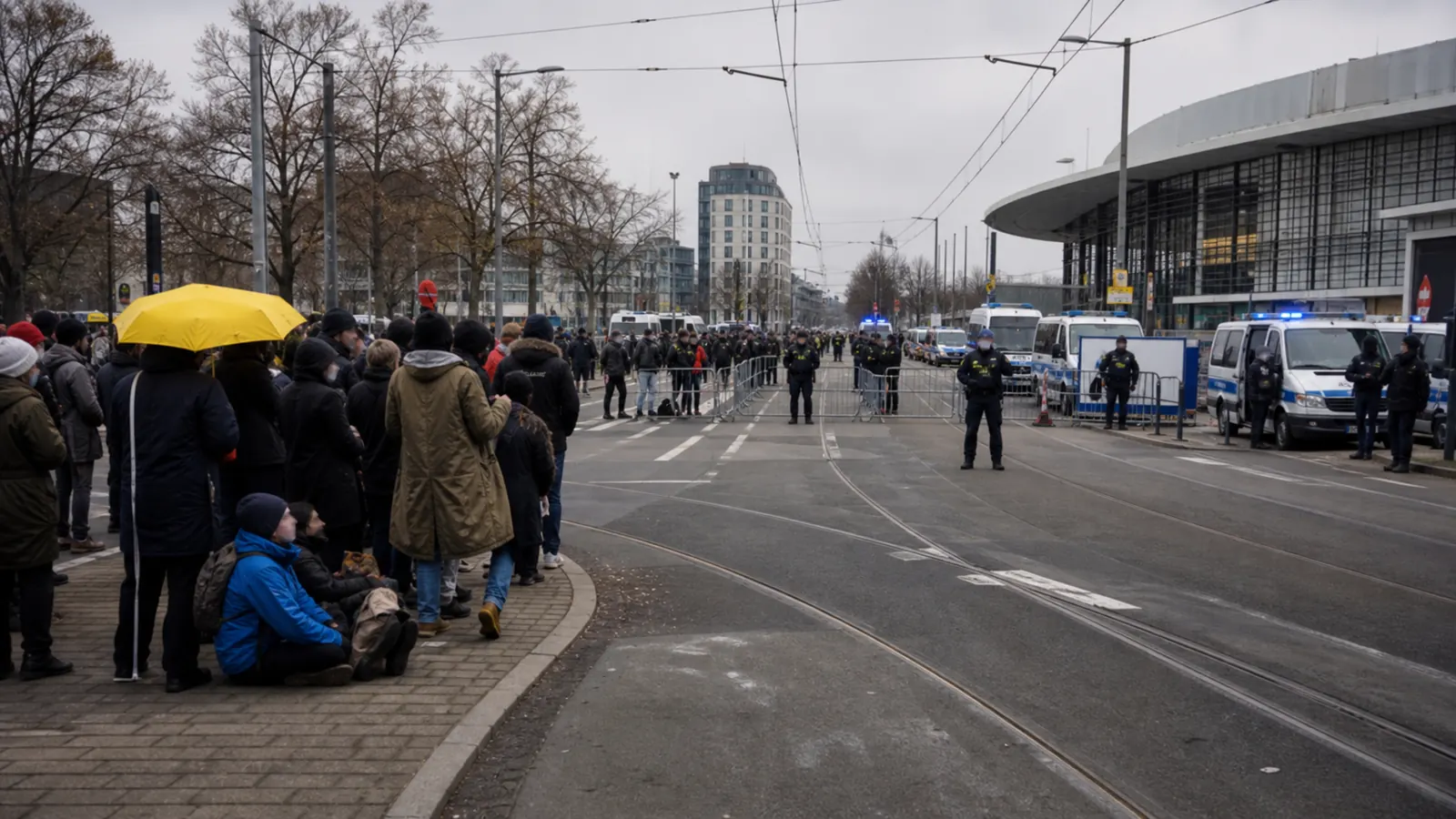
MOZOM has placed five layers next to each other. Layer one: the legal basis. Demonstrating is a fundamental German right, but peaceful and unarmed; blocking, hindering and public order are separate legal questions. Layer two: the FAQ layer. By answering questions about what demonstrators are allowed, Tagesschau makes legal boundaries visible. This can be explained journalistically, but it can also have a practical effect as normalization of presence and pressure. Layer three: the live layer. WELT and n-tv show how quickly such a day becomes an image machine: police, blockades, buses, entrances, delays. Layer four: the power layer. ZEIT shows that behind the protest there is also an ordinary party political day with leadership, candidates and internal relations. Layer five: the MOZOM layer. The question is not whether protest should be prohibited. The question is whether the media realize that they not only observe, but with their selection and tone also build the conflict format in which the AfD subsequently reappears as a social problem.
Striking in this message
It is striking how easily the word right to demonstrate takes on a moral glow when it is used against the AfD. The same right also applies to unpopular parties and their opponents. But as soon as the images mainly show blockades, police and angry crowds, the attention shifts away from the legal balance to the emotion of disruption. This can strengthen the demonization dynamic without an editor having to explicitly say: start demonstrating.
Less visible context
What is less visible is that a democracy must be able to tolerate two things at the same time: a controversial party that meets legally and citizens who demonstrate against it. Those who only glorify protest forget about access to party politics. Anyone who only condemns the nuisance forgets the right to demonstrate. The more subtle question lies with the media: do they use the law as a neutral explanation, or does the law become part of a dramaturgy in which the AfD is mainly shown as a permanent emergency?
Possible message behind the news
A possible message is that society democratically opposes extremes. The critical counter-reading is that media sometimes need such resistance as visual material for a previously known story.
Neutral conclusion
The neutral conclusion: the AfD party day in Erfurt brings together legal party politics, the right to demonstrate and public order. The more pointed MOZOM reading is that the media not only report on that collision, but also determine how she feels. An FAQ about the right to demonstrate is an explanation on paper. In a highly charged political context, the same explanation can also function as soft legitimization of pressure at a party meeting. Precisely for this reason, the question must remain: is democracy being protected here, or is conflict being organized in such a way that the next demonizing headline is already ready?
Source:
- Grundgesetz artikel 8: Versammlungsfreiheit
- Versammlungsgesetz paragraaf 14: aanmelding openbare vergadering
- Tagesschau: FAQ over Versammlungsfreiheit rond AfD-partijdag Erfurt
- Tagesschau: demonstraties rond AfD-partijdag in Erfurt
- n-tv: Erfurt vor AfD-Parteitag im Ausnahmezustand
- WELT: liveblog over AfD-Bundesparteitag Erfurt en blokkades
- DIE ZEIT: AfD-partijdag, Chrupalla, Weidel en bestuursverkiezing