
MOZOM-analyse
AfD at the top in polls: watchdog journalism or framing against a voter bloc?
- Source
- NOS, NU.nl, AD, Tagesschau, ZDF, Der Spiegel, Verfassungsschutz-context, Reuters, Wahlrecht en Politico Poll of Polls
- MOZOM headline
- AfD at the top in polls: watchdog journalism or framing against a voter bloc?
- Original headline
- AfD in media and polls: when does critical journalism become political delegitimization?
- Author
- the MOZOM.nl editorial team
- Date
- 26 juli 2026 om 09:35
- Subject
- MOZOM investigates whether the reporting on AfD is mainly ordinary watchdog journalism, or whether a voter bloc is politically delegitimized through repeated use of labels and security framing.
Summary of the original report
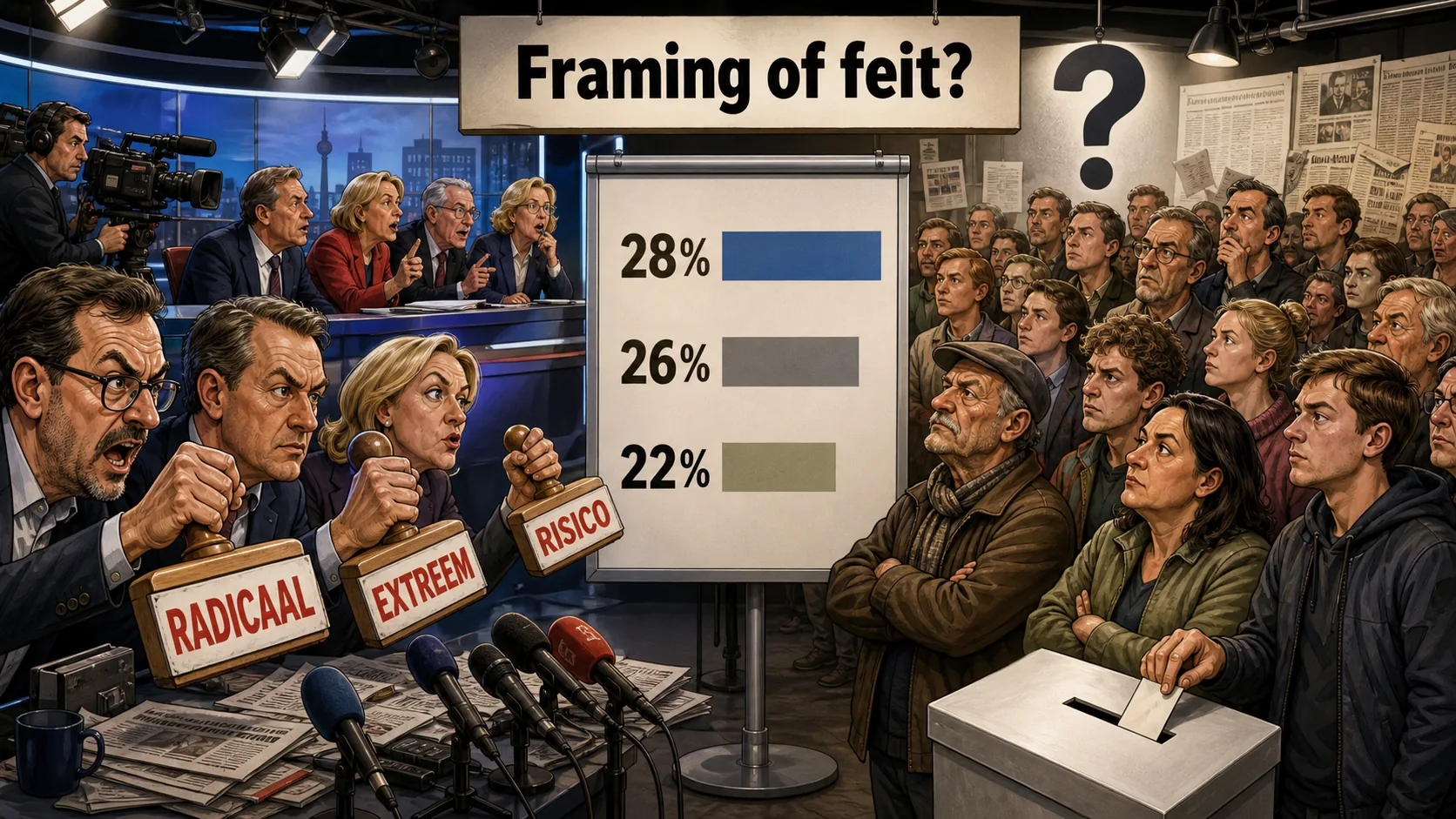
In German and Dutch mainstream media, AfD is much more than an ordinary opposition party. Reports regularly link the party to extremism research, democratic risks, the Brandmauer discussion, immigration conflict and the question of whether cooperation with AfD is politically acceptable. This approach has a factual basis: the German domestic security service gave the AfD a more severe classification in 2025, after which that classification was legally challenged and, according to Reuters, was temporarily not actively used as a fixed label pending the procedure. At the same time, polls show that AfD is moving around 26 to 29 percent, making it sometimes the largest or almost largest party. That is not a majority of the people, but it is a large voter bloc that cannot simply be dismissed as a peripheral phenomenon.
Own source research: label, poll and voter bloc
MOZOM has structured its reporting along three axes. First the labels: terms such as radical right, extreme right and democratic risk do not come from nowhere, but are often linked to Verfassungsschutz, legal proceedings, statements by AfD politicians and the German debate about the Brandmauer. Then the polls: overviews such as Wahlrecht and Politico show that AfD is around the top of German party politics. Depending on the pollster and measurement moment, the party is roughly in the high twenty percent, often next to or above CDU/CSU and well ahead of SPD, Greens and FDP. Thirdly, the democratic meaning: a party with about a quarter to almost a third of the voters is not 'the largest part of the people', but it is a powerful electoral signal. Precisely for this reason, the question is relevant whether media mainly inform, or also standardize which choice is socially acceptable.
From party to risk object
The striking frame is not that AfD is being followed critically. That's part of journalism. The striking thing is that AfD appears less often in many reports as an ordinary party with voters, program and position of power, and more often as a risk object: a test for democracy, a problem for coalition formation, a case study for security services. That frame can be justified when concrete facts give reason to do so. But if the frame becomes the default opening, the effect may be that the political choice of millions of voters is already morally pre-coded before the substantive discussion begins.
Poll profit is not an absolute popular will
The claim that AfD represents 'the will of the people' requires precision. If AfD is around 28 percent in polls, it could be the largest party or the largest political bloc. That does not mean that a majority of Germans support AfD. It does mean that a very large proportion of voters send a message that must be taken seriously by the media and political parties. Anyone who treats this solely as an extremism problem may miss the social causes: migration, purchasing power, trust in institutions, Ukraine policy, energy prices, security and dissatisfaction with established parties.
Possible message behind the news
The visible message of much mainstream reporting is: AfD is not an ordinary party but a risk to the democratic order. The counter-message from AfD and sympathizers is: established parties and media are trying to disrupt a growing voter bloc. The MOZOM reading is that both claims can only be assessed fairly if label use and poll reality are compared.
Neutral conclusion
The statement that there is a proven coordinated mainstream anti-AfD movement goes too far based on public sources. But the statement that AfD is structurally treated through a risk lens is defensible. That could be part watchdog journalism and part political standardization. Precisely because AfD is moving around the largest party in polls, the media question becomes sharper: when does journalism protect democracy, and when does it help to place a large block of voters socially and politically outside the normal discussion?
Source:
- NOS: Is de AfD rechts, radicaal-rechts of extreemrechts?
- NU.nl tagpagina AfD
- AD zoekresultaten AfD
- Tagesschau zoekresultaten AfD
- ZDFheute zoekresultaten AfD
- Der Spiegel zoekresultaten AfD
- Reuters: Duitse veiligheidsdienst classificeert AfD als extreemrechtse beweging
- Reuters: AfD meldt opschorting classificatie tijdens juridische procedure
- Wahlrecht.de: actuele Sonntagsfrage-overzichten
- Politico Europe Poll of Polls: Duitsland