
MOZOM-analyse
Google as gatekeeper: when search is no longer a neutral access to the internet
- Source
- Google, U.S. Department of Justice, Europese Commissie, EUR-Lex, PNAS, Nature, Freedom House en UNSW
- MOZOM headline
- Google as gatekeeper: when search is no longer a neutral access to the internet
- Original headline
- Analysis of search power, ranking, commerce, AI content and democratic visibility
- Author
- Ron Caroselli
- Date
- 19 juli 2026 om 10:20
- Subject
- MOZOM investigates why Google's role as a commercial gateway to information poses a democratic risk: not because every ranking choice proves malicious intent, but because visibility itself is power.
Summary of the original report
The open information order has shifted. In theory, anyone can publish. In practice, findability increasingly runs through a small group of gatekeepers: search engines, app stores, browsers, social platforms, cloud companies, payment providers and AI response systems. Google itself says that Search wants to show useful and reliable information and uses systems that take into account quality, authority, reputation, spam detection and low-quality content. Proponents call this necessary, because the web is full of spam, fraud, AI junk and deception. Critics see the same mechanism as concentration of power: when a commercial platform determines which sources are authoritative, a ranking is created in which some opinions are automatically given a platform and other opinions mainly fade into the background.
Own source research
MOZOM has placed five layers next to each other. Layer one: Google itself describes ranking and quality systems that aim to show useful, reliable and authoritative information and reduce low-quality content or spam. Layer two: the American case United States v. Google shows that search access is also a competition issue; the case started in 2020 under the first Trump administration, continued under Biden and entered a remedies phase in 2025 that focused on exclusive standard contracts, search data and competitive access. Layer three: the EU treats Alphabet/Google as a gatekeeper under the DMA and imposes systemic risk obligations on very large search engines under the DSA. Layer four: Research like the Search Engine Manipulation Effect shows why ranking is politically relevant: search results can influence preferences, especially when users perceive ranking as neutral. Layer five: the discussion surrounding the Dead Internet Theory has not been proven in hard conspiracy form, but the weak version is serious: bots, AI content, SEO machines and platform filters pollute the open web and make human, independent information less easy to find.
Striking in this debate
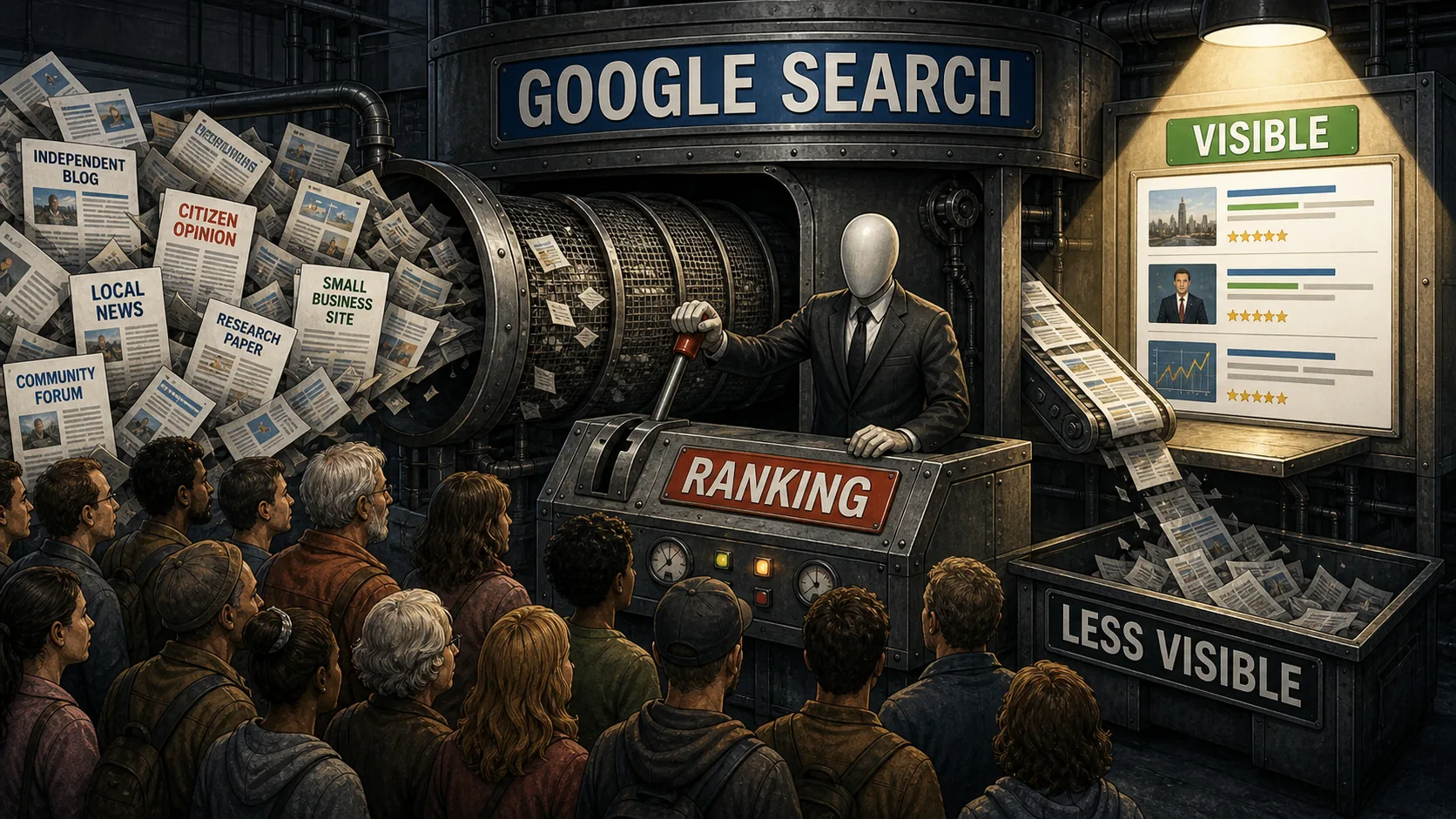
The word 'filtering' sounds technical and sensible. The word 'gatekeeper' sounds political. Yet they often describe the same process. A ranking filter decides which source is visible, which source drops further down and which source can only be found by those who search very specifically. So the discussion is not just about removal. The more modern power question is visibility.
Less visible context
Less visible is the commercial importance behind search. Google makes money not as a public information institution, but as an advertising company within a broader ecosystem of search traffic, browsers, Android, YouTube, ad networks and AI responses. This does not mean that every search result is consciously driven by profit or politics. It does mean that the infrastructure of public knowledge has become dependent on a private market party with its own business interests, its own risk assessments and its own reputational interests. When such a party simultaneously organizes information, sells advertisements, builds AI answers and is pressured by governments to limit risks, a powerful mix of commerce, policy and public opinion is created.
Possible message behind the news
Google's visible message is: we help users find reliable information. The critical MOZOM lecture is: whoever defines and commercially ranks reliable information simultaneously manages access to the public debate.
Neutral conclusion
The conclusion is not that Google has proven to consciously suppress every dissenting opinion. The harder, more defensible conclusion is that Google has become too powerful and too commercial to be seen as a neutral gateway to information. Democracy requires free expression of opinion, but free expression of opinion also requires visibility. When a commercial company controls the front door to public debate, democracy becomes dependent on an algorithm that citizens cannot control. That is not a small technical detail, but a question of power.
Source:
- Google Search Central: ranking systems
- Google Search Central: helpful, reliable, people-first content
- Google Search Quality Rater Guidelines
- Google Search Central: spam policies and scaled content abuse
- U.S. Department of Justice: Google search monopoly case, 2020 complaint
- U.S. Department of Justice: remedies in Google search monopoly case, 2025
- European Commission: DMA gatekeepers
- European Commission: DSA obligations for very large platforms and search engines
- EUR-Lex: Digital Services Act, Regulation (EU) 2022/2065
- PNAS: The search engine manipulation effect
- Nature: news exposure and engagement on Google Search
- Freedom House: Freedom on the Net 2025
- UNSW: Dead Internet Theory and an AI-filled web