
MOZOM-analyse
Slimming injections as a trend: medical breakthrough or new market for uncertainty?
- Source
- WHO, EMA, IGJ, Zorginstituut Nederland, RTL Nieuws en NOS
- MOZOM headline
- Slimming injections as a trend: medical breakthrough or new market for uncertainty?
- Original headline
- GLP-1 medicines such as Ozempic, Wegovy and Mounjaro are shifting from specialist obesity care to a mass-discussed weight-loss trend.
- Author
- Ron Caroselli
- Date
- 16 juli 2026 om 15:15
- Subject
- MOZOM investigates how GLP-1 weight loss drugs are turning from medical obesity treatment into a social trend, with online trading, reimbursement, healthcare costs, shortages and social pressure as key questions.
Summary of the original report
RTL Nieuws reported at the end of June 2026 that hundreds of thousands of Dutch people use or have used slimming drugs such as Ozempic, Wegovy or Mounjaro and that almost one in three users receives the drugs without their own doctor: online, illegally or via via. The Healthcare and Youth Inspectorate has been warning for some time that medicines ordered online can be dangerous: the origin, dosage, contamination and medical guidance are uncertain. At the same time, the World Health Organization sees GLP-1 agents as a serious treatment option for adults with obesity, within chronic obesity care and under medical supervision. The National Health Care Institute opts for a graduated approach when considering possible reimbursement: first looking at people with the highest disease burden. This means that the trend is at three crossroads simultaneously: medical breakthrough, commercial market and public healthcare bill.
Own source research
MOZOM places four layers next to each other. Tier one: medical. WHO calls obesity a chronic, recurring disease and sees GLP-1 therapy as a possible long-term treatment for adults with obesity, but not as a single panacea. Layer two: regulation. EMA and national regulators emphasize correct indication, prescription and availability; Previous shortages showed that high demand can affect healthcare. Layer three: Netherlands. When assessing the package, the Dutch Healthcare Institute first wants to look at patients with BMI from 30 with associated diseases and patients with severe or very severe obesity from BMI 35. Layer four: market behavior. RTL and IGJ show that part of the demand is outside the normal doctor-pharmacy route. It has therefore not only been proven that the substances are medically relevant, but also that social demand is growing faster than the regulated system can comfortably process.
Striking in this message
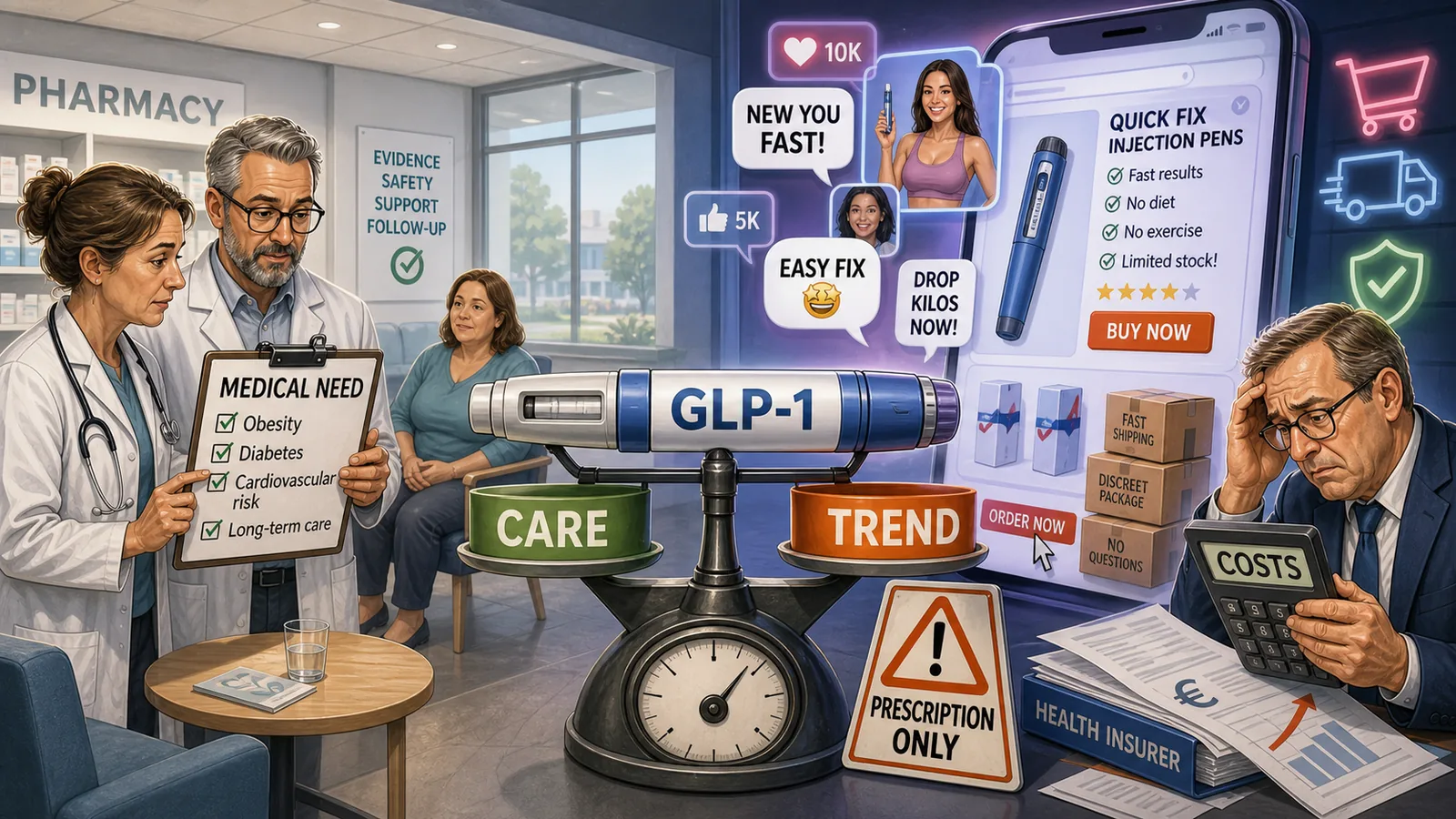
The word 'slimming shot' makes the drug small, fast and personal. It almost sounds like a cosmetic procedure. The medical language is different: GLP-1 therapy, obesity, BMI, comorbidities, chronic care, side effects and follow-up. The social shift lies between those two languages. Anyone who calls it a 'slimming shot' will see the trend and appearance more quickly. Those who call it 'obesity medication' are more likely to see disease and treatment. The market benefits from the first word; healthcare must pay for the second.
Less visible context
What is less visible is that these resources cause a clash between individual hopes and collective care choices. If someone loses 30 or 40 kilos and can exercise again, compensation sounds logical. If the same drugs are used en masse by people who mainly want to get slim faster, a different story emerges: shortages, medical risks, pressure on general practitioners, online trading and higher premiums. The question is therefore not only whether the resources work, but who gets them, who supervises, who earns and who ultimately pays.
Possible message behind the news
The commercial message is: losing weight quickly becomes attainable. The medical message is: obesity can sometimes be treated with medication, under supervision. The critical MOZOM lecture is: as soon as a treatment becomes a trend, a market is created that wants to grow faster than healthcare can safely regulate.
Neutral conclusion
The conclusion: slimming injections are newsworthy because they are no longer just a medical topic. They are at the same time treatment, hype, revenue model and healthcare policy choice. Those who only shout about kilos miss the risks of online trading and social pressure. Anyone who only warns ignores the real medical benefits for people with severe obesity. The real question is therefore: can the Netherlands use these resources to provide care for those who need them medically, without turning them into an expensive lifestyle market for uncertainty?
Source:
- RTL Nieuws: bijna 1 op 3 koopt afslankmedicatie online of illegaal
- RTL Nieuws: vergiftigingen en experimentele afslankmiddelen
- IGJ: online medicijnen kunnen gezondheid ernstig in gevaar brengen
- IGJ: snel een slanke lijn? Bestel geen medicijnen online
- WHO: GLP-1 guideline for treating obesity
- WHO Q&A: GLP-1 therapies for obesity
- EMA: EU actions on GLP-1 shortages
- Zorginstituut: obesitasmedicijnen eerst voor hoogste ziektelast