
MOZOM-analyse
Bangladesh first responders: road safety or the gap before the ambulance?
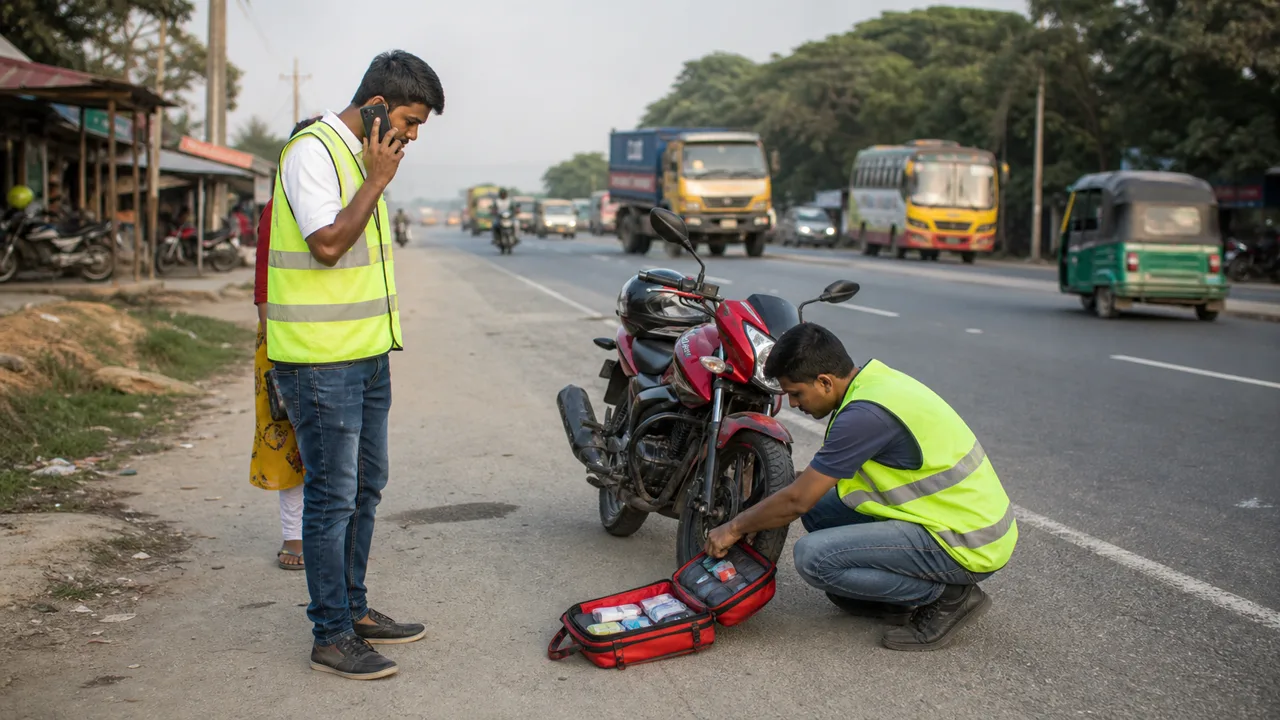
- Source
- WHO, WHO road traffic injuries fact sheet, GHSP/TraumaLink en UN Road Safety Fund
- MOZOM headline
- Bangladesh first responders: road safety or the gap before the ambulance?
- Original headline
- Community first-responders save lives on Bangladesh's roads
- Author
- Paul Giezen
- Date
- 9 juli 2026 om 21:09
- Subject
- MOZOM investigates why a WHO project with community first responders on highways in Bangladesh shows that road safety does not stop at helmets, speed and asphalt, but also revolves around the first minutes after a crash.
Summary of the original report
The World Health Organization describes a pilot project in Bangladesh in which the Directorate General of Health Services, with support from WHO, deployed community first responders along a busy stretch of national highway. The pilot started in 2023 on 10 kilometers of road and was expanded by another 30 kilometers in 2025. The system consists of a 24-hour emergency line, a call center and 120 trained volunteer first responders. The volunteers are locals, including shopkeepers, drivers, housewives and teachers, who live close to the road. According to WHO, all crash victims in the project received first aid within five to eight minutes. The broader road safety framework is large: WHO estimates that around 1.19 million people die from road accidents worldwide every year, with the heaviest burden in low- and middle-income countries.
Own source research
MOZOM compared the WHO pilot with global road safety data and the previous TraumaLink model. Our own finding is that the project should not be read separately as a sympathetic volunteer story. It is a response to a structural pre-hospital care gap: the care gap between crash and hospital. The calculation is simple but hard. With 1.19 million road deaths per year, this equates to an average of more than 3,200 deaths per day worldwide. If 92 percent of road deaths occur in low- and middle-income countries, there is not only a safety problem there but also a healthcare infrastructure problem. The Bangladesh pilot does not claim a solution for dangerous roads themselves, but for a moment when traffic policy often becomes invisible: the time before the ambulance, police or clinic functionally comes into the picture.
Striking in this message
It is striking that the word first responder in rich countries often immediately conjures up professional emergency services. In this WHO message it means local infrastructure: residents near the road, a telephone, a call center and training. That changes the framing of road safety. Safety is not only a better way or stricter law, but also the question of whether a community knows what to do and what not to do in the first minutes.
Less visible context
Less visible is that volunteer models have risks if they are poorly embedded. First aid can save lives, but requires training, legal protection, referral, data registration, connection to ambulance and hospitals, and clear boundaries. Otherwise, a structural shortage of professional emergency care is too easily placed on local residents. The strength of the Bangladesh model therefore lies not only in volunteers, but in the combination with an emergency line, call center, selection of road sections and WHO support.
Possible message behind the news
One possible message is that Bangladesh shows how local volunteers can save lives when formal emergency care is not fast enough. The sharper MOZOM lecture: the success also points to a weakness in many road safety policies, namely the invisible gap between crash and professional care.
Neutral conclusion
The neutral conclusion: WHO sees the Bangladesh pilot as a practical model for rapid first aid in road accidents. The MOZOM conclusion: community first responders can be important, but only if they are part of a broader chain with safer roads, emergency lines, ambulances, hospitals and protection for people who help.
Source:
- WHO: Community first-responders save lives on Bangladesh's roads
- WHO: Road traffic injuries fact sheet, 1 May 2026
- Global Health: Science and Practice: TraumaLink community-based first responder system
- UN Road Safety Fund: pledging forum and global road safety financing
- Asian Transport Observatory: Bangladesh road safety profile 2025