
MOZOM-analyse
If 'probably' already makes you guilty
- Source
- AP, The Guardian, NU.nl, Rzeczpospolita, Reuters, PAP en NATO
- MOZOM headline
- If 'probably' already makes you guilty
- Original headline
- Missile in Poland: how preliminary indications are already becoming public blame
- Author
- the editorial team
- Date
- 30 juli 2026 om 16:22
- Subject
- MOZOM investigates how probabilistic language surrounding missiles, drones and airspace violations in Poland can create public guilt before the forensic investigation is complete.
Summary of the original report
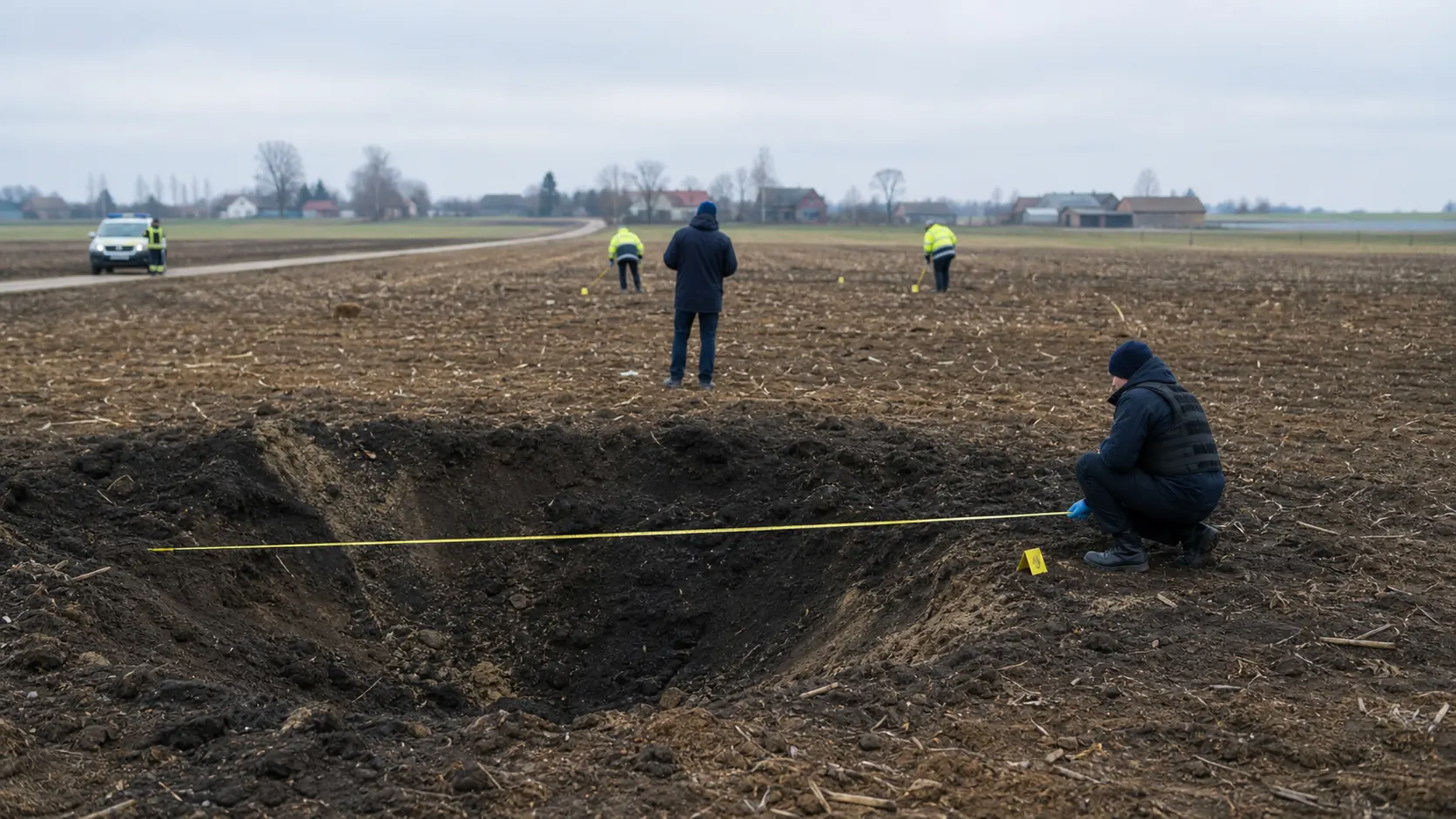
AP and The Guardian report that during a heavy Russian attack on Ukraine, an object entered Polish airspace and landed in agricultural areas. Polish sources report fragments pointing to a Russian Kh-101 cruise missile. Prime Minister Donald Tusk called the incident very serious, but also said there is no reason to think Poland was targeted. According to reports, Ukraine and the United States want to help with the investigation. The question for MOZOM is not whether Russia in a broader sense is responsible for the threat of war at the border. The question is narrower and more journalistic: how quickly does 'possibly Russian' turn into public certainty, and how visible is a later nuance still?
Own source research: three Polish moments side by side
MOZOM compared three moments. Przewodow, November 15, 2022: Two people were killed after an explosion in Poland. NATO said a day later that the preliminary analysis pointed to a Ukrainian air defense missile, not a deliberate Russian attack on NATO. Wyryki, September 2025: after Russian drone incursions, damage to a house was first read within that Russian threat frame; Rzeczpospolita later reported that according to sources a Polish AIM-120 AMRAAM from an F-16 had hit the house, and Minister Tomasz Siemoniak then said that everything pointed to this. Tarnawa-Kolonia, July 30, 2026: Polish and Ukrainian sources speak of indications for a Russian Kh-101, but the investigation into remains, radar image and exact route must provide the technical final layer. The pattern is not that Russia is always exonerated. The pattern is that the first frame often travels much faster than the technical reconstruction.
The frame extends in front of the report
Words like possible, suspected and likely seem cautious. In news consumption they often work differently. The reader does not scan a report, but remembers a combination of location, enemy image and urgency: rocket, Poland, Russia, NATO. If weeks later it turns out that the immediate cause was different or more complicated, that correction rarely comes with the same sirens. As a result, an initial suspicion can become a public reality before it has been forensically completed.
Why this is not an acquittal
This analysis does not absolve Russia of the war, the attacks on Ukraine or the danger it creates on the Polish border. She says something different: political responsibility is not the same as technical origin. A Russian attack could create a situation where a Ukrainian, Polish or Russian missile misfires. But if the media fix the direct question of guilt too early, later precision becomes almost an afterthought politically. Especially in war, the evidentiary threshold must be higher, because every word can have diplomatic, military and public consequences.
Possible message behind the news
The visible message of rapid reporting is: Russia is bringing the danger to NATO territory. The critical counter-question is: how do the media keep the direct technical blame question open without downplaying the broader threat of war?
Neutral conclusion
The damage has not been completely irreparably done, but the first frame is already underway. Therefore, the journalistic conclusion must remain narrow and strict: report the Russian threat of war, report the indications of a Kh-101, but do not treat 'probably Russian' as if it is already the same as a completed technical proof. In war, precision is not a luxury. It is the brake on public debt formation.
Source:
- AP: Poolse autoriteiten vinden fragmenten die op Russische Kh-101 wijzen
- The Guardian liveblog: Tusk over vroege aanwijzingen en onderzoek
- The Guardian: raketincident bij Tarnawa-Kolonia
- NU.nl: Oekraine en VS willen Polen helpen mogelijke Russische raket te onderzoeken
- Rzeczpospolita: Poolse raket trof volgens bronnen huis in Wyryki
- Reuters via Investing.com: minister zegt dat Poolse raket waarschijnlijk huis raakte
- PAP: Siemoniak over Wyryki en de Poolse raket
- NATO: persconferentie over Przewodow, 16 november 2022
- NATO: bondgenoten bespreken explosie in oostelijk Polen, 2022
- Russische VN-missie: tegenframe rond Poolse drone-incursie in 2025