MOZOM-analyse
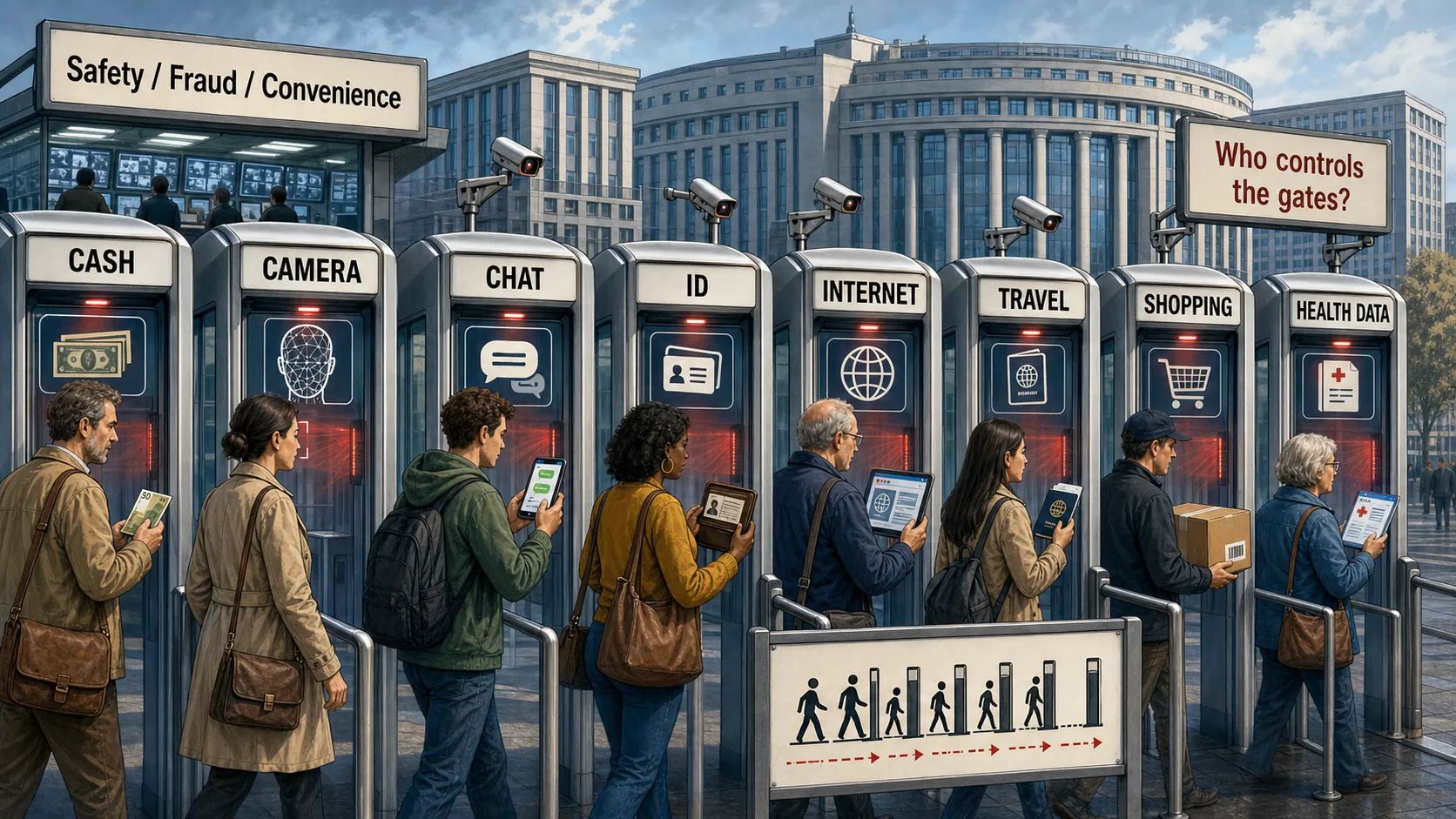
Cash, camera, chat and ID
- Source
- Europese Commissie, ECB, EUR-Lex, Raad van de EU, DSA-context, AI Act-context, EES/ETIAS, Prüm II, PNR, EHDS, AMLA, DAC7, CESOP en douanevoorstellen
- MOZOM headline
- Cash, camera, chat and ID
- Original headline
- The silent building blocks of a control society: when convenience, security and fraud control together form one network
- Author
- the editorial team
- Date
- 27 juli 2026 om 00:58
- Subject
- MOZOM investigates how EU measures regarding cash, digital identity, chat control, age verification, travel data, police data, parcels, health and digital euro can together form a network of gateways.
Summary of the original report
Europe is visibly building a series of digital and legal gateways. Money, travel, online identity, communication, health data, platform trading, import packages and product information are increasingly linked to registration, verification or automatic control. That proves no secret central plan to subjugate citizens. But it does make it visible that more and more normal actions first pass a checkpoint. The critical question is therefore not only whether each measure individually sounds reasonable, but who will monitor the coherence.
Own source research: the sum in short lines
The most important building blocks can be briefly summarized. Cash: EU-wide limit of EUR 10,000 and customer due diligence on certain cash transactions. Digital euro: public digital money in addition to cash, but possibly much more traceable than cash. New banknotes: official proof that cash is here to stay, but cash use is at the same time more strongly regulated. Digital ID: European wallet for identification with government, banks and digital services. Age verification: Online access may increasingly require proof of age. Chat Control: Scanning against child abuse material can normalize a scanning infrastructure. DSA: platforms must limit systemic risks and therefore moderate or demote more quickly. AI Act: biometric identification is limited, but has security exceptions. EES and ETIAS: travel becomes biometric and database driven. PNR: flight data is used for risk analysis. Prüm II: police data, facial images and vehicle data become easier to search across borders. EHDS: medical data is shared more easily for healthcare, policy and research. DAC7 and CESOP: platform revenues and cross-border payments become more visible to tax authorities. Customs reform: parcels from outside the EU become more expensive, better registered and more strictly controlled. Digital product passport: products receive a verifiable data layer. CBAM: import is linked to CO2 reporting. The pattern is not one ban, but a network of gates.
Security, fraud and convenience as key words
Almost every measure comes with a positive label: protection of children, fight against fraud, security at the border, fair tax, consumer protection, better care, climate policy or convenience. That makes criticism difficult, because no one wants to appear in favor of money laundering, abuse or insecurity. But that is precisely why journalism must ask the second question: what authority is built up, what data is collected, who gets access and can the measure be expanded later?
Why the three-euro discussion is appropriate
The announced levy or handling costs for packages from outside the EU are officially linked to customs control, product safety and fair competition with European stores. Yet the effect is also behavioral control. Buying outside the EU will become more expensive, more heavily registered and less attractive. This is not personal surveillance such as facial recognition, but economic control: money and consumption are pushed towards the regulated European market. This also fits in with the broader development in which access to the market, payment and product is increasingly via European rules and data sources.
Possible message behind the news
The visible message of policy is: we make Europe safer, fairer and more modern. The critical counter-message is: more and more normal actions are given a digital gatekeeper. The MOZOM lecture is that the sum of journalism is more important than each individual press release.
Neutral conclusion
Cash, camera, chat and ID are no longer separate topics. Together with travel data, health data, parcel checks, platform rules, digital euro and product passports, they form a growing infrastructure of gateways. That is not automatically a dictatorship nor is it a proven secret plan. But it is a controllable administrative movement: more and more daily actions are becoming measurable, linkable and controllable. The modern control society is not created because everything is banned, but because more and more normal actions must first pass through a digital gate.
Source:
- Europese Commissie: European Digital Identity Wallet
- Europese Commissie: age verification approach
- ECB: digitale euro FAQ
- ECB: nieuwe eurobankbiljetten
- EUR-Lex: AML Regulation 2024/1624
- Raad van de EU: strengere antiwitwasregels en cashlimiet
- Europese Commissie: Digital Services Act
- AI Act: verboden en uitzonderingen rond biometrische identificatie
- EU Entry/Exit System
- Europese Commissie: ETIAS
- Europese Commissie: Passenger Name Record data
- EUR-Lex: Prüm II politiedata-uitwisseling
- Europese Commissie: European Health Data Space
- Europese Commissie: digital product passport
- Europese Commissie: VAT in the Digital Age
- Europese Commissie: CESOP betaalrapportage
- Europese Commissie: DAC7 platformrapportage
- Europese Commissie: douanehervorming e-commerce
- Europese Commissie: Carbon Border Adjustment Mechanism