
MOZOM-analyse
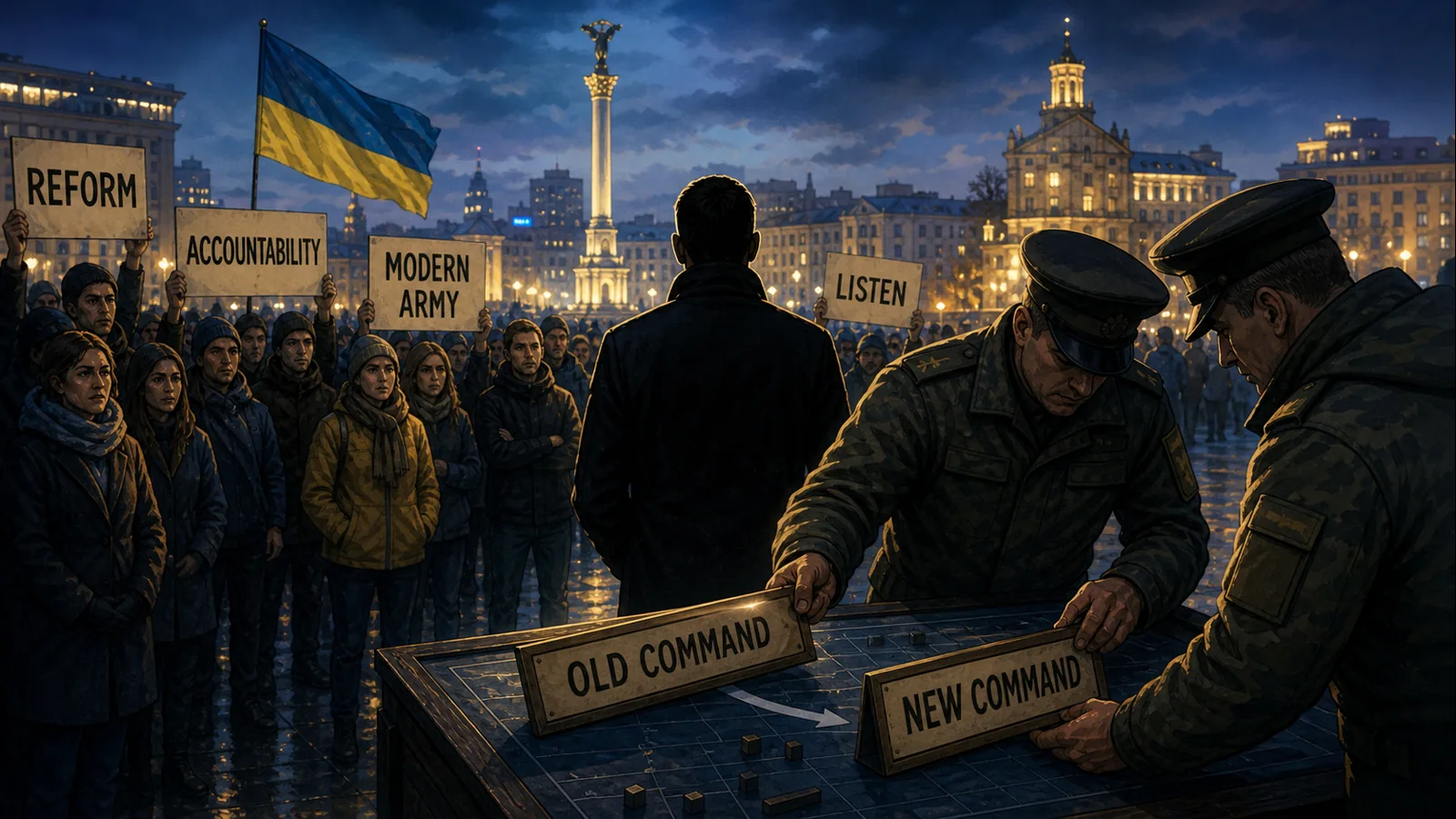
Zelenskyy replaces Syrskyi: military reform or bow to protest pressure?
- Source
- NU.nl, Tagesschau, AP, Reuters, Kyiv Independent, Ukrainska Pravda, Euromaidan Press en Voennoe Delo
- MOZOM headline
- Zelenskyy replaces Syrskyi: military reform or bow to protest pressure?
- Original headline
- Zelenskyy replaces Ukrainian commander-in-chief Oleksandr Syrskyi with Mykhailo Drapatyi after days of protest over Fedorov, Syrskyi and army reform
- Author
- the MOZOM.nl editorial team
- Date
- 21 juli 2026 om 23:30
- Subject
- MOZOM investigates whether the replacement of Syrskyi by Drapatyi is primarily a military reform, or also a visible response to the recent Ukrainian protests around Fedorov and the war summit.
Summary of the original report
Ukrainian President Volodymyr Zelenskyy has replaced Commander-in-Chief Oleksandr Syrskyi with Mykhailo Drapatyi. Officially, the appointment fits in with a broader reorganization of the war leadership and in the search for a more modern army. But the change comes immediately after protests surrounding the resignation or shift in power of Mykhailo Fedorov, with demonstrators not only wanting Fedorov back, but also Syrskyi gone. This means that this is no ordinary military appointment. The question is whether Zelenskyy is only renewing the command structure, or at the same time trying to release the street pressure before it develops into broader criticism of his war policy.
Own source research
MOZOM places this follow-up next to the previous article about the protests from July 16 to 19, 2026. At that time, the core question was still the cause of the protests: only Fedorov, or broader mistrust around Syrskyi and the war summit? The new appointment changes that question. One of the visible demands from Ukrainian reporting, Syrskyi gone, has now been implemented. That is why the article is not a duplicate of the protest analysis, but a next step: what happens when a protest demand is visibly reflected in personnel policy during wartime? The sources were examined at four levels: international news media, German and Dutch transfers, Ukrainian media close to the protests and pro-Russia interpretation. This combination does not show evidence for a simple cause, but it does show a clear pattern: the war leadership responds not only to the front, but also to domestic legitimacy.
From personnel issue to confidence meter
Anyone who writes that Zelenskyy is replacing a commander-in-chief is telling the fact. Anyone who mentions that Syrskyi's departure a few days earlier was a protest demand tells the political meaning. The framing then shifts from army reform to legitimacy: does power listen to civilians and soldiers, or does it try to massage away pressure without resolving the real conflict about war culture?
Less visible context
Less visible in short messages is that Ukrainian criticism of its own army leadership in wartime almost always has double effect. For Ukrainian citizens, criticism can mean: improve warfare, protect soldiers better, modernize faster. For Russia, the same criticism could be useful as a narrative that Kyiv is internally divided. That makes reporting difficult, but not impossible. That is precisely why distinction between sources is important: the protest demand itself is visible; the claim that Zelenskyy acted solely through street pressure has not been solidly proven; the propaganda value for Moscow is also visible.
Possible message behind the news
The visible message is: Zelenskyy is renewing the military leadership. The critical MOZOM lecture is: this innovation comes exactly at the time when the streets are demanding that the old command culture be broken.
Neutral conclusion
The conclusion: the replacement of Syrskyi by Drapatyi is newsworthy because it visibly affects a protest demand. That does not automatically mean that Zelenskyy will capitulate to the streets, nor that Ukraine will collapse. It does mean that the war summit in Kyiv must take domestic legitimacy into account. If Drapatyi inspires confidence and Fedorov's new role is credibly fulfilled, the pressure may temporarily decrease. If the change turns out to be mainly cosmetic, the same wave of protest may return with a broader question: who is leading this war, and is that leadership still listening?
Source:
- NU.nl: Zelensky vervangt Oekraiense opperbevelhebber
- Tagesschau: Syrskyj entlassen, Drapatyj volgt hem op
- AP: Zelenskyy replaces Ukraine's army chief after protests
- Reuters: Oekraiense legerleiding en protestdruk rond Fedorov
- Kyiv Independent: Zelensky weegt Syrskyi's ontslag terwijl protesten doorgaan
- Ukrainska Pravda: Oekraiense berichten over protest en legerleiding
- Euromaidan Press: Zelenskyy dismisses Ukraine's commander-in-chief
- Voennoe Delo: Ruslandgezinde lezing van protesten en kabinetscrisis