MOZOM-analyse
Wir schaffen das?
- Source
- Bundesregierung, Bundesamt fuer Verfassungsschutz, Tagesschau, ZDFheute, Bundesanwaltschaft, BKA-context en Duitse rechtbankverslaggeving
- MOZOM headline
- Wir schaffen das?
- Original headline
- Ten years before and ten years after Merkel's sentence: what does the German attack chronology show?
- Author
- the editorial team
- Date
- 27 juli 2026 om 13:20
- Subject
- MOZOM compares Islamist-motivated attacks and serious plans in Germany ten years before and ten years after August 31, 2015, the day on which Angela Merkel uttered her well-known sentence Wir schaffen das.
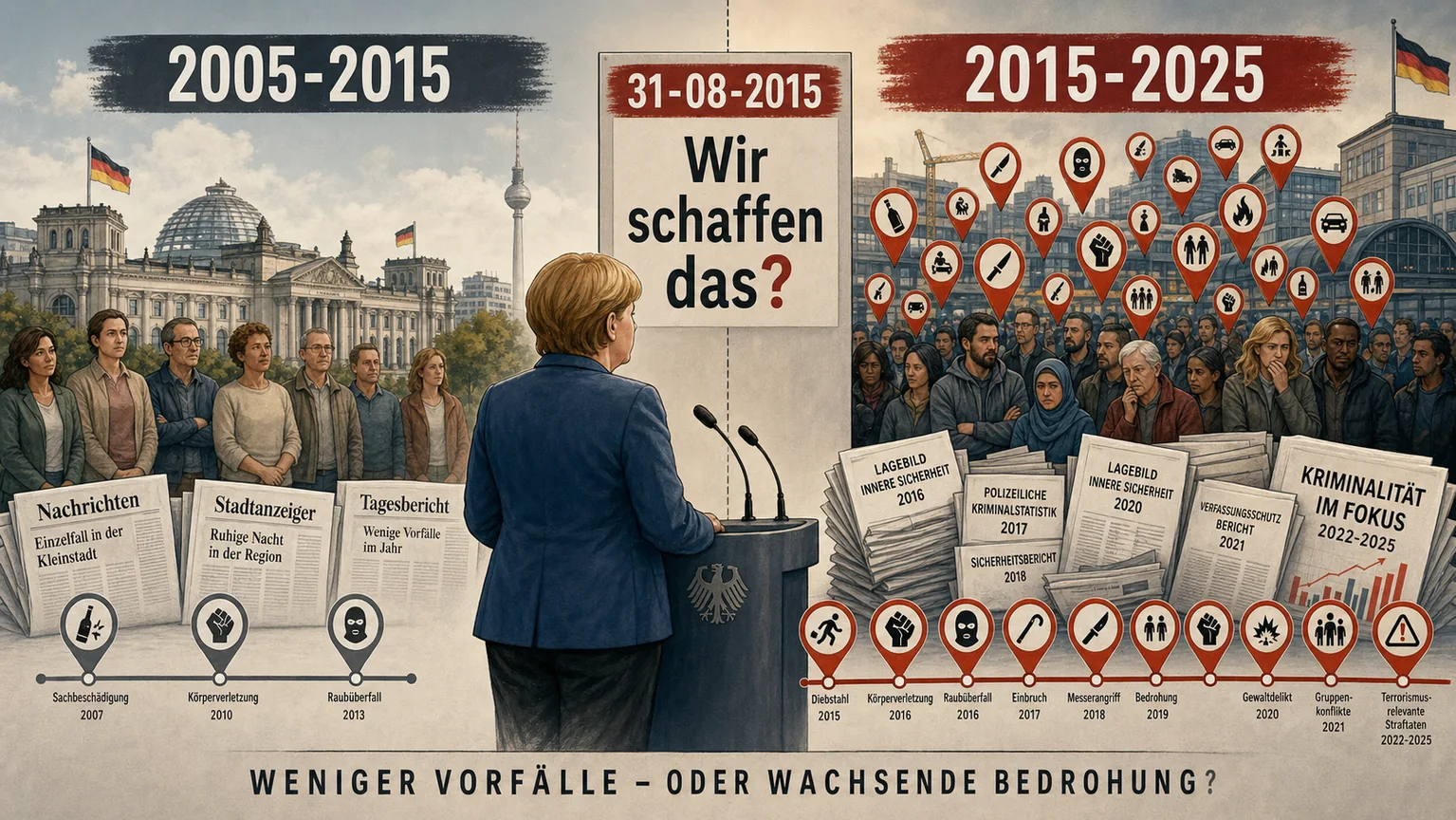
Timeline in proportion: 3 red attack cases + 2 green foiled plans versus 14 red + 5 green after 2015
The list distinguishes between carried out or failed attack cases and plans that were foiled beforehand. Red marks carried out or socially visible attack/violence incidents; green marks foiled plans. The colour is a visual interpretation of the pattern, not proof that one sentence or policy moment directly caused every later case.
Ten years before Wir schaffen das: 3 attack cases + 2 foiled plans
- 2006 Cologne: suitcase bombs on regional trains; the explosions failed.
- 2011 Frankfurt Airport: fatal shooting of US soldiers.
- 2012 Bonn central station: placed bomb that did not explode.
- 2007 Sauerland Group: foiled plans for attacks.
- 2013 Pro NRW context: foiled plan according to German reporting.
Ten years after Wir schaffen das: 14 red + 5 green foiled plans/selection
- 2016 Hanover: serious incident in German security chronologies.
- 2016 Essen: violent incident described in an Islamist context.
- 2016 Wuerzburg: attack on a regional train.
- 2016 Ansbach: bombing near a festival site.
- 2016 Berlin Christmas market: truck attack on Breitscheidplatz.
- 2017 Hamburg: fatal knife attack in a supermarket.
- 2020 Waldkraiburg: violent incidents described in an Islamist context.
- 2020 Dresden: fatal knife attack, later described as Islamist-motivated.
- 2021 Bavaria: ICE knife attack, investigated as extremist-motivated.
- 2023 Duisburg: attack in a gym and later legal assessment.
- 2024 Mannheim: knife attack that sharpened the security debate again.
- 2024 Solingen: deadly attack during a city festival.
- 2025 Munich: serious incident in German chronologies.
- 2025 Berlin: serious incident near the Holocaust memorial.
- 2016 Chemnitz/al-Bakr: foiled plan for an Islamist-motivated bombing.
- 2023 Castrop-Rauxel: foiled suspected poison/bioweapon plan with Islamist suspicion.
- 2023 Hamburg/Kempten: foiled plan for an explosives attack according to BKA and prosecutors.
- 2023 Cologne Cathedral: foiled or averted threat around a possible attack plan.
- 2024 Bernau/Berlin: foiled plan for an attack on the Israeli embassy.
Summary of the original report
A comparison of the period August 31, 2005 to August 30, 2015 with the period August 31, 2015 to August 31, 2025 shows a clear shift. Strictly counting only Islamist-motivated attacks with victims, the period before Wir schaffen das resulted in a fatal attack: Frankfurt Airport in 2011. In the ten years that followed, German media and security chronologies show approximately fourteen attacks or attacks that were described or investigated as Islamist-motivated. If you also include failed, thwarted or serious preparation cases, this amounts to approximately five to six cases before the zero date and approximately eighteen to twenty after the zero date. That does not prove a simple cause-and-effect relationship, but it does make the safety question journalistically legitimate.
Own count for Germany: before and after the zero date
For the ten years before August 31, 2015, German chronologies include: the suitcase bombs in regional trains near Koeln in 2006, the Sauerland-Gruppe in 2007, the fatal shooting at Frankfurt Airport in 2011, the bomb in Bonn Hauptbahnhof in 2012 and a foiled plan involving Pro NRW in 2013. Strictly executed with victims counted, mainly Frankfurt Airport 2011 remains for the zero date. For the ten years after August 31, 2015, chronologies include Hanover, Essen, Wuerzburg, Ansbach and Berlin in 2016, Hamburg in 2017, Waldkraiburg and Dresden in 2020, the ICE attack in Bavaria in 2021, Duisburg in 2023, Mannheim and Solingen in 2024, and Munich and Berlin in 2025. Depending on the definition used, this results in approximately 1 versus 14 attacks with victims, or more broadly approximately 5 to 6 versus 18 to 20 serious cases, including thwarted and failed plans. After 2015 there were also foiled plans, including Chemnitz/al-Bakr 2016, Castrop-Rauxel 2023, Hamburg/Kempten 2023, the Cologne Cathedral threat in 2023 and Bernau/Berlin 2024 around the Israeli embassy. MOZOM counts that green category separately, because a foiled plan does not have the same social impact as a carried out attack.
What the zero date does and does not say
The sentence Wir schaffen das is symbolically powerful, but not a legal piece of evidence. It marks a political moment, not an automatic cause. Yet a zero date can help to reveal a pattern. Anyone who only says that every attack is independent of policy may be missing the system question. Anyone who says that the sentence itself caused the attacks goes further than the public sources bear. The journalistically safe conclusion lies in between: after 2015, Germany was demonstrably confronted with Islamist-motivated incidents of violence more often, and this requires an honest debate about policy, security and integration.
Not the Muslim, but extremist networks
A careful analysis must be explicit: most Muslims in Germany and Europe are not extremists, live peacefully, work, study, build families and are part of society. Precisely for this reason it is important to clearly distinguish extremist Islamist ideology from ordinary religious identity. The problem is not that someone is Muslim. The problem arises when a small radical minority legitimizes violence, recruits young people, uses online propaganda or abuses existing residence and integration systems. That distinction protects both society and the many Muslims who have nothing to do with extremism.
Possible message behind the news
The visible message of Wir schaffen das was administrative optimism and moral duty. The critical counter-question ten years later is whether a society had, in addition to reception, also sufficiently organized borders, screening, integration and protection against radicalization.
Neutral conclusion
Wir schaffen das? is newsworthy because, ten years later, the question is no longer only moral but also administrative and security-related. The count before and after 31 August 2015 does not prove a simple question of blame. It does show that after 2015 Germany faced a much denser pattern of Islamist-motivated attacks. An honest debate protects citizens against extremism and also protects peaceful Muslims against collective suspicion.
Source:
- Bundesregierung: Sommerpressekonferenz Angela Merkel, 31 augustus 2015
- Bundesamt fuer Verfassungsschutz: Zahlen und Fakten islamistischer Terrorismus
- Tagesschau: Chronik islamistischer Terror in Deutschland
- ZDFheute: Chronologie islamistischer Anschlaege in Deutschland
- Tagesschau: Kofferbomber Koeln
- Tagesschau: Prozess zur Bonner Bombe
- Bundesanwaltschaft: informatie over terrorismezaken
- Bundeszentrale fuer politische Bildung: Islamismus en jihadistische dreiging
- BKA: Festnahme wegen geplantem Sprengstoffanschlag, Hamburg/Kempten 2023
- Tagesschau: Anti-Terror-Einsatz Castrop-Rauxel 2023
- Tagesschau: Anschlagsplan op de Israelische ambassade in Berlijn, Bernau 2024
- Deutschlandfunk: Al-Bakr bereidde volgens Bundesanwaltschaft concreet een aanslag voor
- ZEIT: Hinweise op een mogelijk aanslagplan op de Keulse Dom 2023