
MOZOM-analyse
MOZOM analyzes: Gaza aid restrictions, Kerem Shalom and UN 2720, access or false control?
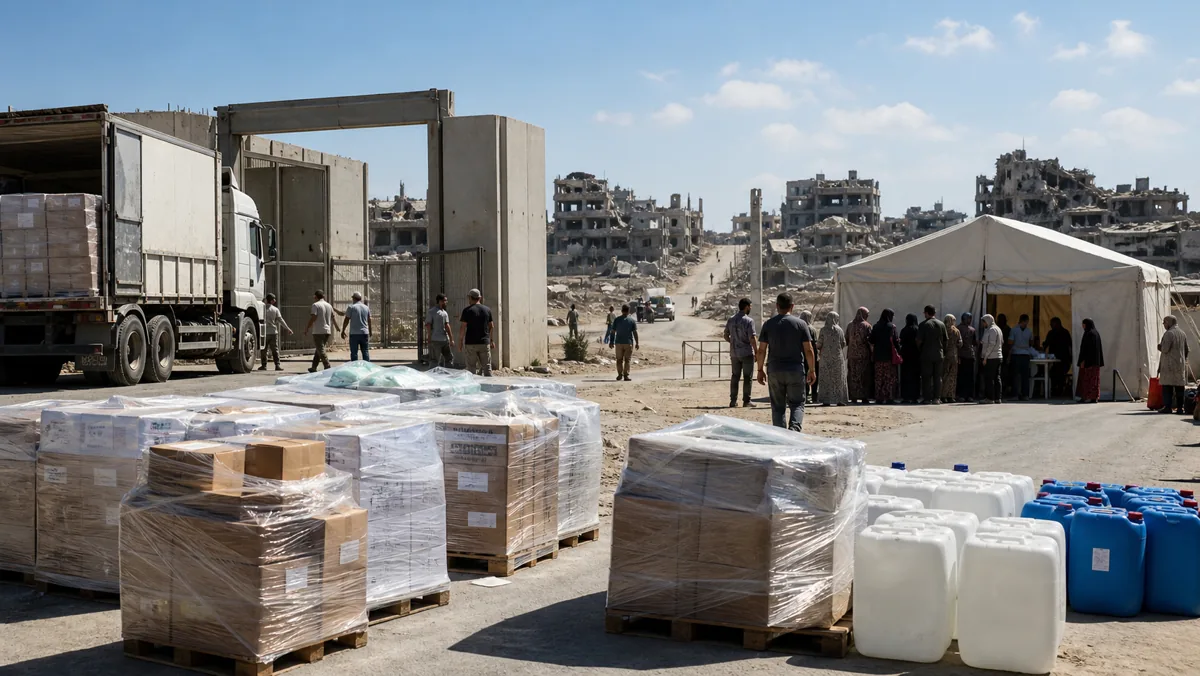
- Source
- UN News, OCHA oPt, UN 2720 Mechanism en COGAT/Israelische hulpdata
- MOZOM headline
- MOZOM analyzes: Gaza aid restrictions, Kerem Shalom and UN 2720, access or false control?
- Original headline
- Occupied Palestinian Territory: Aid restrictions in Gaza, 'senseless' infant deaths in the West Bank
- Author
- Paul Giezen
- Date
- 7 juli 2026 om 02:56
- Subject
- MOZOM investigates why the UN report on Gaza aid restrictions is not just about trucks, but about the difference between approved aid, offloading at Kerem Shalom, actual distribution and medical access for civilians.
Summary of the original report
UN News reported on July 6, 2026 that aid in Gaza is once again being slowed down by closed border crossings and restrictions on specific goods. According to UN spokesperson Stephane Dujarric, UN teams were able to collect food and fuel from Kerem Shalom over the weekend, but all other cargo crossings remain closed and certain supplies are restricted. According to UN News, the UN 2720 Mechanism data shows that the total volume of aid delivered fell to less than 42,000 pallets in June, down from around 46,600 in May. Even more important is the difference between approval and practical passage: last week only 42 percent of supplies from Egypt and 65 percent of supplies via Ashdod could be unloaded at Kerem Shalom, even though they had already been approved in principle. OCHA's July 3 report makes the consequences more concrete: nearly 9,300 chickenpox cases in two weeks, more than 1,600 active displacement sites with approximately 1.7 million people, only 34 percent site management coverage, and 45 to 50 percent of dialysis machines in Al Shifa out of use due to sodium bicarbonate shortage. In the West Bank, OCHA also reported that Israeli forces shot dead a 16-year-old at Qalandiya, while OHCHR reported that a four-month-old baby died after a locked gate delayed access to medical care.
Own source research
MOZOM has placed four layers next to each other. Layer one is the current UN News report: lower aid volume in June and low offload rates at Kerem Shalom for supplies from Egypt and Ashdod. Layer two is the 2720 mechanism: that system should make assistance visible from request to authentication, but the existence of tracking does not automatically resolve access. Layer three is OCHA's health and WASH layer: chickenpox, waste, displacement sites and dialysis problems show that logistical delays turn directly into public health. Tier four is the West Bank: the deaths of children at checkpoints or closed access shows that humanitarian access is not just about Gaza crossings, but also about freedom of movement to medical care. MOZOM's own layer is that 'approved help' and 'achieved help' are two different SEO and policy questions.
Striking in this message
It is striking that the word approved in this file sounds almost reassuring. But UN News uses the problem that goods had already been approved in principle and could still only be partially unloaded. This shifts the story from consent to feasibility. The political question becomes not only whether aid is allowed, but whether the system works fast enough, broadly enough and predictably enough to limit civilian damage.
Less visible context
What is less visible is that a humanitarian chain consists of many links: registration, inspection, corridor, offloading, storage, local security, fuel, transport, distribution and medical or nutritional prioritization. Each link can fail while another party can still say that help is formally permitted. This makes Gaza information difficult: the same shipment can appear as approved in a dashboard, get stuck at a crossing and still be missing from a clinic.
Possible message behind the news
A possible message is that humanitarian access does not end with permission on paper. The sharper reading: if aid is in a system but does not reach citizens quickly enough, administration becomes a false form of control.
Neutral conclusion
The neutral conclusion: UN sources report that aid in Gaza declined in June and that approved supplies could only be partially unloaded, while OCHA simultaneously reports serious health and access signals. The MOZOM lecture: this news is less about counting pallets than about the question of who decides when help has really arrived.