
MOZOM-analyse
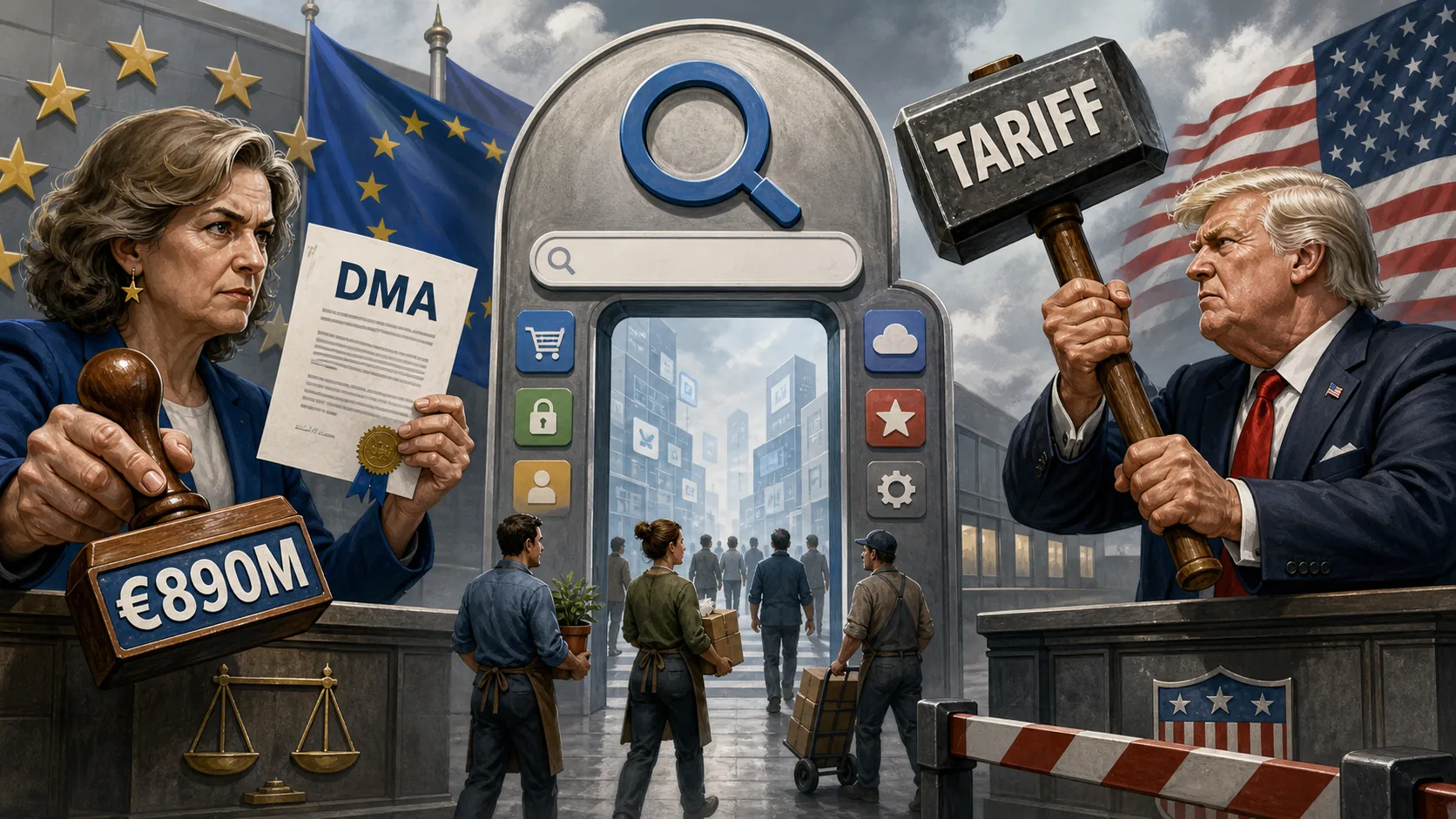
Google fine becomes trade weapon: is America protecting Big Tech from Europe?
- Source
- Europese Commissie, AP, Al Jazeera, Euronews, Le Monde en USTR-context
- MOZOM headline
- Google fine becomes trade weapon: is America protecting Big Tech from Europe?
- Original headline
- After EU fine for Google, Trump threatens countermeasures: digital rules become trade policy
- Author
- Ron Caroselli
- Date
- 25 juli 2026 om 22:40
- Subject
- MOZOM investigates how a European fine of 890 million euros for Google under the Digital Markets Act turns into a trade conflict between the United States and the European Union.
Summary of the original report
The European Commission announced on July 23, 2026 that Google will be fined 890 million euros for violations of the Digital Markets Act. According to the Commission, Google favored its own services in Google Search and limited app developers' ability to direct users to cheaper offers outside Google's own system. Google disputes that reading and states, according to international reports, that European rules can harm innovation and user experience. Then came the second layer: Trump threatened that the EU would pay a large price and linked the fine to broader American criticism of digital rules for American tech companies. This makes Google not only the subject of supervision, but the use of commercial power.
Own source research: fine, gatekeeper and tariff threat
MOZOM has placed three lines next to each other. Line one is legal: the Digital Markets Act gives the European Commission powers to oblige major digital gatekeepers to provide fairer access, less self-benefit and more choices for business users and consumers. Line two is economic: Google Search, app distribution, advertising and payment routes are no longer ordinary services, but gateways to customer flows. Line three is geopolitical: as soon as an American president responds to European enforcement with the threat of trade measures, it becomes clear that Big Tech is not only seen as a company, but also as a power project. That makes this message stronger than a normal fine case.
From fine to commercial weapon
The word fine sounds administrative: a supervisor detects a violation and imposes an amount. The word tariff sounds geopolitical: a state uses trade power to exert pressure. It is precisely that shift that is striking. If every stiff European fine against an American tech company can be translated into an American trade threat, a new question arises: can Europe still regulate Big Tech independently, or will every digital rule become part of negotiations with Washington?
Why Google is more than a search engine
What is less visible is that Google not only finds information, but also organizes markets. Who is at the top in Search, which app a user finds, which payment route is visible and which service is built-in as standard, determines revenue flows. Therefore, the DMA affects not only consumer choice, but economic power. For Europe, this is reason for strict supervision. For the United States, it may feel like an attack on a national technology cluster. The clash therefore concerns more than 890 million euros: it is about who writes the rules for digital access.
Possible message behind the news
The visible message from Brussels is: gatekeepers must adhere to European rules. The visible message from Washington is: if Europe hits American tech hard, there could be economic consequences. The MOZOM lecture is that digital sovereignty is only really tested when regulation costs the most powerful platforms money.
Neutral conclusion
The Google fine is legally a DMA enforcement issue, but politically much more. As soon as the American president threatens countermeasures, it becomes clear that Big Tech regulation is no longer a purely European internal matter. Google is then not only a company with market power, but also a part of American economic influence. The sharp, but legally safe conclusion: Europe can regulate Google, America can respond politically, but the clash shows that digital gatekeepers are now so powerful that their fines can become trade weapons.
Source:
- Europese Commissie: Google krijgt 890 miljoen euro boete onder de Digital Markets Act
- AP: VS onderzoekt buitenlandse digitale heffingen en techregels
- Al Jazeera: Trump dreigt EU na Google-boete
- Euronews: EU-parlementarier verwacht meer Amerikaanse druk na Google-boete
- Le Monde: EU legt Google 890 miljoen euro boete op
- USTR: Section 301 en onderzoek naar buitenlandse handelspraktijken