
MOZOM-analyse
Grain as target: military pressure on Russia or dangerous game with food prices?
- Source
- NOS, Reuters, TASS, CGTN, Al Jazeera, The Guardian, FAO en ICRC
- MOZOM headline
- Grain as target: military pressure on Russia or dangerous game with food prices?
- Original headline
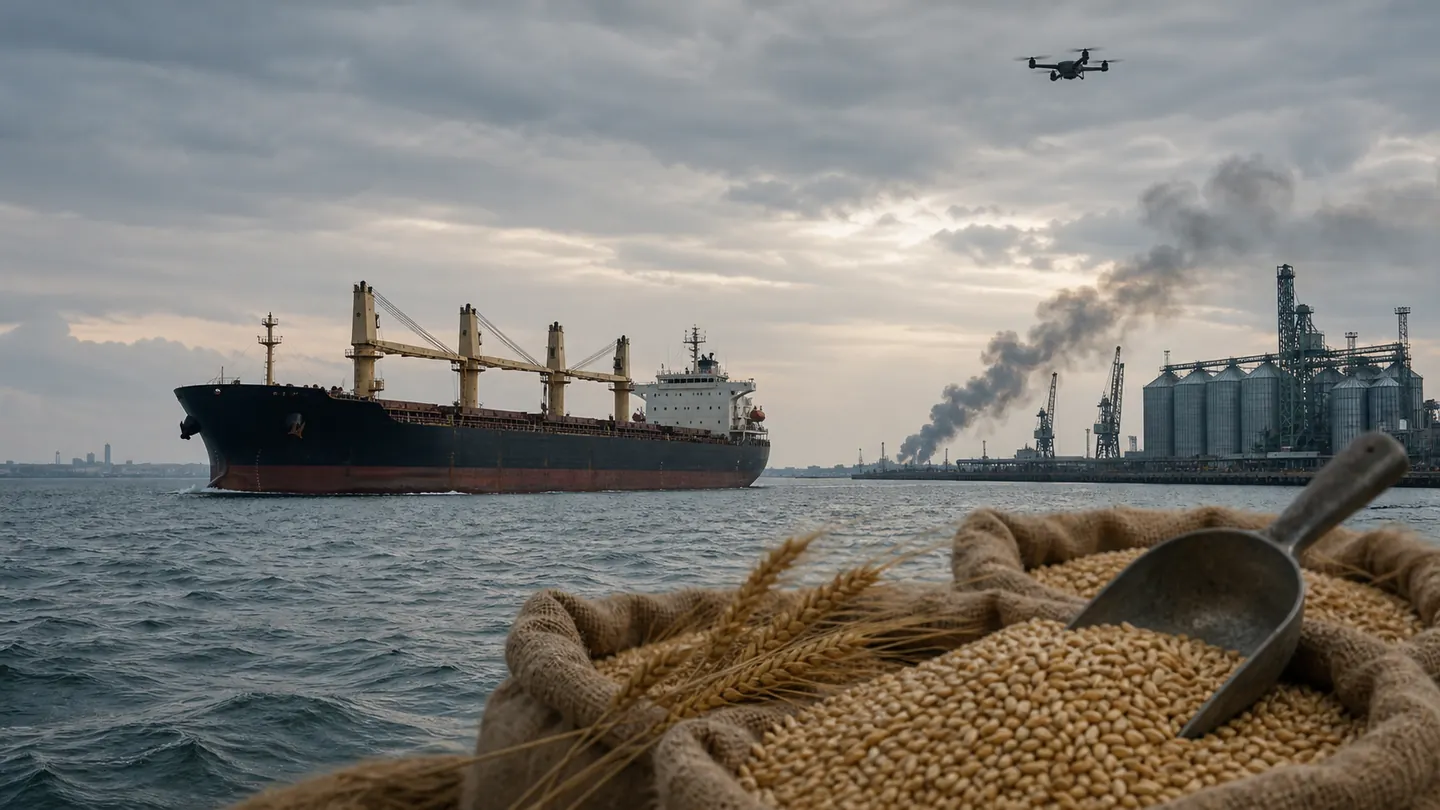
- Ukrainian drones hit Russian shipping in the Sea of Azov. Western media talk about logistical pressure on Russia, Russian sources talk about attacks on civilian grain routes.
- Author
- Ron Caroselli
- Date
- 15 juli 2026
- Subject
- MOZOM investigates how Ukrainian drone attacks on Russian shipping and grain routes in the Sea of Azov are framed, what war law questions this raises and whether food prices could boomerang back.
Summary of the original report
NOS reports that Ukraine is not only targeting Russian oil tankers and ships from the so-called shadow fleet, but is also hitting the Russian grain industry and shipping around the Sea of Azov. Reuters reports that Ukrainian drones struck 11 Russian vessels in the Sea of Azov, including tankers, dry cargo ships and a tugboat, according to Kyiv. Reuters and The Moscow Times also report that Russia wants to divert grain exports from the Sea of Azov after several vessels came under fire. This means that the grain route will be affected; per ship, the precise cargo and legal status of the target remains important. The Ukrainian counter-reading is that only military targets or targets that strengthen Russia militarily are attacked, not civilian cargoes. TASS actually emphasizes civilian shipping, food supplies and Russian export obligations.
Own source research
MOZOM has placed four layers next to each other. Layer one is the Ukrainian/Western military layer: the Sea of Azov and the Kerch Strait are strategic, because they provide access to Russian and Russian-controlled logistics to Crimea, oil, fuel and exports. Layer two is the Russian layer: TASS and Russian officials discuss attacks on civilian shipping, protecting the fleet, maintaining food supplies and rerouting grain logistics. Layer three is the non-Western observation layer: CGTN and Indian media mainly indicate that a new front at sea increases export and price risks. Layer four is the law of war: a ship or grain installation does not automatically become a military target because it is Russian. The core principles are distinction, military necessity and proportionality. There must therefore be a concrete military use or advantage, and expected damage to civilians or civilian objects must not be excessive compared to that military advantage.
Striking in this message
The word shadow fleet is powerful, but not neutral. Oil often involves sanctions avoidance and Russia's war chest. With grain it is more complicated. A ship on a grain route could transport economic exports, potentially transport stolen Ukrainian grain, provide logistical cover, or simply deliver civilian food to third countries. One label does not solve that legal question. That is why it is important to look per ship and per cargo: what was it transporting, for whom, under what flag, for what purpose and what direct military advantage did the attack provide?
Less visible context
The statement that this is a proxy war by NATO against Russia goes too far as a harsh conclusion. Legally and factually, the war began with Russia's large-scale invasion of Ukraine. At the same time, it is also true that the war has been strongly internationalized by Western weapons, intelligence, sanctions and financing. Russia therefore increasingly presents NATO as a de facto opponent. That makes the risk of escalation real. The further Ukraine touches Russian infrastructure, shipping and exports, the greater the chance that Moscow will hit back harder on Ukrainian ports, energy, railways or civilian shipping. The warning 'poking the Russian bear' is therefore not a legal argument, but a strategic warning: escalation often has its own logic.
Possible message behind the news
The Ukrainian message is that the war must be brought back to Russia and its logistics. The Russian message is that Ukraine is attacking civilian food routes. The critical MOZOM reading is that both frames conceal something: military pressure can be morally understandable, but food as a pressure point is a dangerous limit.
Neutral conclusion
The neutral conclusion: attacks on Russian shipping in the Sea of Azov are militarily explainable, but as soon as civilian food transports are hit or threatened, they become much more ethically and legally sensitive. If a ship directly contributes to military capability, transports stolen grain, or covers logistics for the war, an attack may be more defensible. When it comes to regular civilian food trade, it becomes a very risky move. When civilian food transports are targeted, the consequences can extend beyond the military theater of operations: bread prices, importing countries and international political and diplomatic support can come under pressure.
Source:
- NOS: Oekraïne richt oorlogsdrones op Russische graanindustrie
- Reuters via Internazionale: Russia accuses Ukraine of terrorism in Sea of Azov
- The Moscow Times / Reuters: Russia prepares to reroute grain exports from Sea of Azov
- Al Jazeera: Russia readies to reroute exports from Sea of Azov
- The Guardian: Ukrainian drone strikes force Russia to suspend shipping in Sea of Azov
- TASS: logistics, food supplies and fleet protection in Sea of Azov
- CGTN: Ukrainian drones hit Russian vessels in Sea of Azov
- ICRC Customary IHL Rule 54: objects indispensable to civilian survival
- ICRC Customary IHL Rule 8: definition of military objectives
- ICRC Customary IHL Rule 14: proportionality in attack
- FAO Food Price Index, 3 juli 2026