
MOZOM-analyse
MOZOM analyses: IAEA on Fukushima ALPS water, measurement control or trust?
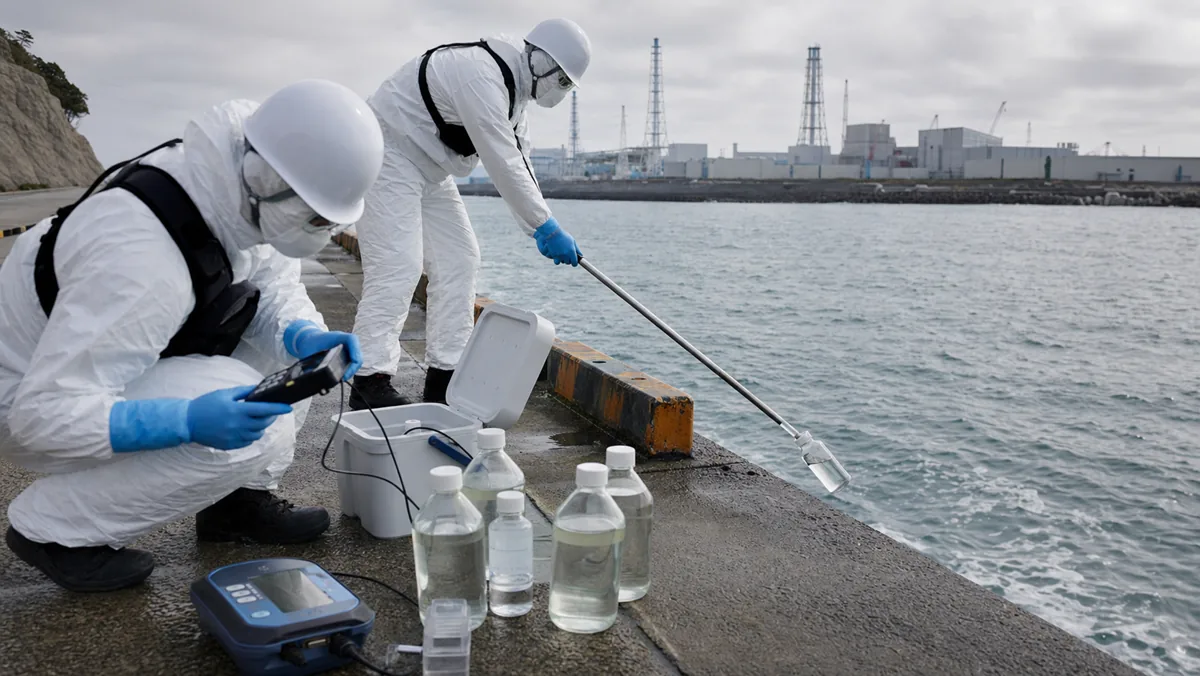
- Source
- IAEA, IAEA Fukushima ALPS-data en TEPCO-monitoring
- MOZOM headline
- MOZOM analyses: IAEA on Fukushima ALPS water, measurement control or trust?
- Original headline
- Tritium Level Far Below Japan's Operational Limit in 21st Batch of ALPS Treated Water, IAEA Confirms
- Author
- the MOZOM.nl editorial team
- Date
- 6 juli 2026 om 15:38
- Subject
- MOZOM investigates why the IAEA confirmation on the 21st batch of Fukushima ALPS-treated water is not only a measurement message, but also a test of transparency, environmental trust and nuclear communication.
Summary of the original report
The International Atomic Energy Agency reports that analysis at Fukushima Daiichi for the 21st batch of ALPS-treated water showed tritium levels well below Japan's operating limit of 1,500 becquerels per liter and meeting international safety standards. ALPS stands for Advanced Liquid Processing System: water from the damaged nuclear power plant is treated to remove many radioactive substances, after which tritium remains as a radionuclide that is difficult to separate and is controlled by dilution and controlled discharge. In its broader July 2023 assessment, the IAEA concluded that Japan's approach is consistent with international safety standards and that the release, as assessed, would have a negligible radiological impact on humans and the environment. At the same time, the IAEA emphasized that its report is not a recommendation or political endorsement of Japan's policy choice. The current 21st batch therefore fits into a long-term control system: source measurements, real-time data, independent sampling, seawater and environmental monitoring, and inter-laboratory comparisons.
Own source research
MOZOM has placed four layers next to each other. Layer one is the current batch measurement: the 21st batch is well below Japan's operational tritium limit, according to the IAEA. Layer two is the 2023 safety baseline: the IAEA concluded that Japan's approach meets international standards, but called the Japanese decision itself a national policy choice. Layer three is the data layer: monitoring consists of real-time operational data, source measurements, dilution measurements, seawater measurements and laboratory comparison. Layer four is the confidence layer: even when the values are low, people must be able to trust that samples are representative, laboratories work independently enough, deviations become visible and data is not only technically available but also understandable. MOZOM's own layer is that Fukushima shows that environmental trust does not arise from one safe outcome. It arises from repeatable measurements that have to answer the same question for years: does the system continue to do what it promises?
Striking in this message
The word 'far below' is striking. That frame is reassuring and technically strong, but it can also sound too quickly as if the entire debate has ended. The stronger reading is more precise: this batch measurement reduces the acute concern about tritium in this sample, but the social file is about continuous monitoring, cumulation, fishing confidence and the credibility of institutions.
Less visible context
Less visible is that tritium is not the only word people hear when Fukushima is mentioned. They also hear 2011, nuclear meltdown, evacuation, loss of trust and years of cleanup. This makes the debate asymmetrical: a low reading may be technically convincing, but emotionally and politically it competes with a disaster memory. Independent monitoring must therefore not only measure radioactivity, but also show that uncertainty, errors and deviations do not disappear under the carpet.
Possible message behind the news
A possible message is that repeated independent measurements are the only way to keep a charged environmental dossier rational. The critical counter-reading is that measurement control only builds trust when the data remains understandable, verifiable and available for a long time.
Neutral conclusion
The neutral conclusion: the IAEA confirms that the tritium value in the 21st batch of Fukushima ALPS-treated water is well below the Japanese operational limit. The sharper MOZOM reading: this is not an end to the debate, but a new data point in a long-running test of whether nuclear transparency is strong enough to regain social trust.
Source:
- IAEA: Tritium level far below Japan's operational limit in 21st batch of ALPS treated water
- IAEA: Fukushima ALPS-treated water discharge in focus
- IAEA: Data from Fukushima Daiichi ALPS treated water discharge
- TEPCO: Methods and results of treated water discharge and monitoring
- IAEA: independent marine sampling near Fukushima Daiichi