
MOZOM-analyse
MOZOM analyses: IAEA on Zaporizhia, fire station or nuclear safety margin?
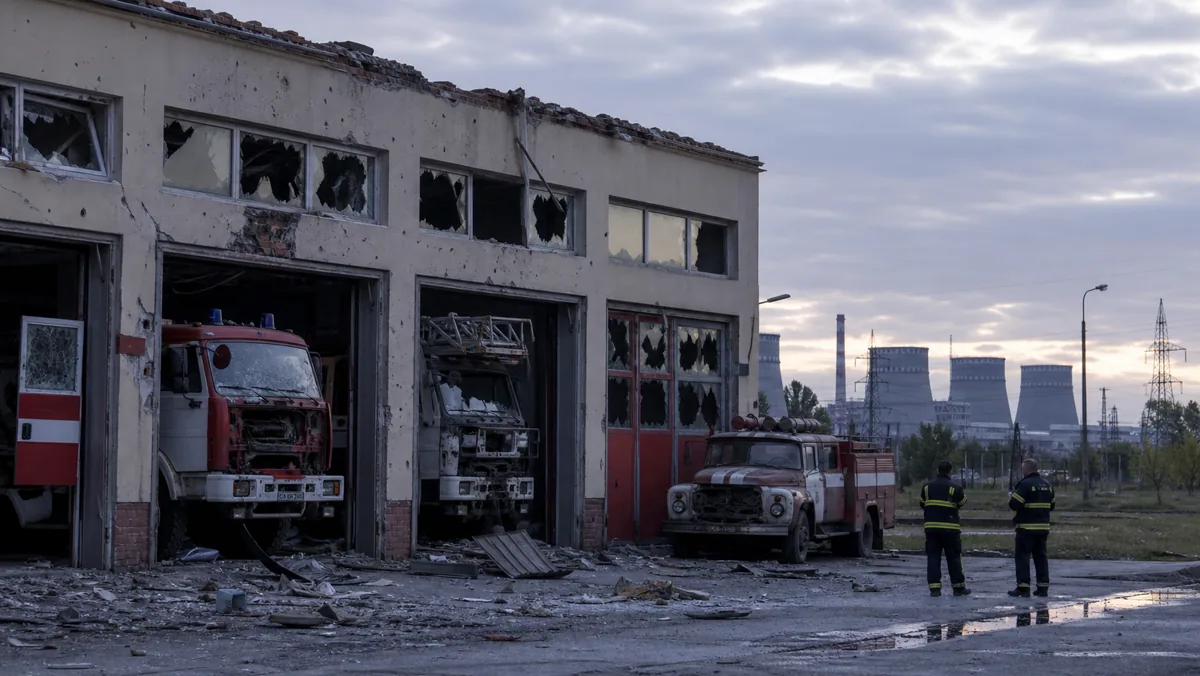
- Source
- IAEA Update 356, IAEA Ukraine safety framework en Xinhua
- MOZOM headline
- MOZOM analyses: IAEA on Zaporizhia, fire station or nuclear safety margin?
- Original headline
- IAEA reports heavy damage to a fire station in Enerhodar supporting emergency response to the Zaporizhia nuclear power plant
- Author
- the MOZOM.nl editorial team
- Date
- 5 juli 2026 om 19:45
- Subject
- MOZOM investigates why, according to the IAEA, damage to a fire station in Enerhodar is not only local war damage, but also affects emergency preparations around the Zaporizhia nuclear power plant.
Summary of the original report
The International Atomic Energy Agency reported in Update 356 that the IAEA team at the Zaporizhia nuclear power plant found significant damage to a fire station in the nearby town of Enerhodar. According to the IAEA, this post plays an important role in supporting emergency aid around the nuclear power plant. During a site visit, the team saw damage to the building and several fire vehicles. Xinhua, which summarized the IAEA statement, wrote that the fire station provides important backup support to the plant's own fire brigade in the event of a large-scale emergency. IAEA Director Rafael Mariano Grossi warned that attacks that undermine nuclear security and emergency preparedness are unacceptable. The update fits into a longer pattern: the Zaporizhia nuclear power plant has been under Russian control since March 2022 and is assessed according to the IAEA framework through the seven indispensable pillars for nuclear safety and the five concrete principles that Grossi presented to the UN Security Council in 2023.
Own source research
MOZOM has compared the message to the IAEA framework. Layer one is the visible fact: the damage is at a fire station in Enerhodar, not in the reactor itself. Layer two is the function: the station supports the emergency response of the nuclear power plant and therefore forms a backup outside the plant. Layer three is the safety margin: if war gradually affects emergency services, vehicles, personnel, power supplies or access routes, nuclear safety can deteriorate without immediately releasing radiation. MOZOM's own layer is therefore that these types of incidents should not be read as 'no disaster, so nothing to worry about'. They are part of the slow erosion of emergency capacity around a nuclear power plant in times of war.
Striking in this message
It is striking that the word fire station makes the news sound smaller than it is. A fire station is not a reactor vessel or a fuel pool. Yet firefighting at a nuclear power plant is not an afterthought. It is part of the practical layer of defense against escalation. The IAEA language is therefore deliberately precise: it is not a nuclear accident, but a violation of nuclear emergency preparedness.
Less visible context
What is less visible is that large technical installations remain safe through redundancy: multiple ways to cool, measure, communicate, extinguish and allow personnel to act. War often indirectly affects that redundancy. A cable breaks, a road is unsafe, a team is exhausted, a fire truck is damaged. Each individual element seems manageable, but together they determine how much wiggle room is left when something goes really wrong.
Possible message behind the news
A possible message is that there is no direct nuclear incident. The critical counter-reading is that nuclear safety also depends on auxiliary systems outside the reactor, and it is precisely that layer that slowly wears away in war.
Neutral conclusion
The neutral conclusion: the IAEA reports damage to a fire station in Enerhodar that supports the emergency response around Zaporizhia. The sharper MOZOM reading: this is not a nuclear disaster message, but it is a safety margin message. Anyone who only looks at whether the reactor has been hit misses how emergency capacity around the power plant can become more vulnerable piece by piece.