
MOZOM-analyse
MOZOM analyses: Khamenei funeral in Tehran, mourning ritual or message of power?
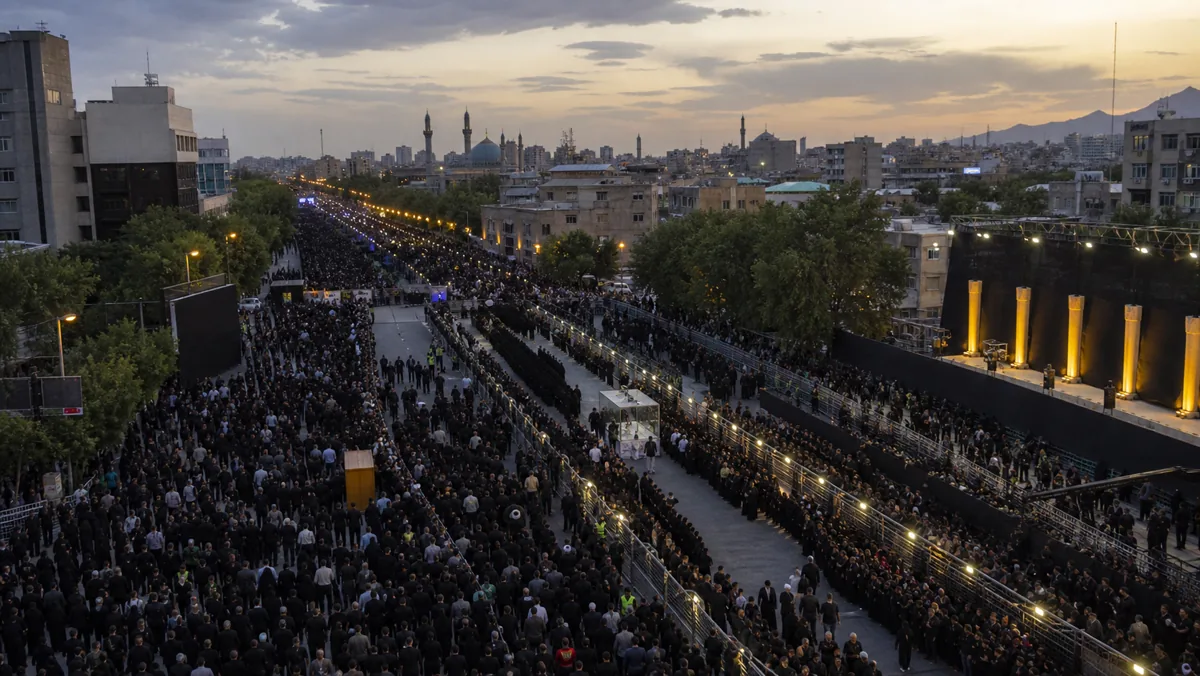
- Source
- AP, Leader.ir, Al Jazeera en Wall Street Journal
- MOZOM headline
- MOZOM analyses: Khamenei funeral in Tehran, mourning ritual or message of power?
- Original headline
- Funeral prayers in Tehran place Iran's mourning for Ali Khamenei inside a wider struggle over succession, security and war diplomacy
- Author
- Ron Caroselli
- Date
- 5 juli 2026 om 23:09
- Subject
- MOZOM investigates why the funeral ceremonies for Ali Khamenei in Iran are not only mourning, but also a public signal about succession, security and room for negotiation.
Summary of the original report
AP reports that senior Iranian officials and three sons of Ali Khamenei took part in the funeral prayers in Tehran on Sunday, while Mojtaba Khamenei has not yet appeared publicly at the ceremony, according to AP. Al Jazeera also reports that Mostafa, Meysam and Masoud Khamenei were visible at the prayers, but Mojtaba remained absent. The official Iranian source Leader.ir presents the ceremonies as a multi-day national and religious farewell: farewell at the Imam Khomeini Mosalla on Saturday 13 and Sunday 14 Tir 1405, a procession in Tehran on Monday 15 Tir, a procession in Qom on Tuesday 16 Tir and funeral in Mashhad on Thursday 18 Tir. The Wall Street Journal highlights the scale of the mourning and the anticipation of very large crowds. The shared core: the funeral is a ceremony, image of power and security operation at the same time.
Own source research
MOZOM has compared the AP report to the official Iranian planning. This creates a simple timeline: July 4 and 5 farewell in Mosalla, July 6 procession in Tehran, July 7 Qom and July 9 Mashhad. This planning is important, because a multi-day state funeral is not just about logistics. Every day extends public attention, giving the state an opportunity to produce images of mass and order, and giving allies or foreign delegations time to show presence. MOZOM's own layer is that the absence of one person in such an orchestrated ceremony is sometimes just as political as the presence of thousands.
Striking in this message
It is striking how the same crowd can carry two opposing frames. In Iranian state communications, the crowd is evidence of loyalty and national mourning. In international reporting, the same crowd is also read as a backdrop within which the demand for succession, security and negotiating power becomes visible. So the photo does not automatically say what it means; the source determines which part of the photo is made political.
Less visible context
Less visible is that mourning ceremonies in authoritarian or highly centralized systems are often also moments of institutional confirmation. They show who is at the front, who speaks, who prays, who is protected and who consciously stays out of the picture. In a period of war, pressure on the Strait of Hormuz and talks with the United States, even the order of presence becomes geopolitically charged.
Possible message behind the news
A possible message is that despite the death of Khamenei, Iran is showing order, mass and continuity. The critical counter-reading is that it is precisely the need to show continuity that reveals how much tension there is around succession and safety.
Neutral conclusion
The neutral conclusion: Iran holds multi-day funeral ceremonies around Ali Khamenei and international media see mourning, a show of power and succession signals at the same time. The sharper MOZOM lecture: at this funeral the route itself is political language. Who is in front and who is missing tells almost as much as the official words.
Source:
- AP: Khamenei's other sons appear at his funeral in Iran as new supreme leader remains in hiding
- Leader.ir: officiële planning van uitvaart en begrafenis
- Leader.ir: fotoalbum gebedsdienst op 14 Tir 1405
- Al Jazeera: sons of Ali Khamenei attend funeral, Mojtaba absent
- Wall Street Journal: massive crowds gather in Tehran for six-day funeral