
MOZOM-analyse
The Netherlands locked by bridges: who decides, who pays and who earns from the multi-billion-euro operation?
- Source
- Rijkswaterstaat, Ministerie van Infrastructuur en Waterstaat, Algemene Rekenkamer, TLN, NU.nl, NOS, L1 Nieuws en regionale bronnen
- MOZOM headline
- The Netherlands locked by bridges: who decides, who pays and who earns from the multi-billion-euro operation?
- Original headline
- Analysis of bridge closures, freight bans, overdue maintenance and the billion-dollar challenge surrounding Dutch infrastructure
- Author
- Paul Giezen
- Date
- 22 juli 2026 om 20:00
- Subject
- MOZOM investigates why Dutch bridges and viaducts are suddenly in the news so often due to closures, freight bans and diversions, and what questions of money and power lie behind this.
Summary of the original report
Rijkswaterstaat has banned freight traffic from the Merwede Bridge near Gorinchem from July 18, 2026. A week later, cameras followed and hefty fines are threatened for trucks that continue driving. That does not stand alone. The Dordrecht Traffic Bridge is closed to heavy vehicle groups, three bridges over the Juliana Canal have restrictions, the Papendrechtse Bridge will be closed for months, lanes will disappear at the A20 Giessen Bridges, weight restrictions apply at Velperbroek and support structures, temporary bridges or long-term diversions are also in place elsewhere. Strictly speaking, at least eighteen bridges and viaducts are listed in the public sources as currently closed, restricted or seriously inconvenienced. In addition, a letter to Parliament mentions thirteen Rijkswaterstaat objects with a risk of hydrogen embrittlement that will be replaced as a priority.
Own source research
MOZOM has placed the current bridge reports next to the maintenance documents. The first outcome is the list: at least eighteen bridges and viaducts are mentioned as closed, limited or subject to serious disruption in the public sources examined. This concerns: 1. Merwedebrug Gorinchem A27, closed to freight traffic; 2. Dordrecht/Zwijndrechtsebrug road bridge, closed to trucks, coaches and agricultural and forestry vehicles; 3. Kelper Bridge N280, closed to trucks, agricultural vehicles and buses; 4. Roosteren Bridge over the Juliana Canal, restrictions for freight, buses and slow motorized traffic; 5. Bridge over the Juliana Canal, restriction for particularly heavy transport; 6. Illikhoven Bridge over the Juliana Canal, center lane and weight limit; 7. Papendrechtsebrug N3, closed for long periods to road traffic; 8. Baanhoekbrug cycle path, affected by the Papendrechtsebrug closure; 9. Giessen Bridges A20, from three to two lanes with freight traffic to the middle; 10. Giessenbaan Bridge Rotterdam, part of the same disability complex; 11 to 14. four A12 viaducts at Velperbroek, with a limit above 50 tons; 15. Algera Bridge N210, temporary closure and weight restriction on the reversing lane; 16. Uitwellingerga Bridge, temporary fixed bridge through which high shipping traffic has to detour; 17. Krusrak bridge N7 near Sneek, repairs stopped and bridge dismantled because structural safety could not be guaranteed; 18. Oirschot A58 bridge, support and a 24/7 overtaking ban for trucks. The second outcome is the threat list: the hydrogen embrittlement letter to Parliament lists thirteen Rijkswaterstaat objects that would not pose an acute safety risk, but are given priority for replacement and for which closure or support is possible later if the assessment gives reason to do so.
From nuisance to billion-dollar machine
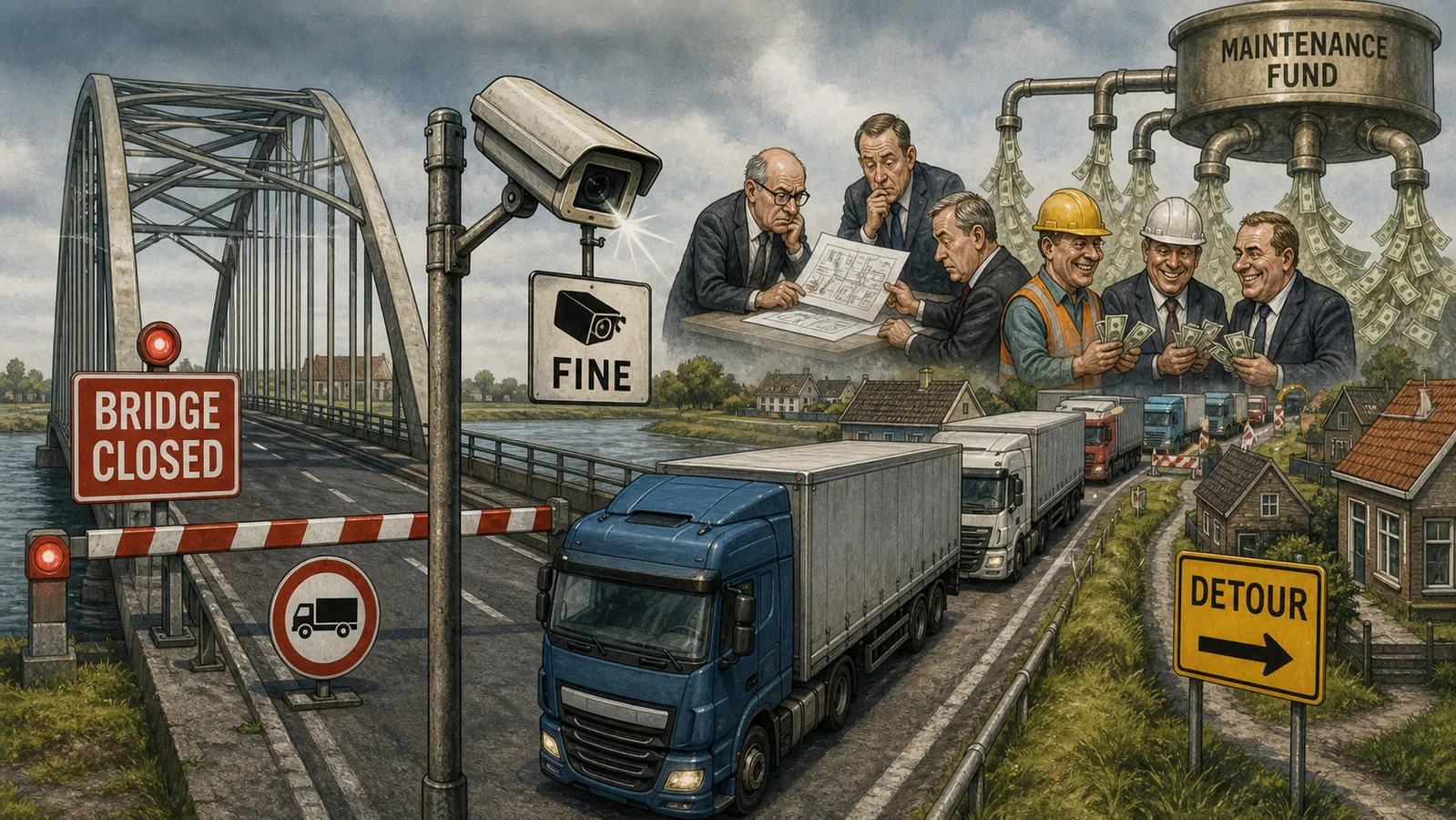
The word maintenance sounds technical and boring. But as soon as maintenance is late, it turns into closures, cameras, fines, diversions, legal threats and billion-dollar decisions. That's the framing shift. Citizens first hear that a bridge may be unsafe. Then he hears that trucks have to take a detour. Only deeper in the documents does it appear that Rijkswaterstaat is working on the largest maintenance in its history and that the market needs stable orders, economies of scale and deal flow.
Less visible context
Less visible is who benefits. That doesn't mean a contractor is wrong when he repairs bridges. The Netherlands needs those companies. But the money trail does indeed run through engineering firms, contractors, material producers, traffic management, camera and enforcement systems, diversion logistics, advice, design, monitoring and legal guidance. Rijkswaterstaat itself writes that portfolio framework agreements must tender several comparable objects at once and provide a predictable flow of orders to the market. The question for citizens is therefore not only whether a bridge is safe. The question is also who sets priorities, who controls costs, who earns from additional work and why the financial layer is much less visible than the traffic jam and the fine.
Possible message behind the news
The visible message is: safety first, detour trucks and enforce cameras. The critical MOZOM lecture is: The Netherlands is now paying the price of years of delay, while the same crisis is organizing a predictable flow of billions to the infrastructure market.
Neutral conclusion
The conclusion is not that Rijkswaterstaat closes bridges on purpose to obtain money. There is no public evidence for this. The harder and more defensible conclusion is that the Netherlands is in a self-reinforcing maintenance spiral: postponement leads to restrictions, restrictions lead to social damage, damage leads to political pressure, and political pressure legitimizes billion-dollar programs with long-term contracts for the market. Anyone who only looks at the closed bridge will see disruption. Anyone who looks at the documents sees a much bigger question: why are citizens mainly informed about detours and fines, while the flow of money behind the bridge crisis remains much less visible?
Source:
- Rijkswaterstaat: vrachtverkeer vanaf 18 juli 2026 niet meer over Merwedebrug Gorinchem A27
- NOS: Rijkswaterstaat plaatst camera's op Merwedebrug, vrachtverkeer riskeert boete
- NU.nl: week na verbod op vrachtverkeer camera's op Merwedebrug
- Rijkswaterstaat: geen vrachtauto's, touringcars en land- en bosbouwvoertuigen over Verkeersbrug Dordrecht
- Rijkswaterstaat: drie bruggen over het Julianakanaal krijgen een gewichtsbeperking
- L1 Nieuws: metaalmoeheid bij drie bruggen over Julianakanaal
- Rijkswaterstaat: start afsluiting Papendrechtsebrug voor renovatie klep
- Rijkswaterstaat: A20 Giessenbruggen richting Gouda van drie naar twee rijstroken
- Rijkswaterstaat: A12 gewichtsbeperking viaducten Velperbroek
- Rijkswaterstaat: verkeersmaatregelen Algerabrug
- Rijkswaterstaat: A58 brug Oirschot
- Ministerie van Infrastructuur en Waterstaat: Kamerbrief waterstofverbrossing
- Algemene Rekenkamer: tekort Rijkswaterstaat voor instandhouding groter dan gedacht
- Rijkswaterstaat: Meerjarenprogramma Instandhouding 2025-2030
- TLN: juridische stappen wegens mogelijke nalatigheid overheid bij Merwedebrug