
MOZOM-analyse
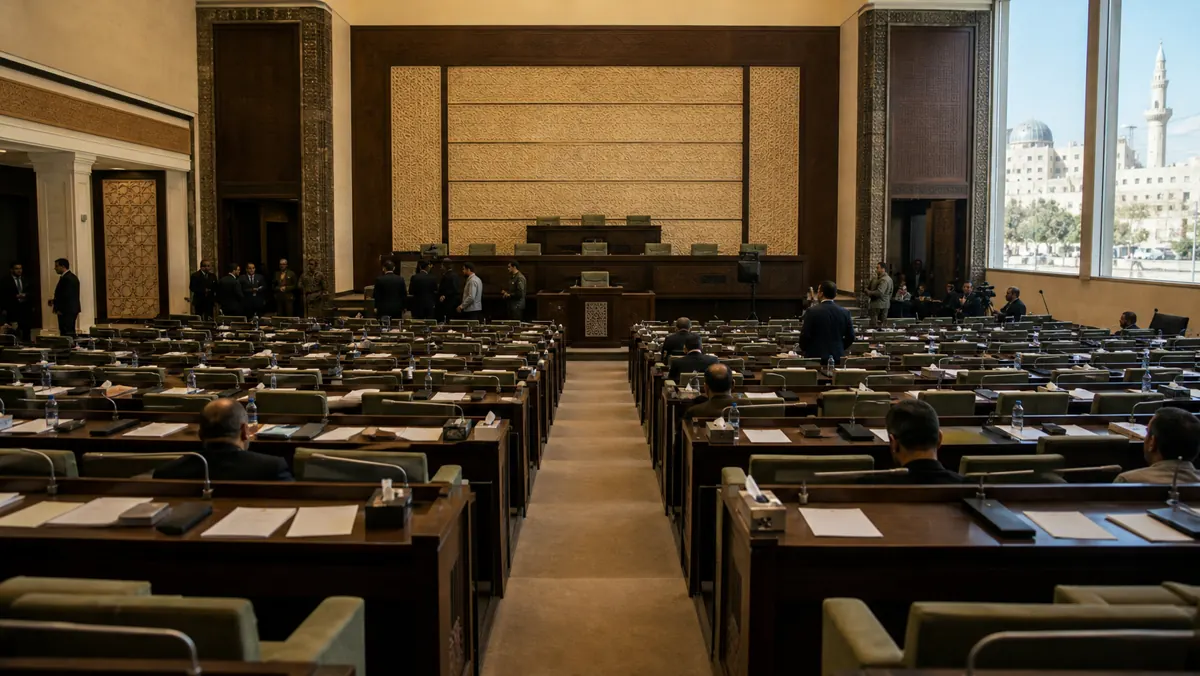
Syria opens new parliament: democratic restart or controlled transition?
- Source
- AP, Reuters via Asharq Al-Awsat, Al Jazeera, Türkiye Today, Anadolu en OPCW
- MOZOM headline
- Syria opens new parliament: democratic restart or controlled transition?
- Original headline
- New parliament in Damascus holds first session after the fall of Assad
- Author
- the MOZOM.nl editorial team
- Date
- 12 juli 2026 om 21:24
- Subject
- MOZOM investigates whether the first session of the new Syrian parliament is primarily a step towards democratic reconstruction, or also a controlled transition in which power, recognition and representation are carefully managed.
Summary of the original report
AP reports that Syria's newly elected parliament held its first session on Sunday. Parliament must function for 30 months and work towards future elections. According to AP, the meeting chose Abdul Hamid al-Awak from Hassakeh province as chairman. Reuters, published by Asharq Al-Awsat, calls the session a milestone in the political transition, but at the same time points out the limited current powers of the chamber. Al Jazeera previously reported that the first session had been postponed and described how the new authorities dissolved the old assembly controlled by Assad. Türkiye Today and Anadolu place the session in the context of state media and transitional administration: the new assembly must prepare laws and the constitutional route to elections.
Own source research
MOZOM distinguishes three layers. Proven: the new Syrian parliament held its first session on July 12, 2026; the chamber has 210 members; two-thirds came through electoral colleges and one-third were appointed by interim president Ahmed al-Sharaa; the term is 30 months; Parliament must work on the route to later elections. It is also proven that on July 9, 2026, the OPCW restored Syria's rights and privileges under the Chemical Weapons Convention after constructive cooperation with the new authorities. Probably: the parliamentary session is not only intended for domestic governance, but also as an international signal that Damascus wants to be seen as a governable state again. Uncertain: whether this construction is broad enough to actually represent all Syrian regions, minorities and opposition flows.
Striking in this message
The word 'parliament' is reassuring. It calls for elections, debate and control. But in transition countries, the precise design is at least as important as the name. A chamber can be a step towards pluralism, but also a controlled intermediate station in which the new power already writes the rules for the next phase. That makes this report journalistically interesting: not because every transition is suspect, but because legitimacy does not arise from chairs, microphones and a chairman alone.
Less visible context
It is less visible that Syria communicates inwardly and outwardly at the same time. Domestically, the new administration must demonstrate that the Assad period is over and that legislation is no longer solely through security forces or presidential control. The message is at least as important abroad: those who want investments, sanctions relief, diplomatic recognition and reconstruction must show institutions. The OPCW decision of July 9 is part of that normalization route. At the same time, previous explosions and security incidents in Damascus make it clear that institutional form does not guarantee a stable rule of law.
Possible message behind the news
One possible message is that Syria will return to legislation, diplomacy and state building after Assad. The critical MOZOM reading is that normalization is not the same as democratic control: it is precisely in the transition phase that it is determined who will write the rules of the game.
Neutral conclusion
The preliminary conclusion: the first session of the new Syrian parliament is newsworthy and historic, but not yet final proof of democratic rebirth. It is at the same time an institutional restart, a diplomatic signal and a power construction in the making. If the chamber really leads to open elections, minority protection and parliamentary control, this could be a break with the Assad era. If the selection and appointment logic continues to limit the political space, it will mainly be a controlled restart with a democratic form.
Source:
- AP: Syria's new parliament holds first session since ouster of ex-President Assad
- Reuters via Asharq Al-Awsat: New Syrian Parliament Meets for First Time in Damascus
- Al Jazeera: Syria delays first session of transitional parliament
- Türkiye Today: Syria holds first People's Assembly session after fall of Assad regime
- Anadolu: Syria postpones first session of newly formed parliament
- OPCW: Syria's rights and privileges reinstated under the Chemical Weapons Convention