
MOZOM-analyse
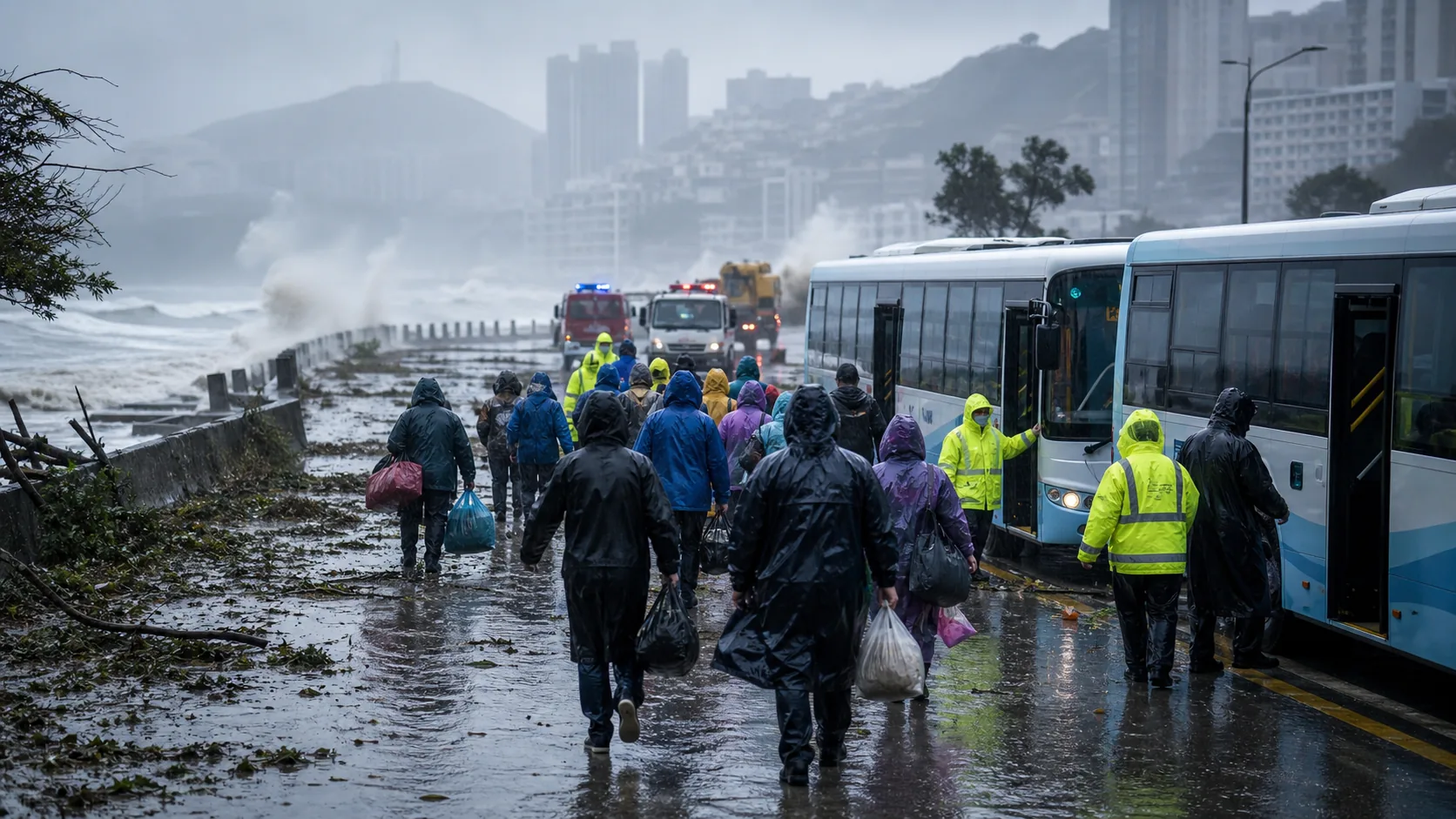
Typhoon Bavi hits eastern China: 1.7 million evacuations or disaster logistics as new normal
- Source
- AP via PBS NewsHour, Xinhua, National Weather Service Guam en Al Jazeera
- MOZOM headline
- Typhoon Bavi hits eastern China: 1.7 million evacuations or disaster logistics as new normal
- Original headline
- Typhoon Bavi makes landfall in Zhejiang after China evacuates more than 1.7 million people
- Author
- Ron Caroselli
- Date
- 12 juli 2026 om 01:36
- Subject
- MOZOM investigates why Typhoon Bavi is not just a weather forecast, but also a test for mass evacuation, coastal infrastructure and disaster logistics in East Asia.
Summary of the original report
AP reports via PBS NewsHour that Bavi was making landfall in eastern China with maximum sustained winds of about 90 miles per hour near the center and then weakening inland. More than 1.7 million people had already been evacuated in Zhejiang by Saturday morning. Shanghai moved about 34,000 residents from risk areas around noon. In Ningde, Fujian province, more than 3,700 people were moved from high-risk coastal zones and more than 17,000 emergency responders were on standby. China issued an orange typhoon alert and canceled hundreds of flights; some high-speed trains were shut down. Xinhua also reported that China's National Weather Center issued the highest alert level, red, for rainfall. The center warned of 250 to 500 millimeters of rain in parts of Zhejiang and Fujian, and up to 800 millimeters in parts of Taiwan.
Own source research
MOZOM separates Bavi into three layers. Layer one is meteorology: the storm was previously a super typhoon with very high wind speeds near Guam and later arrived weakened but still dangerous near China. Layer two is precipitation: Xinhua's reference to a red rain alert makes it clear that the biggest danger after landfall is not just wind, but also water, mudslides and urban overload. Layer three is logistics: 1.7 million evacuations mean that every bus, school, road, train connection, emergency shelter and local government becomes part of the disaster system. The real test often only begins after the storm has weakened.
Striking in this message
It is striking that the headline 'typhoon causes landfall' sounds smaller than the reality behind it. The news is not just about a cloud spiral at sea, but about the temporary standstill of part of society. When hundreds of thousands to millions of people have to move preventively, evacuation itself becomes a main topic.
Less visible context
Less visible is that Bavi is not isolated from the broader vulnerability of the western Pacific. The same storm track previously hit the Mariana Islands, bringing wind and rain to Taiwan and Japan's southern islands and intensifying monsoon rains that led to deadly landslides in the southern Philippines, according to AP. For residents of coastal regions, the storm is therefore not an isolated dot on a weather map, but a series of decisions: take shelter, leave, wait, return and recover.
Possible message behind the news
A possible message is that China is effectively deploying its disaster apparatus with large-scale evacuations. The critical MOZOM reading is that such a scale also exposes how normal exceptional disaster logistics threatens to become in densely populated coastal regions.
Neutral conclusion
The preliminary conclusion: Bavi is more than a heavy typhoon that makes landfall. The storm shows that extreme weather is increasingly becoming a complete logistical operation. Wind power makes the headlines, but rain, evacuation, rail failures and repairs ultimately determine the social damage. Eastern China is preparing en masse this time; the bigger question is how often such preparation can still be treated as an exception.