
MOZOM-analyse
Forest fire in Almería: 12 dead shows how quickly heat, wind and evacuation choices become fatal
- Source
- AP, El País, RTVE, The Guardian, Euronews en AEMET
- MOZOM headline
- Forest fire in Almería: 12 dead shows how quickly heat, wind and evacuation choices become fatal
- Original headline
- Deadly forest fire near Los Gallardos and Bédar in the Spanish province of Almería
- Author
- Ron Caroselli
- Date
- 11 juli 2026 om 17:28
- Subject
- MOZOM investigates the deadly forest fire in Almería as world news about heat, evacuation, warning systems and fire risk in Southern Europe.
Summary of the original report
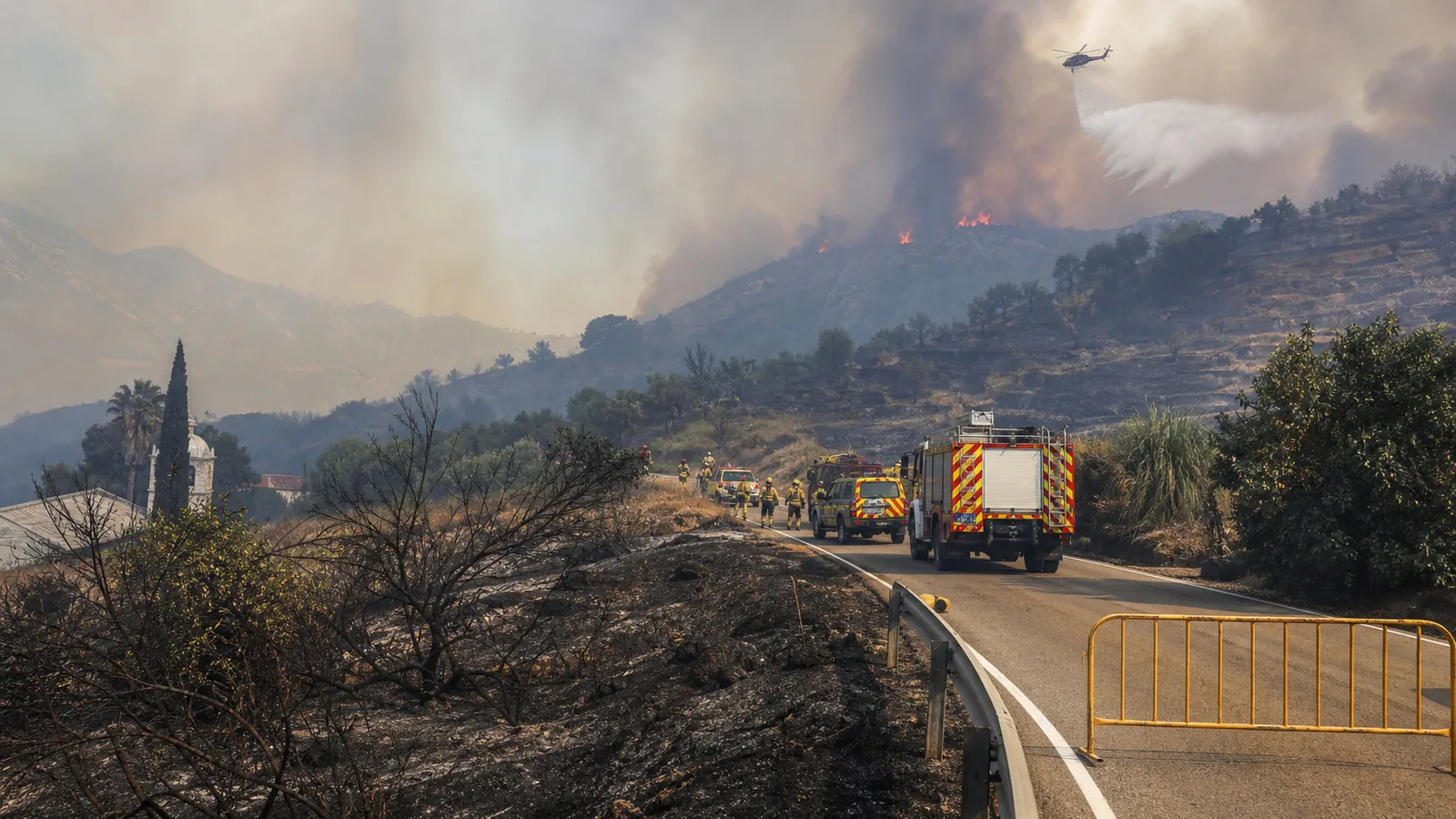
AP reports that hundreds of firefighters in southern Spain are working on one of the deadliest forest fires in recent Spanish history. The fire is raging in Almería, near the Sierra de los Filabres and the surroundings of Los Gallardos and Bédar. According to AP, at least 12 people have been killed and about 66 square kilometers of forest and agricultural land have been affected. Spanish media, including El País and RTVE, report 12 deaths, eight injuries, 23 missing or not yet located people and more than 1,400 evacuees, based on regional authorities. The numbers are subject to change as long as identification, searches and control of the area continue. Some of the victims were found in or near vehicles, according to various sources. The preliminary cause is linked by Spanish media to a fallen or damaged cable, but that investigation has not yet been definitively completed.
Own source research
MOZOM has separated the fire into three layers. Layer one is the immediate incident: a fast-moving fire around Los Gallardos and Bédar, with fatalities, missing, injured and large-scale evacuation. Layer two is the evacuation question: multiple sources report that victims may have deviated from instructions or tried to escape via unsafe routes. This should not be used to simply blame victims afterwards; In panic, smoke, night, poor range and unclear terrain, action is extremely difficult. Layer three is the system demand: for dispersed homes and tourist or expat communities, emergency communications must be much more precise than a general warning. The difference between staying, evacuating, turning right or turning left can literally become life-defining.
Striking in this message
It is striking that the debate quickly shifts from firefighting to behavior: should people have stayed or fled? That is understandable, but too narrow. A good warning system should not only say that there is danger, but also for which valley, which road, which hamlet and which time window which choice is the least dangerous.
Less visible context
What is less visible is that Southern European fire disasters are increasingly occurring at the intersection of nature, infrastructure and habitation. Dry vegetation is fuel, but roads, power lines, scattered homes, campsites, cell coverage and language barriers determine whether people can make the right decision in time. A fire brigade can fight a fire front; A society must also ensure that residents and visitors understand when they should no longer drive independently.
Possible message behind the news
A possible message is that southern Europe is again being hit by extreme weather. The critical MOZOM reading is that climate adaptation becomes concrete at the level of a country road, a telephone warning, a campsite, an isolated house and an evacuation route that may or may not be safe.
Neutral conclusion
The preliminary conclusion: the fire in Almería is world news because it shows how quickly a local forest fire can become an international disaster. The lethality is not just in temperature or flame height, but in the interplay of fire behavior, warning choices, human panic and vulnerable spatial planning. The lesson is harsh: in future heat waves, fire prevention must not only be about extinguishing, but also about understandable, location-oriented and multilingual instructions before roads and smoke close the choices.
Source:
- AP: Hundreds of firefighters battle wildfire in southern Spain
- AP: Wildfire devastates an expat community in southern Spain
- El País: últimas noticias del incendio forestal de Los Gallardos
- RTVE: Al menos 12 muertos en un incendio forestal en Almería
- The Guardian: fast-spreading wildfire kills at least 12 in southern Spain
- AEMET: avisos meteorológicos
- AEMET: predicción estacional julio-agosto-septiembre 2026