
MOZOM-analyse
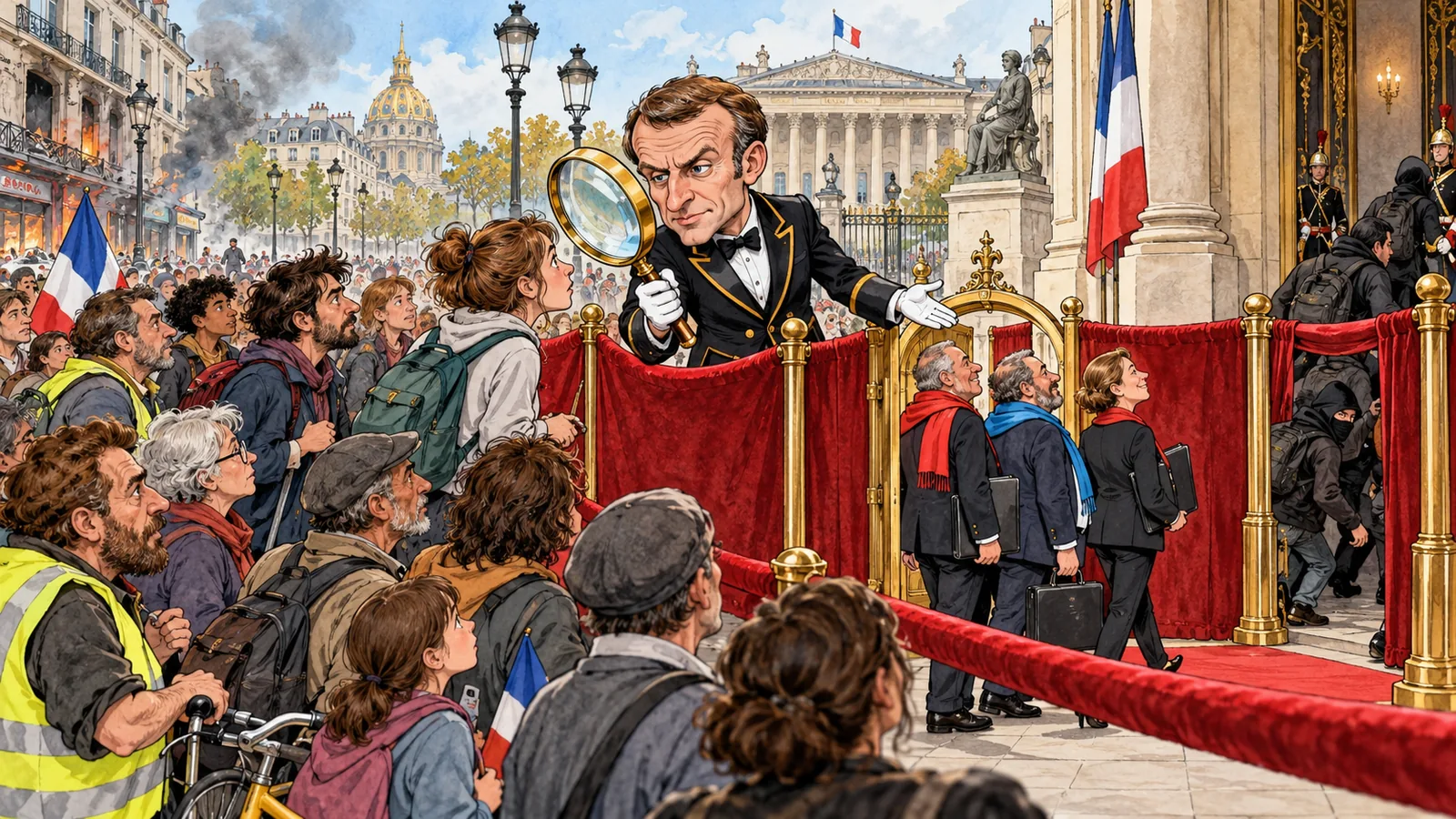
Who decides which protest is still considered 'legitimate'? France is shifting the boundaries of the right to demonstrate.
- Source
- French government, Ministry of the Interior, Tribunal administratif de Paris, European Court of Human Rights, UN, LDH, Amnesty International, AP, and Le Monde.
- MOZOM headline
- Who decides which protest is still considered 'legitimate'? France is shifting the boundaries of the right to demonstrate.
- Original headline
- Who decides which protest is still considered 'legitimate'? France is shifting the boundaries of the right to demonstrate.
- Author
- Paul Giezen
- Subject
- A legal and political analysis of the French protest bans following the riots of October 2026, the statement by President Emmanuel Macron regarding organizers without legitimacy, and the boundary between public order and freedom of assembly.
Summary of the original report
According to the French Ministry of the Interior, approximately 550,000 people demonstrated on October 17, 2026. The vast majority demonstrated peacefully, but in several places, there were serious riots, arson, looting, and attacks on police and public buildings. The government responded with curfews, area bans, checks at train stations, and broad powers for prefects to prohibit new gatherings. Macron spoke of organizers without "legitimacy." The formal ministerial policy is legally narrower: prefects must consider the reliability of organizers, proposed routes, previous incidents, and concrete risks. French judges have meanwhile suspended several bans. This makes the core visible: protection against violence is a government task, but peaceful demonstration is not a favor that only recognized institutions should be allowed to grant.
Claim, public facts, and necessary legal nuance.
The table distinguishes between political statements, formal policy, and the standards that French and European judges can use to review measures.
| Subject or claim | What has been publicly established | Legal or factual nuance | MOZOM assessment |
|---|---|---|---|
| 'There was exceptionally serious violence' | On October 17, looting, arson, vandalism, and attacks on public buildings and police officers took place in several cities. | The damage and injuries are extensively documented; the Senate is also investigating why the security organization was overwhelmed. | Factually correct. The violence provides grounds for targeted measures and criminal prosecution. |
| 'The demonstrations were violent.' | According to the ministry, approximately 550,000 people demonstrated; violence came from groups within and around the much larger mobilization. | The city of Paris explicitly states that the perpetrators should not be confused with the vast, peaceful majority. | Too general when an entire protest movement is equated with rioters. |
| 'Only trade unions can responsibly organize.' | Macron mentioned trade union demonstrations as a category that may be allowed; the cabinet says it will assess applications on a case-by-case basis. | Student groups, citizen collectives, and spontaneous movements can also organize peacefully and are also subject to the right to demonstrate. | Political preference for known discussion partners is understandable, but not an independent legal norm. |
| 'People without legitimacy must be excluded.' | Macron used this formulation after consultation with security services. | The formal communiqué does not speak of political legitimacy, but of reliability, route, previous incidents, and concrete risks. | Framing: a broad political concept replaces the narrower legal test in public communication. |
| 'A risk of disorder justifies a ban.' | Prefects are authorized to take action against serious, foreseeable disruption of public order. | According to the ECtHR, protection does not automatically lapse when outsiders may commit violence; the state must demonstrate necessity and proportionality. | Only justified with a concrete justification and when less intrusive measures are insufficient. |
| 'The prefects are acting within the rule of law.' | Prohibitions are subject to a swift appeal to the administrative court. | Judges have suspended several prohibitions; LDH also argues that late publication makes effective appeal more difficult. | Judicial review functions, but also demonstrably corrects decisions that are too broad. |
| 'The police use proportionate force.' | The government states that measures are necessary to adequately address serious threats. | Officers sustained injuries on a large scale, but also underage protesters were seriously injured by the measures used. | No general conclusion is possible; each incident of violence requires separate investigation. |
| 'Curfews protect residents and shops.' | Temporary, area-specific curfews can make looting and nighttime unrest more difficult. | They also restrict the freedom of movement of large groups who have not used violence. | May be defensible if of limited duration, within a defined area, with verifiable necessity, and subject to judicial review. |
| 'Strict prohibitions restore trust.' | The government expects that visible control will bring back order and safety. | Broad prohibitions and heavy police tactics can increase distrust and deter peaceful participants. | This is a policy hypothesis, not a proven outcome. The effect must be measured afterwards. |
| 'France abolishes the right to demonstrate.' | Many demonstrations can still take place via adjusted routes, and decisions are made on a case-by-case basis. | The number of prohibitions and the political language do indicate a clear shift towards preventative restrictions. | Not proven as an absolute claim; as a warning for the erosion of a fundamental right, it is something to be taken seriously. |
What the primary documents actually show.
The communiqué from the French Ministry of the Interior, dated October 23, provides prefects with three main criteria: the reliability of organizers, the proposed route, and consultation with mayors. Checks at stations and traffic routes are also announced to intercept weapons and individuals with a ban on participation. This is more concrete than Macron's statement about people without "legitimacy." The report from the French Council of Ministers confirms that decisions are made on a case-by-case basis and that appeals to the administrative court are possible. This judicial review is not theoretical: on October 22, the ban on a student march in Paris was suspended in an expedited procedure. The French human rights league LDH previously reported that approximately half of the dozens of contested bans had been suspended, and other decisions had been withdrawn before a ruling. This clearly shows that administrative risk assessments are often too broad.
From "violent perpetrator" to "illegitimate" demonstrator
The word "legitimacy" carries more weight than the word "safety." Safety requires proof of danger, available police resources, and less intrusive alternatives. Legitimacy raises the question of who is authorized to speak on behalf of whom. When only trusted institutions are considered serious partners, a practical safety criterion subtly transforms into political selection. This effect is reinforced by constantly placing images of burning buildings next to every new demonstration call. The riots did indeed happen and should not be ignored. However, when peaceful citizens are visually and linguistically equated with looters, preventive restrictions become more commonplace than they should be legally.
A fundamental right is not a quality mark for approved organizations.
In France, a political demonstration must be announced in advance. This is different from a system in which the government grants permission based on its own preferences. A prefect may restrict or prohibit a demonstration if there are sufficiently serious risks to public order, but the measure must be necessary, appropriate, and proportionate. Article 11 of the European Convention on Human Rights protects the right to peaceful assembly. The European Court emphasizes that the peaceful nature of a gathering is not the same as the individual behavior of each person present. Even a real risk that outsiders will cause disorder does not automatically remove a gathering from protection. According to the UN Human Rights Committee, a complete ban is a last resort; less intrusive measures must first be considered.
Possible message behind the news
Those who use violence can be prosecuted. Those who protest peacefully do not have to first receive their political legitimacy from the government. The crucial boundary lies not between recognized and unrecognized organizations, but between concrete danger and peaceful expression of opinion.
Neutral conclusion
The riots of October 17 presented the French government with a real and urgent security challenge. Shopkeepers, residents, aid workers, and police officers are entitled to protection. But precisely in such a situation, it becomes clear whether a fundamental right is truly a fundamental right. As soon as the 'legitimacy' of the organizer replaces evidence of concrete danger, the executive branch can begin to select which forms of social discontent are still acceptable. The formal French instructions are more nuanced than Macron's political language: they call for an assessment of organizers, routes, and local circumstances. Nevertheless, the suspended bans show that prefects regularly exceed the limits. The legal standard therefore remains essential: restrictions must be legally, necessary, and proportionate, and a complete ban should be the last resort. What this investigation does not prove is that France is permanently abolishing the right to demonstration, or that every measure is unlawful. It does show that the term 'not legitimate' is dangerously broad when the state uses it against citizens who want to exercise a fundamental right. In a democracy, peaceful protest derives its legitimacy not from a union stamp, but from the right of citizens to collectively express their voices.
Source:
- French Ministry of the Interior: measures for October 24, 2026
- French government: report from the Council of Ministers and explanation of protest bans
- LCP Assemblée nationale: Macron's statement about legitimacy.
- Tribunal administratif de Paris: ban insufficiently substantiated and suspended.
- AFP: judge suspends ban on Paris student march of October 22.
- European Court of Human Rights: guide to Article 11 of the ECHR.
- UN Human Rights Committee: General Comment 37 on peaceful assembly.
- Ligue des droits de l’Homme: legal proceedings against protest bans.
- Amnesty International France: criticism of the security escalation.
- City of Paris: do not confuse violence with the peaceful majority.
- French Senate: investigation into events and the failing security apparatus.
- Associated Press: judge lifts ban on demonstration.
- Associated Press: violence, arrests, and injuries among police and demonstrators.