
MOZOM-analyse
Baku as a backdoor to Moscow: private conversation or deniable diplomacy?
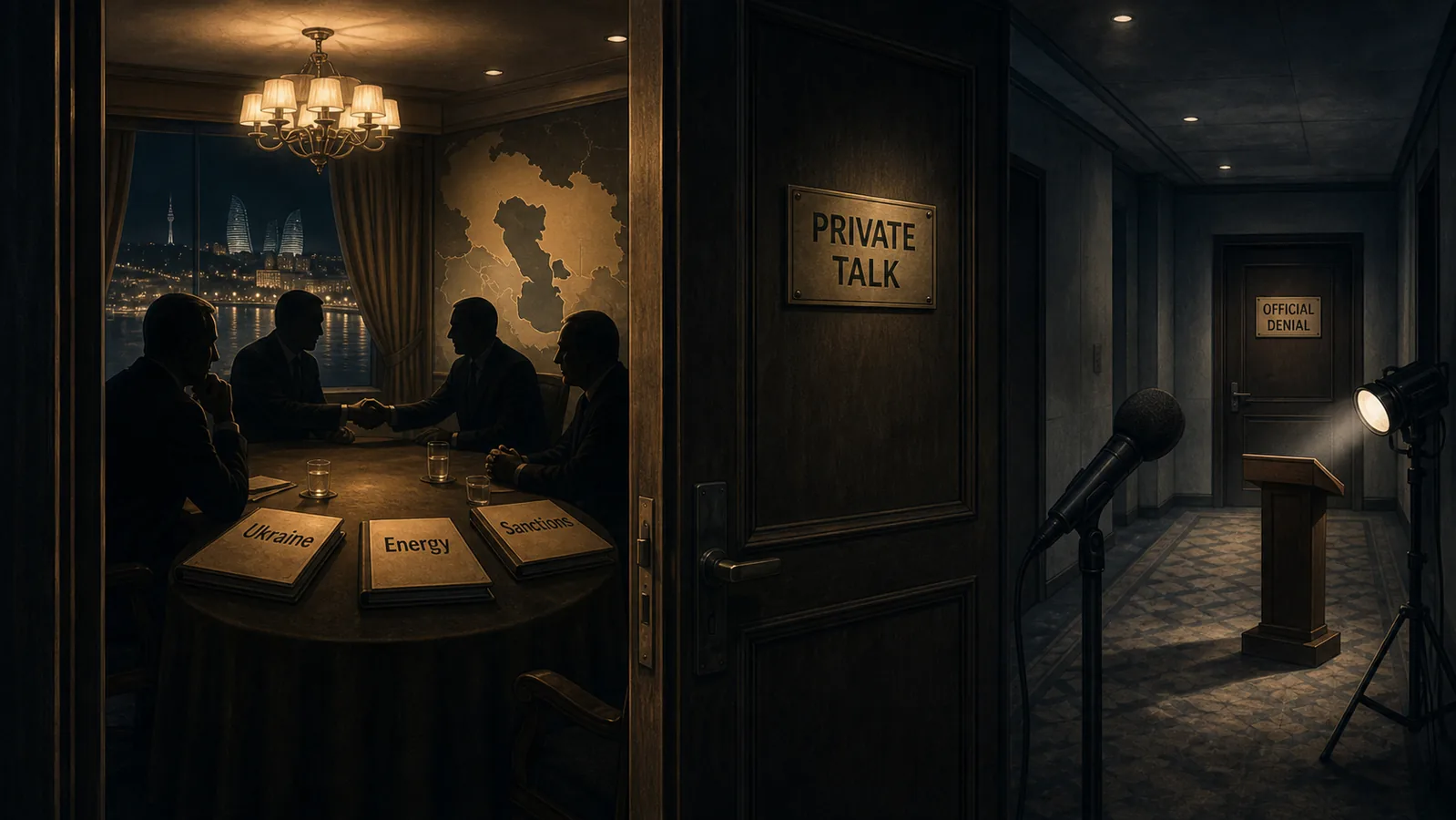
- Source
- Reuters, Tagesschau/ARD-Kontraste, Die Zeit, Euronews, DW Russisch, Azerbeidzjaanse en Russische bronnen
- MOZOM headline
- Baku as a backdoor to Moscow: private conversation or deniable diplomacy?
- Original headline
- Former German politicians spoke to Russian representatives in Baku, while Merz says he knew nothing
- Author
- the MOZOM.nl editorial team
- Date
- 23 juli 2026 om 08:10
- Subject
- MOZOM investigates the meeting in Baku between former German politicians and Russian representatives, the denial of Chancellor Friedrich Merz and the question of whether informal diplomacy is turning into a deniable back channel here.
Summary of the original report
The core is a gray area. Legally, this concerns former politicians without a current government mandate. Ronald Pofalla was previously a CDU politician and head of the German Chancellery under Angela Merkel. Matthias Platzeck was SPD chairman and Prime Minister of Brandenburg. Both are no longer ministers, but they are part of older power networks around Berlin, the Russia dialogue and economic-political contacts. On the Russian side, names such as Viktor Zubkov, former prime minister and Gazprom figure, and Valery Fadeev, chairman of the Russian Presidential Human Rights Council, are mentioned. Germany does not present this as official diplomacy. Precisely for this reason the political question is sharp: when does a private conversation between former politicians actually become informal diplomacy?
Own source research
MOZOM has organized its public reporting along four lines. First line: the actual time and place. The meeting is posted on July 12 to 14, 2026 in Baku, not in Russia and not in Germany. Second line: the formal status. Pofalla and Platzeck do not hold government positions. That supports the private line, but does not nullify their political significance. Third line: denial. Merz said, according to reports, that he was not aware of the meeting. Aliyev then stated that according to border and flight data, the persons mentioned were indeed in Baku at the same time and that Azerbaijan had not been informed in advance. Fourth line: historical precedent. Informal channels have often been later recognized as government strategy or preparation of official policy, such as the secret American China contacts under Nixon, the Oslo talks between Israel and the PLO and the US-Cuba contacts under Obama. That proves nothing about Baku, but shows why a private stamp does not automatically mean political innocence.
Private as a political smoke layer
The word private works as a layer of smoke here. Formally it is important: there is no public evidence that Merz or his government organized or approved this meeting. But politics in private is not the same as unimportant. In the case of war, sanctions, energy, Ukraine and Russia, a conversation outside the official agenda can be valuable because it can be denied later. The sentence 'I was not aware' is therefore not proof of involvement, but neither is it a full explanation of the network in which such conversations can take place.
Less visible context
The less visible context is Germany itself. Berlin is balancing between military support for Ukraine, economic damage from an energy break with Russia, domestic war fatigue and old networks that built on dialogue with Moscow for years before 2022. The old Petersburger Dialog, contacts around Gazprom and German Ostpolitik show that Russia-Germany was not only a government relationship, but also a network of administrators, companies, former politicians and discussion platforms. A meeting in Baku therefore does not fit neatly into one box. It has not been proven to be official, but neither can it be credibly dismissed as an ordinary private agreement without geopolitical significance.
Possible message behind the news
The visible message is: this was not an official German mission. The critical MOZOM reading is: it is precisely the absence of an official mandate that makes the meeting interesting, because it can function as informal diplomacy with maximum deniability.
Neutral conclusion
The conclusion is not that Merz was proven involved. That conclusion would go too far. The stronger and more defensible conclusion is that Baku shows the classic gray area of geopolitics: former politicians without a mandate, Russian representatives with positions close to the state, a host country that says it was not informed in advance, and a chancellor who says he knows nothing. Formally this can be private. Politically it smells like a back door. And that is precisely why the question is justified: who is really speaking here, on behalf of no one or on behalf of a line that only becomes visible later?
Source:
- Euronews: Aliyev says former Russian and German officials were in Baku for possible meeting over Ukraine
- Reuters Connect: Aliyev confirms recent meeting between former German and Russian politicians in Baku
- Tagesschau/ARD-Kontraste: geheimtreffen in Bakoe tussen Duitse oud-politici en Russische vertegenwoordigers
- DW Russisch: wat Duitse en Russische deelnemers over Bakoe niet zeggen
- Sputnik Azerbaijan: Aliyev over gesloten ontmoeting van vertegenwoordigers uit Rusland en Duitsland in Bakoe
- Merkur: Duits-Russisch geheim overleg en reactie van Merz