
MOZOM-analyse
Cameras as a control layer: London, Germany and DeFlock show the same direction
- Source
- Tagesschau, GOV.UK, ICO, Liberty, Big Brother Watch, DeFlock, Flock Safety en ALPR Watch
- MOZOM headline
- Cameras as a control layer: London, Germany and DeFlock show the same direction
- Original headline
- Analysis of live facial recognition, AI movement analysis and license plate readers as new surveillance infrastructure in public spaces
- Author
- the MOZOM.nl editorial team
- Date
- 22 juli 2026 om 07:30
- Subject
- MOZOM investigates how live facial recognition in London, new German police powers and American license plate reader networks are combining to transform public space into a searchable layer of control.
Summary of the original report
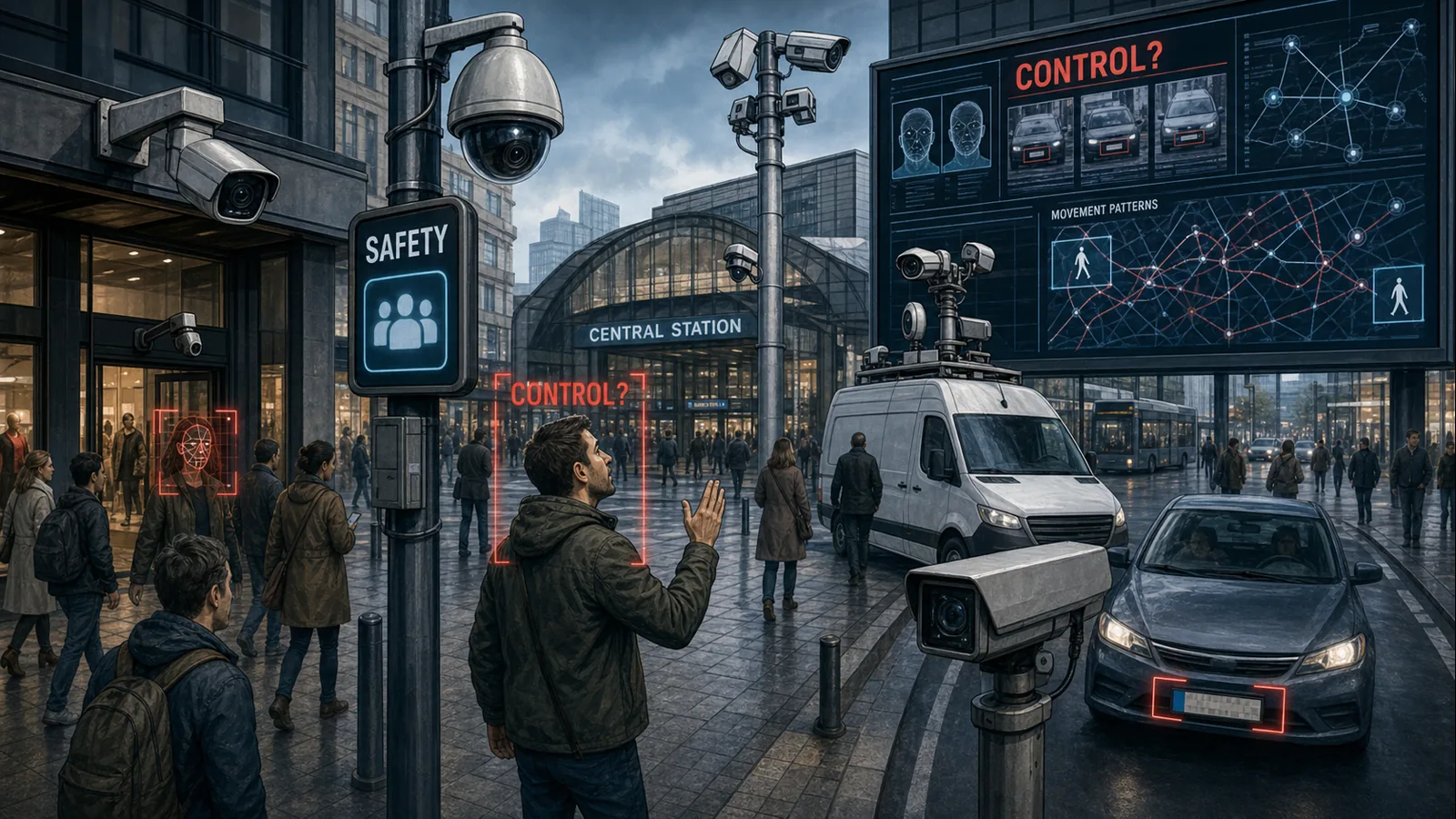
Tagesschau reports that the London police are increasingly using live facial recognition and are presenting the technology as successful. According to the police, thousands of wanted people have been arrested since 2024 after recognition by the system. The UK government is simultaneously working on a more specific legal framework, as existing law, according to GOV.UK, consists of a complex combination of common law, data protection, human rights law, national guidelines and local policies. Germany is moving in the same direction with the new Bundespolizeigesetz: in special dangerous situations, live facial recognition should be possible in federal police areas, such as stations and airports. AI must also be able to help recognize dangerous movement patterns. In the US, DeFlock mainly revolves around ALPR/LPR cameras: automatic license plate readers. That's not proof of facial recognition, but it is a related logic: vehicles, places and times become searchable data.
Own source research
MOZOM has placed three layers of supervision next to each other. Tier one is London: live facial recognition is being visibly rolled out, with police vans and cameras that compare faces to watch lists. Tagesschau cites up to around a million public and private surveillance cameras in London as context, while police say error messages are rare. Layer two is Germany: the new Bundespolizeigesetz has been adopted by the Bundestag and must still be passed by the Bundesrat after the summer. The law opens the door to real-time facial recognition in special danger situations and to AI that recognizes dangerous movement patterns. Tier three is the US: DeFlock and ALPR Watch show how license plate readers can be inventoried as a network, while Flock Safety itself talks about thousands of police departments, communities and businesses, billions of monthly license plate readings, real-time alerts and converting existing cameras to license plate readers. Flock says that his LPR cameras capture vehicle data and not faces. It is precisely that distinction that is important: this article does not state that all systems do the same, but that together they form a recognition infrastructure.
Safety as a keyword
The key word is safety. An abducted child, a wanted perpetrator of violence or a car on a wanted list is a strong argument. Few citizens will be against such goals on principle. But precisely because of this, the debate quickly shifts to implementation, purchase and expansion, while the question of power remains behind: who decides when the camera searches, who is on the list, who is watching, which private party supplies and when the system will be turned off again?
Less visible context
The revenue model is less visible. Cameras, recognition software, license plate readers, data platforms, cloud storage, control rooms, maintenance and legal compliance are a market. Private cameras are not illegal in themselves, but in the United Kingdom and Europe there are rules regarding data protection, purpose limitation, proportionality and biometrics. A government cannot simply look at everything that is private without authority. Yet a public-private direction is emerging: companies supply the technology, governments use the alerts, citizens move through the measurement layer. In such a system, control is not always a big central plan. It can also grow through individual tenders, local pilots, safety incidents, software updates and political pressure after incidents.
Possible message behind the news
The visible message is: more technology makes society safer. The critical MOZOM lecture is: when every camera can recognize, filter and alarm, an infrastructure is created that can later also be used for broader control.
Neutral conclusion
The conclusion is not that London, Berlin or American camera companies have proven to be building a total surveillance state today. The more defensible conclusion is sharper: the building blocks for a permanent recognition layer in public space are indeed becoming visible. First as an aid to serious crime. Then real-time alerts, AI patterns, license plate routes, private networks and new legal exceptions. If Europe does not clearly define what is technically allowed, safety can gradually turn into a standard argument for permanent control.
Source:
- Tagesschau: Polizei in London nutzt Gesichtserkennung fur Festnahmen
- Tagesschau: Bundestag besluit over nieuw Bundespolizeigesetz
- GOV.UK: Consultation on a new legal framework for facial recognition
- ICO: Facial recognition technology and surveillance
- Liberty: zorgen over uitbreiding gezichtsherkenning in Londen
- Big Brother Watch: briefing over politiegebruik van gezichtsherkenning
- DeFlock Maps: ALPR camera map en privacy routes
- Flock Safety: license plate reader network
- ALPR Watch: uitleg over automatische kentekenlezers