
MOZOM-analyse
Online age limit: child protection or identification requirement for the internet?
- Source
- NU.nl, Europese Commissie, CNIL, EDPB, EDRi, EFF en Franse wetgeving
- MOZOM headline
- Online age limit: child protection or identification requirement for the internet?
- Original headline
- France wants to be the first EU country to introduce an age limit for social media, while Brussels is working on a European age-verification infrastructure
- Author
- Paul Giezen
- Date
- 22 juli 2026 om 00:20
- Subject
- MOZOM investigates whether online age limits for social media are only child protection, or also the normalization of a broader digital gateway.
Summary of the original report
NU.nl reports that France is the first EU country to introduce an age limit for social media. In France, the concept of digital adulthood already exists at around fifteen years of age; Below that age, parental consent is a central line. At the same time, the European Commission is working on a European age verification solution that will allow users to prove that they are over 18, for example, without sharing other personal data. According to Brussels, this must be privacy-friendly, user-friendly and later compatible with the European digital identity wallet. The criticism starts right there: if platforms have to know who is a child, they often have to let adults prove that they are adults. In this way, a measure for minors can develop into a general authentication gateway for online services.
Own source research
MOZOM has placed three layers next to each other. Tier one is France: the age limit for social media is in line with the French line regarding digital age of consent and parental consent. Layer two is Brussels: the European Commission writes that the age verification solution has been feature-ready since April 2026, that member states and market parties can adapt it, that it can now prove 18+ and can later also support other age limits such as 13+ or 65+. The Commission calls the solution a 'mini wallet' that is built on the same technical specifications as future European digital identity wallets. Layer three is the criticism: privacy regulators and civil rights organizations do not automatically accept that age proof is innocent. Their core question is not only which data is shared today, but who will decide which websites, apps and services will no longer be accessible without evidence.
Child protection as a key word
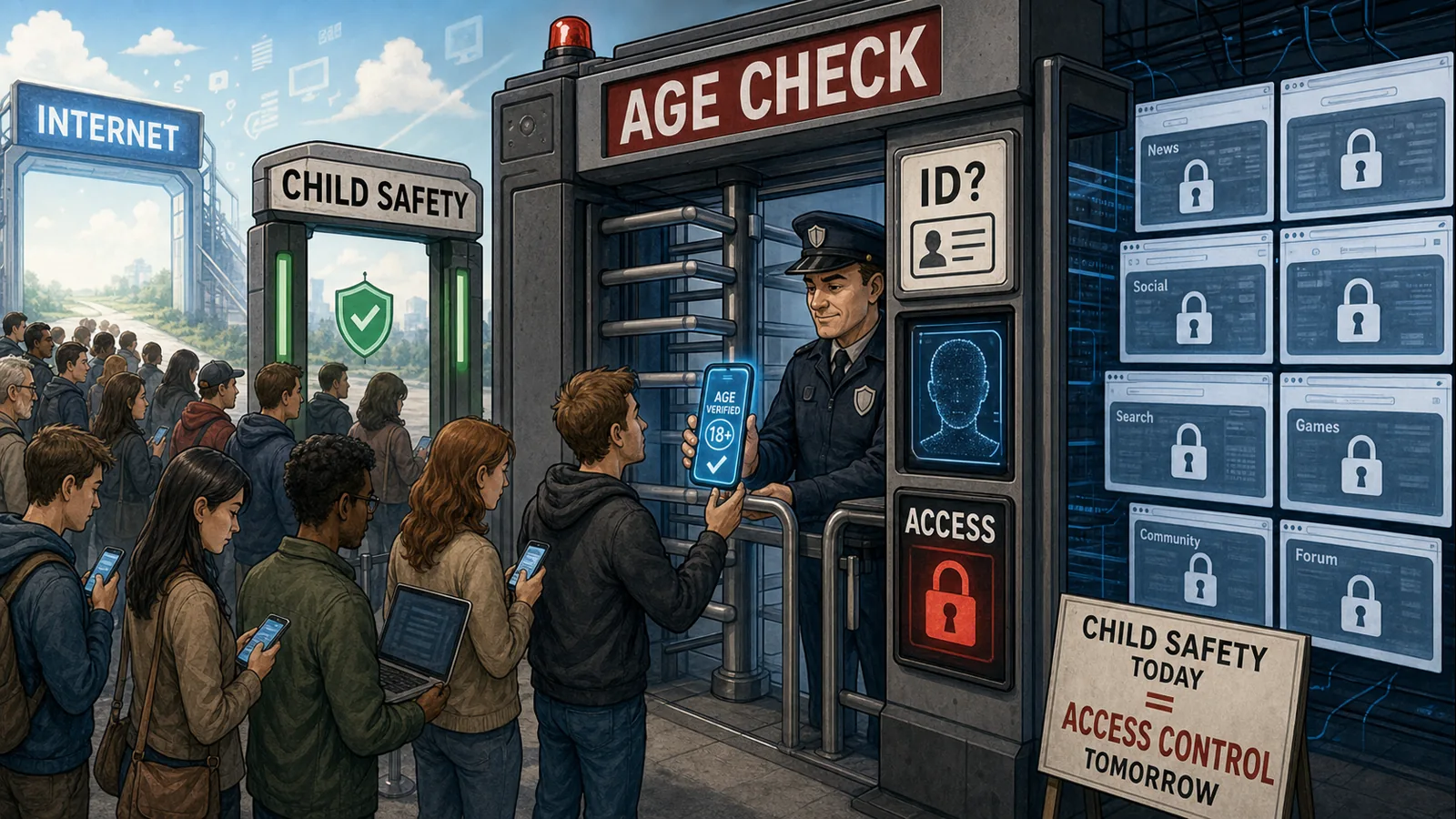
The word child protection is almost untouchable. Who can be against that? As a result, the debate quickly shifts from the question of whether the infrastructure is desirable to the question of how quickly it is introduced. But especially with a morally strong goal, the design must be examined extra rigorously. The gate that is supposed to protect children today could tomorrow become the standard gate that everyone has to go through to prove that they can have access to something.
Less visible context
Less visible is that age control logically tends towards general control. A platform does not know in advance whether a visitor is 14, 17, 21 or 65. To keep minors out, it often has to monitor adults as well. This does not always have to be with a full passport or real name. There are more privacy-friendly models with only a yes/no proof. But even then there is a dependency on publishers of age certificates, apps, wallets, app stores, operating systems and access rules. If more categories are added afterwards, such as gambling, alcohol, social media, video, games, forums, news comments or 'harmful content', age verification will no longer be an exception. Then it becomes a digital border post.
Possible message behind the news
The visible message is: protect children from harmful platforms. The critical MOZOM reading is: as soon as age proof becomes the normal access method, a broader online identification obligation is technically and administratively much closer.
Neutral conclusion
The conclusion: France makes the debate concrete, but the European infrastructure makes it big. There is no public evidence that the EU is introducing a general internet identification requirement today. It is clear that Brussels, member states and platforms are working on systems that will make age demonstrable online. This can be designed to be limited and privacy-friendly. But as more and more services start requiring such proof, the promise will change. Then it is no longer just child protection, but a new layer of digital access power. That is precisely why the line must be drawn now: protection of children must not become a shortcut to an internet where everyone must first identify themselves.
Source:
- NU.nl: Frankrijk komt als eerste EU-land met leeftijdsgrens voor sociale media
- Europese Commissie: The EU approach to age verification
- EUR-Lex: Digital Services Act, Regulation (EU) 2022/2065
- CNIL: Online age verification, privacy and protection of minors
- EDPB: Statement 1/2025 on Age Assurance
- EDRi: Age verification gains traction in the EU
- EFF: Age Verification and Age Gating Resource Hub
- Legifrance: Franse wet over digitale meerderjarigheid en sociale netwerken