
MOZOM-analyse
South Korea settles with old power: rule of law or political sidelining?
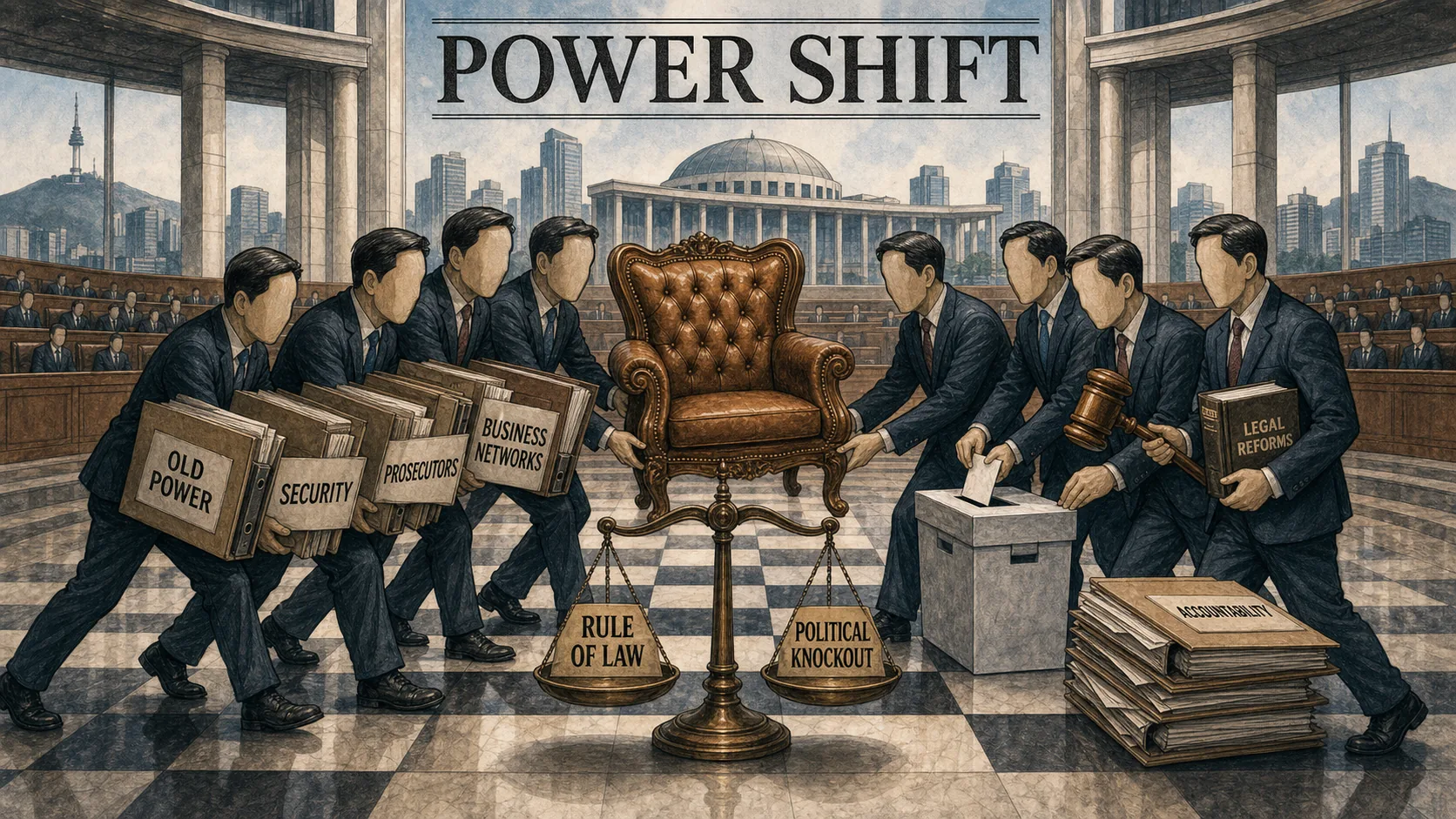
- Source
- NOS, AP, International IDEA, ABC News, Stanford FSI, Brookings, Atlantic Council, Stimson, The Diplomat en Global Asia
- MOZOM headline
- South Korea settles with old power: rule of law or political sidelining?
- Original headline
- South Korea continues to legally and politically settle scores with the camp surrounding former President Yoon
- Author
- Paul Giezen
- Date
- 24 juli 2026 om 18:30
- Subject
- MOZOM investigates whether the harsh legal aftermath surrounding former president Yoon Suk Yeol in South Korea is mainly a correction of the rule of law, or also the political elimination of an old conservative power network.
Summary of the original report
In the reporting around South Korea, the files are piling up. Yoon Suk Yeol was deposed after his declaration of martial law and later severely sentenced. According to NOS, he was given a life sentence for the attempted coup and then another 30 years in prison for drone provocations towards North Korea. His wife Kim Keon Hee also came under heavy fire in the reports: according to NOS, she was sentenced to seven years in prison for bribery surrounding luxury gifts and political reciprocation, while she was allegedly acquitted on other charges. Separately, South Korea also continues to mess with the economic elite, with the so-called divorce of the century surrounding SK Group, in which family, wealth, political past and chaebol power come together. The question is therefore bigger than a single criminal case: does South Korea see the rule of law taking action against abuse of power here, or is a political restructuring of old circles of influence emerging at the same time?
Own source research: timeline from power to reckoning
The timeline is decisive. In April 2024, Yoon's conservative People Power Party lost badly in the parliamentary elections; AP and International IDEA described a clear opposition victory. On December 3, 2024, Yoon declared martial law, arguing that the opposition would paralyze the country and aid pro-North Korean forces. Parliament resisted, the measure only lasted a short time and the Constitutional Court later opened the door to his permanent removal. This was followed by new presidential elections, in which Lee Jae-myung of the Democratic camp took power. From that moment on, the story shifts: no longer just the question of whether Yoon was wrong, but also which institutions, ministers, prosecutors, party members and family members may have been part of the system around him. In that phase, the rule of law becomes both an instrument of power and a means of control.
Calming down is not legal proof, but it is a political effect
The word 'caltstelling' is politically charged. It suggests that someone is not only punished, but also permanently disabled. Legally, you cannot state that as a fact without evidence that judges, prosecutors or politicians collaborated unlawfully. Politically, you can conclude that the outcome works like this: Yoon is gone, his wife has been convicted according to reports, his former ministers are being prosecuted or judged, and his power base has been severely damaged. The key question is therefore not whether there was formally a coup by the new government. The key question is whether the rule of law purely corrects this, or also confirms a new order of power.
From conservative safety line to reform line
Internationally, Yoon stood for a hard security line: stronger alliance with the United States, rapprochement with Japan and a sharp attitude towards North Korea. His domestic power base lay strongly with conservative voters, judicial networks and parts of the security apparatus. The Lee administration actually emerged after Yoon's fall, with greater emphasis on institutional reform, domestic reconciliation and checks on prosecutorial power. That makes the image double. For Lee's supporters, this is cleansing after an authoritarian derailment. For opponents, it looks like a change of power in which the old right side not only lost elections, but was also legally removed from the field.
Possible message behind the news
The visible message is that no one is above the law, not even a president. The deeper MOZOM reading is that in practice that message can simultaneously confirm a transfer of power: who controls the institutions after a crisis also determines how the settlement with the old system is read.
Neutral conclusion
South Korea is not experiencing a classic coup by the new government. The formal route went through institutions: parliament, Constitutional Court, elections and courts. But the political consequence is that the old conservative camp around Yoon has been pushed almost completely aside. This may be the result of justified constitutional correction after a dangerous emergency power grab. It can also be experienced by opponents as a reckoning in which justice, politics and public imagery reinforce one another. The fairest conclusion is therefore sharp but cautious: South Korea shows how a democracy can correct a power grab, but also how that correction itself can establish a new order of power.
Source:
- NOS: levenslang voor Zuid-Koreaanse ex-president Yoon voor poging staatsgreep
- NOS: nog eens 30 jaar cel voor afgezette president Yoon voor provocatie Noord-Korea
- NOS: miljoenenuitspraak in Zuid-Koreaanse echtscheiding van de eeuw
- AP: South Korea's 2024 parliamentary election and opposition landslide
- International IDEA: 2024 South Korean National Assembly election
- ABC News: South Korea Constitutional Court ruling on Yoon
- Stanford FSI: South Korea's new president and democracy
- Brookings: South Korea and democratic resilience
- Atlantic Council: what Lee Jae-myung means for South Korea's future
- Global Asia: Yoon's foreign policy initiatives
- The Diplomat: South Korea's criminal justice reform debate